2D Sketching vs. 3D Haircards: How Industry Artists Actually Model and Draw Braids
2D Sketching vs. 3D Haircards: How Industry Artists Actually Model and Draw Braids
Every junior artist makes the same fatal mistake with hair: they try to draw every single strand. The result is inevitably a flat, chaotic nest devoid of volume or weight. In professional production pipelines, whether producing concept art for an indie title or high-poly hero assets for game studios, constructing braided hair demands an entirely different mindset. Hair is structural geometry governed by gravity, tension, and volume.
Braided hair carries profound visual and cultural significance across human storytelling. Beyond technical drafting, braids function as potent cultural markers. Consider how contemporary photojournalism captured widespread attention when the traditional Kurdish hair braid re-emerged as an international emblem of Kurdish female fighters resisting authoritarian oppression, documented in detailed coverage by The Jerusalem Post Report. In entertainment art, capturing that tactile weight, tension, and visual rhythm requires artists to bridge traditional drafting techniques with modern digital tools like ZBrush, Maya, and Unreal Engine haircards.
📌 Key Takeaways:
- Core Mechanics: Professional braid illustration relies on establishing 3D volume, ribbon interlocking, and silhouette rhythms before rendering individual hair strands.
- Pipeline Shift: Production pipelines contrast sharply between 2D concept workflows (focused on gesture and values) and 3D haircard authoring (focused on UV alpha textures, normal maps, and vertex baking).
- Practical Mastery: Mastering hair physics and tension prevents stiff, sausage-like plaits, giving characters believable mass across stylized and realistic design briefs.
Deconstructing the Interlocking Plait: Volume, Silhouette, and Tension
A plait is not a flat pattern. It is an interlocking system of compressed cylinders wrapping around an invisible central core. When drawing a three-strand braid sketch, top-tier illustrators never begin by outlining tiny hairs. They establish hair volume and silhouette first, mapping out the overarching gesture line that defines how the hair drops against the neck, drapes over a shoulder, or whips in the wind.
Consider the mechanics: three bundles of hair weave alternately over and under one another. Because the tension pulls taut at the crossing junctions and expands outward in the belly of each section, the braid takes on a distinct teardrop silhouette along its edges. Tighter braiding creates compact, bead-like segments. Loose, bohemian plaits show relaxed tension, causing the strands to sag downward with pronounced overlap.
Understanding hairline root placement prevents the entire structure from looking pasted on. Hair grows out from the scalp in radial directions, not straight backward. Tension pulls root bundles toward the origin of the braid, creating distinct directional flow lines across the scalp. Missing this structural step causes the hair to read as an unnatural plastic helmet rather than living fiber anchored to bone.
The 2D Drafting Workflow: From Zig-Zag Guides to Line Weight Variation
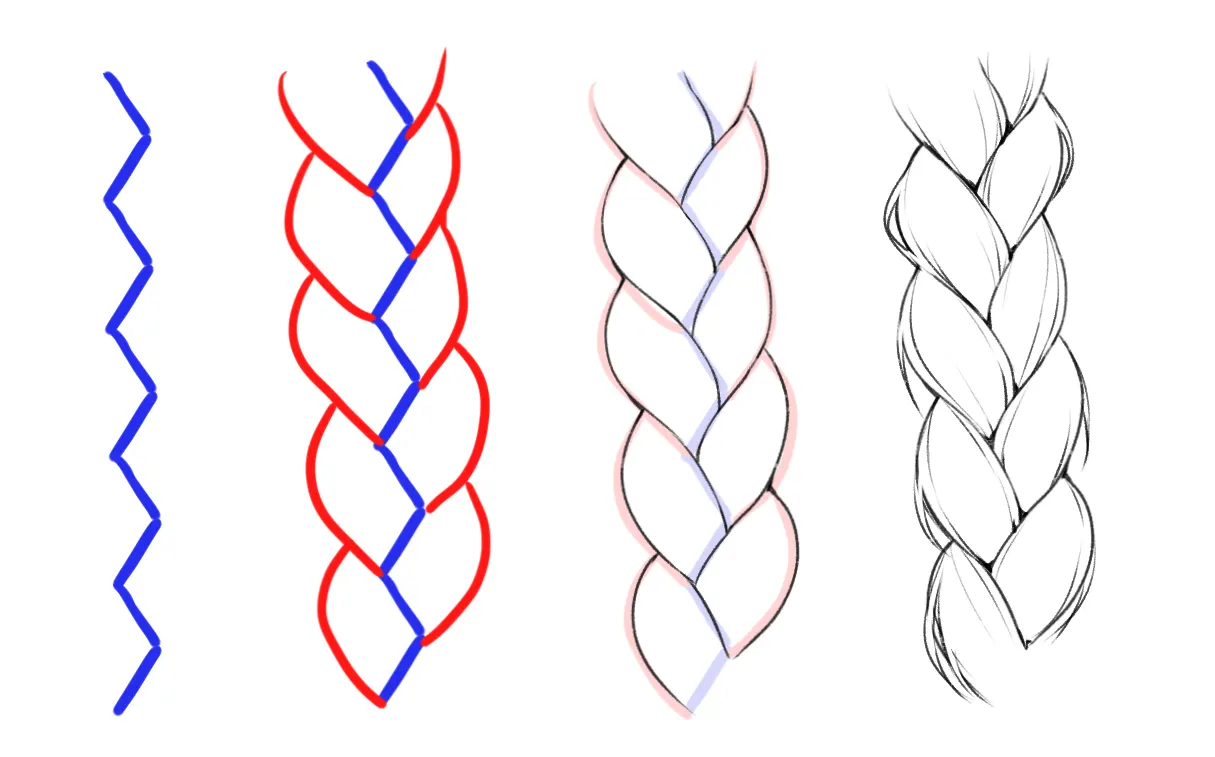
Translating complex weave mechanics into 2D concept art requires a repeatable, systematic construction method. Many beginner tutorials recommend drawing stacked hearts, but that trick frequently creates rounded, stiff shapes that flatten under dynamic angles. The overlapping zig-zag method remains the industry standard for clean construction.
To execute this approach cleanly:
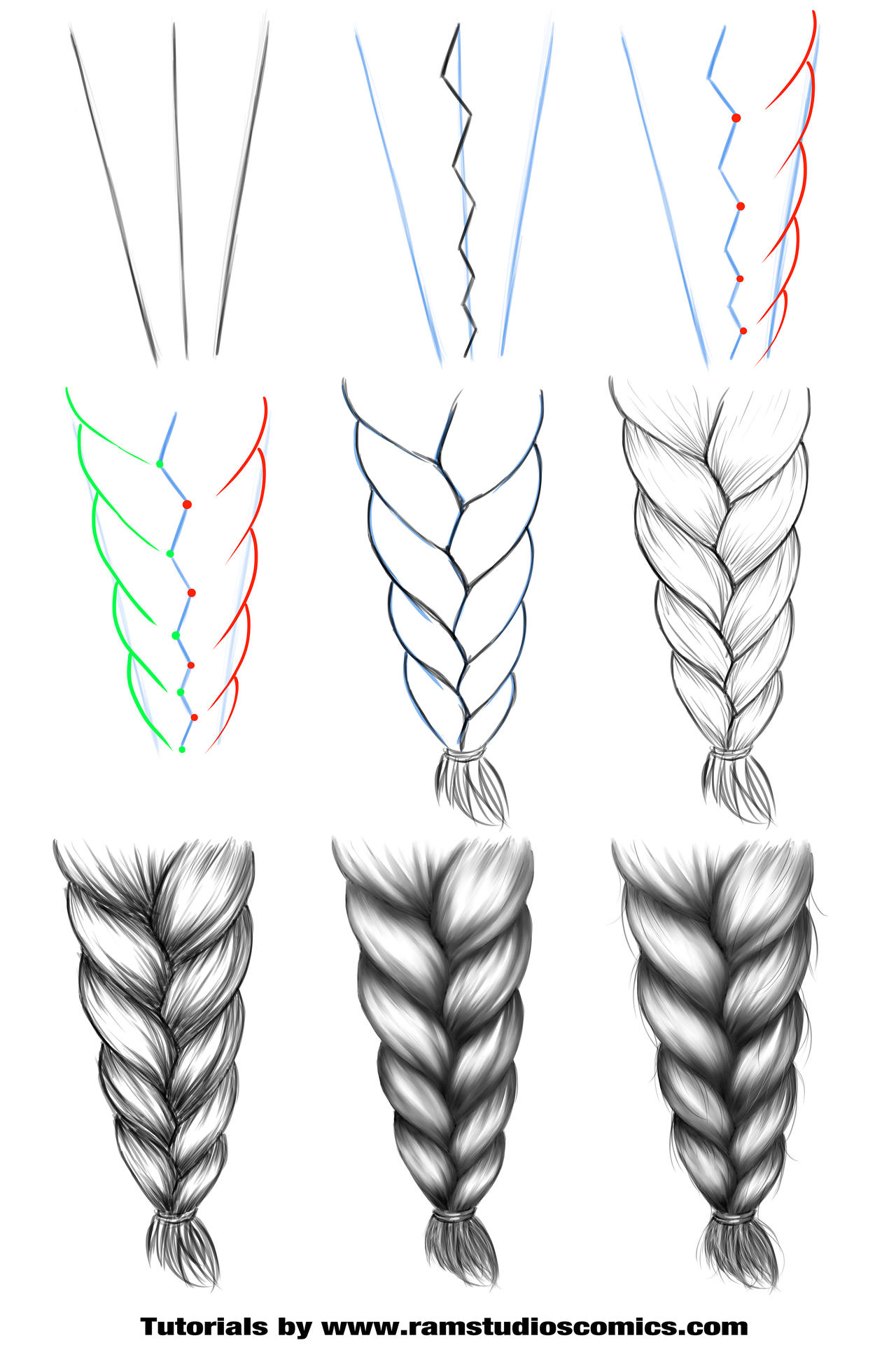
First, draw a curved spine showing the path of the braid. Next, draw a subtle zig-zag line down that path, alternating angles from side to side. From each point of the zig-zag, sweep downward-curving teardrop arcs that tuck under the opposite segment. This creates the classic overlapping rhythm without losing the sense of cylindrical depth.
Once the French braid line art or basic three-strand structure is established, line weight variation does the heavy lifting. Thicken the linework at the deep occluded crevices where two segments intersect, and taper the lines along the rounded outer ridges where light hits the apex. This simple contrast communicates cast shadows and overlap before you lay down a single brush stroke of digital hair rendering.
When shading hair strands, treat each individual segment as a rounded pill or egg. Establish a broad primary shadow across the side turned away from the light source, place secondary ambient occlusion in the deep folds, and apply a sharp specular band across the curve of each segment. Avoid slicing across the entire braid with one uniform highlight line; stagger the specular hits across individual strands to preserve depth.
Comparing 2D Illustration and 3D Asset Creation Pipelines
The workflows for 2D concept art and 3D real-time character assets diverge significantly in software execution, asset constraints, and production budgets. Understanding these operational boundaries ensures efficient handoffs between concept artists and 3D asset modelers.
| Production Factor | 2D Concept Illustration | 3D Real-Time Haircards |
|---|---|---|
| Primary Software | Photoshop, Clip Studio Paint, Procreate | ZBrush, Maya, Blender, XGen, Unreal Engine 5 |
| Turnaround Time | 2, 6 hours per finished character design | 3, 7 business days per hero character asset |
| Geometry & Limits | Zero polycount limits; restricted only by canvas resolution | Strict budgets (20,000, 80,000 tris for total hair groom) |
| Lighting Behavior | Static painted specular, bounce, and ambient occlusion | Dynamic shader-driven anisotropic highlights and subsurface scattering |
| Physics Implementation | Manual dynamic staging via drapery and gestural motion lines | Rigged bone chains, spline IK solvers, or Chaos physics simulation |
The 3D Haircard Workflow: ZBrush Sculpting and XGen Grooming
In high-end real-time game development, rendering hundreds of thousands of individual dynamic hair splines remains computationally prohibitive for complex open-world scenes. Studios bridge this performance gap using a dedicated 3D haircard workflow. A breakdown detailed by 3D asset platform 80 Level highlights how technical artists model primary braided shapes in ZBrush or Autodesk Maya, convert them to guide curves, and drive high-density strand grooms via Maya's XGen interactive grooming toolset.
Rather than laying down thousands of separate geometric strands, artists generate high-density 4K texture sheets containing diffuse, alpha, normal, flow, and depth maps derived from groom baked textures. These maps are applied to low-poly polygon strips, haircards, that twist and conform along the path of the braid.
Achieving realistic depth demands a three-layer strategy. First, artists place wide, solid base haircards to obscure the underlying scalp mesh and block silhouette pass-through. Next, secondary medium cards lay down the primary overlapping braid chunks. Finally, thin "breakaway" or "flyaway" cards sit on the outermost layer, disrupting the clean digital edge with natural frizzy stray hairs.
Stylized Character Concept Art: Simplifying Braids Without Losing Form
Stylized visual development, seen in productions like Arcane or titles from Supergiant Games, strips away procedural micro-detail in favor of bold graphic statements. The goal shifts from micro-fidelity to silhouette readability at a distance.
Concept artists tackle stylized braids by turning the three-strand braid into faceted geometry. Each section of the plait becomes a chiseled polygon with clear light, mid-tone, and shadow planes. Instead of feathering out dozens of thin brush strokes, the artist paints sharp, deliberate value steps. The focal point receives sharp specular accents, while sections receding into the neck fade into unified shadow shapes.
Understanding hair physics and tension is paramount here. A tight military cornrow hugs the skull with rigid, planar tracks, showing crisp scalp division lines. A thick, loose warrior braid bends with substantial inertia, lagging behind character movement and dragging downward under its own physical weight. Exaggerating these silhouettes delivers character attitude long before visual effects and rendering passes enter the frame.
Frequently Asked Questions (FAQ)
Q1: Why do my drawn braids always end up looking flat and sausage-like?
A1: This occurs when artists draw outer borders as parallel straight lines and fill them with uniform chevron patterns. To create three-dimensional depth, push the teardrop curves so they wrap around each other, vary your line weight at occlusion crevices, and ensure the outer silhouette indents sharply where segments overlap.
Q2: How do professional artists handle braid roots without making the character look bald?
A2: Avoid drawing hair pulling directly into hard, razor-sharp geometric seams. Leave a subtle soft transition at the scalp, group hair into directional wedge shapes heading toward the braid base, and let small baby hairs soften the transition around the temples and nape.
Q3: When should a production team choose haircards over spline-based grooms?
A3: Real-time games running on current consoles and mid-tier PC hardware rely on haircards to sustain 60 FPS performance limits. Spline-based interactive grooms (such as Unreal Engine's Strand Hair system) are generally reserved for cinematic close-ups, offline movie rendering, or high-end hero character showcases.
Refining Hair Mechanics for 2026 Character Pipelines
Whether you work with pencil on paper, paint on a digital tablet, or arrange polygonal hair strips across complex skeletal rigs, the fundamental rules of braid mechanics remain identical. Prioritize structural mass over surface detail. Treat interlocking plaits as overlapping ribbons subject to directional tension, gravity, and silhouette rhythm. Once you master the foundational mechanics of volume, line weight, and overlapping planes, translating hair across traditional sketch pads or modern game engines becomes a confident, repeatable art.
