Best Hardtop Convertibles You Can Actually Buy for 2026 Ranked
Automakers have spent the past decade quietly purging the retractable hardtop from their showrooms. High manufacturing costs, packaging nightmares, and significant weight penalties pushed mainstream brands back toward fabric or out of the open-air market altogether. Yet the drivers who demand a hard roof convertible refuse to settle for canvas. They want coupe-grade structural rigidity, theft resistance, year-round weatherproofing, and whisper-quiet highway cruising without sacrificing the option of stowing the roof at a stoplight.
The market has bifurcated into two distinct territories: lightweight targa-style roadsters and high-dollar exotic platforms where aerospace-grade composite roofs fold neatly over mid-mounted engines. As detailed in the latest U.S. News & World Report Report, buyers searching for brand-new hardtop convertibles in 2026 face a tighter, more specialized selection than ever. From sub-$40,000 sports cars to million-dollar supercars, here is how the remaining fleet stacks up.
📌 Key Takeaways:
- The Lineup Squeeze: Mainstream four-seat hardtops like the BMW 4 Series and Lexus IS C have completely vanished, leaving the segment split between pure two-seat sports cars and ultra-luxury grand tourers.
- Mid-Engine Dominance: Modern mid-engine packaging has solved the packaging penalty; cars like the Chevrolet Corvette and Ferrari 296 GTS stow compact hard panels above the powertrain without obliterating trunk volume.
- Acoustic and Thermal Supremacy: While modern triple-layer soft-tops come close, a power-folding hard roof remains unmatched for highway cabin noise insulation and harsh winter durability.
Why the Heavy Metal Folding Roof Disappeared from Showrooms
During the late 2000s, almost every major marque sold a front-engine, four-seat convertible with a three-piece articulating metal roof. Cars like the Volkswagen Eos, Volvo C70, and BMW 3 Series Convertible ruled suburban highways. They also created immense warranty headaches. A multi-hinge convertible roof mechanism contains dozens of microswitches, hydraulic lines, electric motors, and extensive rubber weatherstripping. When those intricate mechanisms aged, repair bills regularly exceeded vehicle value.
Vehicle mass dealt the fatal blow. A complex folding hardtop apparatus typically adds between 150 and 300 pounds over a comparable fixed-roof coupe. In an automotive landscape governed by stringent corporate average fuel economy targets and crash-test crashworthiness, carrying dead weight high on a vehicle's chassis directly degrades center of gravity and efficiency.
Soft-top textiles simultaneously caught up. Acoustic fabric construction using butyl rubber damping cores closed the noise gap, prompting BMW, Mercedes-Benz, and Audi to abandon folding steel tops entirely for their mainstream cabriolets. The buyers still shopping for hardtops in 2026 are not looking for compromise; they are buying purpose-engineered vehicles where the hardtop functions as a structural asset.
The 2026 Rankings: From Grassroots Roadster to Exotic Masterpiece
1. Chevrolet Corvette Stingray / Z06 / E-Ray Convertible
The C8 platform remains the benchmark for value, engineering symmetry, and livability. Chevrolet opted for a two-piece composite power-folding hard roof that stows behind the cabin in 16 seconds at speeds up to 30 mph. Crucially, choosing the convertible Corvette does not sacrifice an inch of trunk cargo space compared to the coupe with its targa panel stowed. The electric motors add roughly 77 pounds, an imperceptible penalty on public roads. Across its naturally aspirated V8, flat-plane crank Z06, and hybrid all-wheel-drive E-Ray trims, it offers unmatched daily usability.
2. Mazda MX-5 Miata RF
Mazda tackled the weight dilemma by abandoning the full folding hardtop of the third-generation NC Miata in favor of the "Retractable Fastback." The RF keeps its rear buttresses fixed in place, motorizing only the center roof section and rear glass behind the headrests. Total deployment takes 13 seconds. It adds roughly 113 pounds to the roadster's feathery curb weight, yet it completely transforms the vehicle's long-distance viability. Highway wind buffeting decreases substantially, turning an otherwise spartan sports roadster into an all-weather commuter.
3. Ferrari 296 GTS
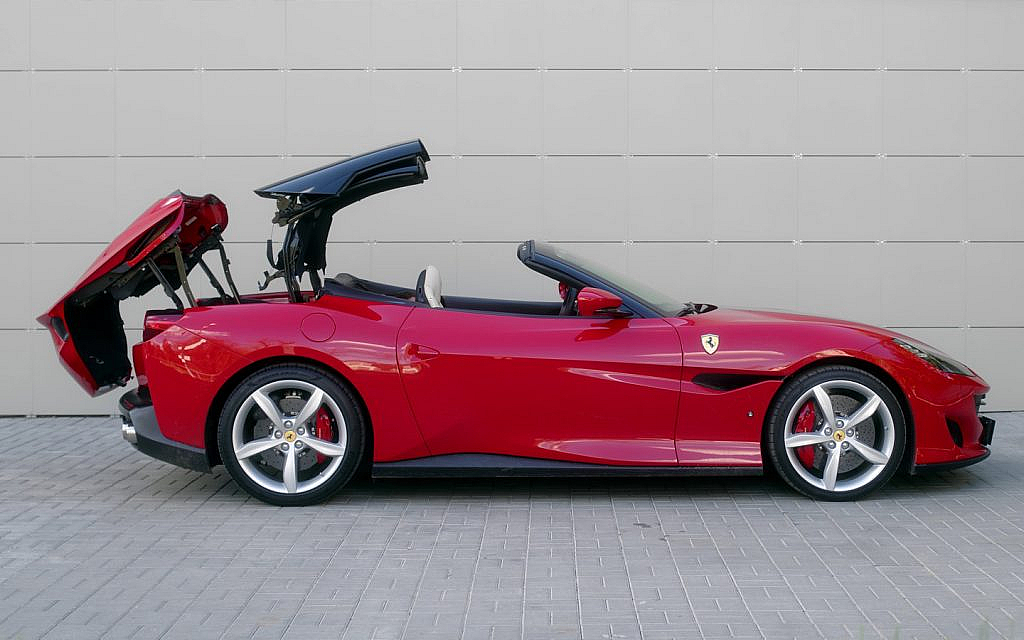
Recent analysis by CarBuzz highlighted that four out of the top five V6 performance convertibles on the market hail from Italy, and the 296 GTS sits at the apex. Pairing a 120-degree twin-turbo 3.0-liter V6 with an axial-flux electric motor, it sends 819 horsepower to the rear wheels. The retractable hardtop divides into two sections, sliding forward of the engine bay in 14 seconds. Structural bracing stiffens the chassis by 50 percent over prior Ferrari mid-rear spiders, preserving razor-sharp track dynamics.
4. McLaren 750S Spider / Artura Spider
McLaren approaches open-top driving with an unfair advantage: a carbon-fiber monocoque chassis. Because the carbon tub provides total structural integrity on its own, cutting the roof off requires zero heavy underbody reinforcement. McLaren's single-piece composite power-folding hard roof retracts in an astonishing 11 seconds at up to 31 mph. An optional electrochromic glass panel lets light flood the cockpit even when the roof is latched shut.
5. Maserati MC20 Cielo
The MC20 Cielo leans into pure grand touring theatre. Its roof mechanism incorporates a polymer-dispersed liquid crystal glass roof that switches from clear to opaque at the touch of a button. The roof folds away beneath the rear decklid in 12 seconds. It suffers from a miniscule 3.5-cubic-foot rear trunk, but the carbon chassis ensures that scuttle shake remains non-existent over broken pavement.
Hard Data: Roof Speeds, Curb Weight, and Cargo Penalties
Selecting an open-air vehicle requires balancing performance tradeoffs against real-world functionality. The table below details how modern systems measure up in weight, deployment speed, and practicality.
| Vehicle Model | Roof Deployment Time | Weight Penalty vs. Coupe | Usable Cargo Capacity |
|---|---|---|---|
| Mazda MX-5 RF | 13 seconds (up to 6 mph) | +113 lbs | 4.48 cu ft (unchanged) |
| Chevrolet Corvette Stingray | 16 seconds (up to 30 mph) | +77 lbs | 12.6 cu ft (frunk + rear trunk) |
| Ferrari 296 GTS | 14 seconds (up to 28 mph) | +154 lbs | 7.1 cu ft (frunk only) |
| McLaren 750S Spider | 11 seconds (up to 31 mph) | +108 lbs | 5.3 cu ft frunk + 7.4 cu ft tonneau |
| Maserati MC20 Cielo | 12 seconds (up to 31 mph) | +143 lbs | 5.2 cu ft (frunk + rear cavity) |
Powertrain Evolution: The Surge of Hybridized V6s and Mid-Engine Layouts
The mechanical layout of hardtops has completely shifted over the past three model years. In earlier eras, luxury convertibles relied on long front noses hiding massive, naturally aspirated eight-cylinder engines. That packaging structure made it nearly impossible to stow solid roof panels without carving out the entire trunk or creating an awkwardly tall rear deck.
The mid-engine architecture inverted this equation. By moving the engine behind the driver, the space directly above the cylinder banks becomes available for flat, horizontal panel storage. Modern heat-shielding composites allow lightweight roofs to rest mere inches above blistering exhaust manifolds without blistering exterior paint.
This layout also enabled the rise of electrified six-cylinder configurations. Italian marques proved that downsizing from V8s to forced-induction V6 powerplants frees up critical volume behind the passenger bulkhead. The Ferrari 296 GTS and Maserati MC20 Cielo leverage compact cylinder blocks to maintain low rear body lines that would be structurally impossible with a traditional front-engine folding hardtop.
Traditionalists still have potent alternatives. The Corvette retains naturally aspirated and flat-plane V8 configurations, but its dominance is heavily contested by European hybrid platforms that utilize immediate electric torque to offset any convertible curb weight gains.
Real-World Livability: Cabin Acoustics, Climate Resistance, and Daily Cargo
A persistent debate among convertible enthusiasts centers on soft-top vs hardtop practicality. Fabric roofs have improved, but owners living in regions with heavy snowfall or dense metropolitan parking consistently validate the benefits of solid panels.
A hard roof convertible delivers superior cabin noise insulation at sustained interstate speeds. Decibel measurements in the Corvette Convertible and Mazda MX-5 RF register between 3 and 5 decibels quieter at 70 mph than equivalent cloth-top roadsters. This difference significantly reduces driver fatigue on road trips and makes hands-free Bluetooth phone calls viable without shouting.
Weather resistance provides another major operational edge. Fabric tops collect road grime, require specialized fabric sealants every six months, and deteriorate when subjected to heavy, freezing slush. A composite or aluminum panel shrugs off snow accumulation and withstands commercial car wash brushes that would quickly destroy canvas tensioners.
The compromise lives in trunk cargo space. Unlike traditional soft-tops that fold into compact, accordion-like bundles, rigid panels must maintain their shape. If an owner packs luggage taller than the cargo divider allows, the roof mechanism simply refuses to cycle. Buyers who demand spontaneous weekend getaways must learn to pack soft duffel bags rather than hard-shell rollaboard suitcases.
Who Should Buy a Hardtop Convertible, and Who Should Walk Away
Opting for a power-folding hard roof involves distinct lifestyle compromises. Understanding your ownership profile prevents expensive buyer's remorse.
The Ideal Candidate
- The Single-Car Commuter: Drivers who rely on one vehicle for all twelve months need the security, climate retention, and structural insulation of a coupe Monday through Friday.
- Street and Garage-Less Parkers: Canvas roofs remain vulnerable to vandalism, knife-point theft, and environmental damage from trees and birds. Solid roofs deter opportunistic break-ins.
- High-Speed Track Drivers: Many amateur racing organizations and track-day sanctions permit factory hardtop convertibles to run without aftermarket roll cages, whereas soft-top vehicles are frequently barred from technical circuits.
Who Should Look Elsewhere
- Pure Featherweight Purists: If ultimate agility and low-speed steering feel are your sole metrics, the added weight of hardtop hydraulic pumps and panel brackets compromises vehicle poise. A base soft-top MX-5 remains sharper through tight transitions.
- Families Requiring Four Seats: If you regularly carry more than one passenger, brand-new hardtop convertibles are entirely off the table for 2026. Every surviving hardtop vehicle features a strict two-seat cabin. Buyers needing rear seats must accept a soft-top from BMW, Mercedes, or Ford.
- Extreme Budget Shoppers: Beyond the entry-level Mazda RF, entry into the modern hardtop convertible segment begins around $76,000 for a Corvette and scales rapidly into six figures.
Frequently Asked Questions (FAQ)
Q1: Are there any four-seater hardtop convertibles in production for 2026?
A1: No mainstream automaker currently manufactures a brand-new four-seat power-folding hard roof convertible. Models like the BMW 4 Series, Lexus IS C, and Infiniti G37 Convertible have all ended production or transitioned back to cloth tops. Buyers who need four seats must either choose a fabric convertible like the Mustang, BMW 4 Series, or Mercedes CLE, or purchase a pre-owned vehicle.
Q2: Does the Corvette Convertible lose trunk space when the top is lowered?
A2: No. Chevrolet engineered the C8 Corvette's roof to fold into a dedicated heat-shielded compartment directly above the mid-engine bay. The front trunk (frunk) and the deep rear trunk retain their full combined 12.6 cubic feet of storage space whether the roof is raised or lowered.
Q3: How durable are modern power-folding roof mechanisms over long-term ownership?
A3: Modern systems are considerably more reliable than the complex multi-panel roofs of the 2000s because automakers use fewer moving segments. The Mazda RF and Corvette utilize straightforward two-piece or hinged fastback designs operated by electric motors rather than high-pressure hydraulic lines. Regular cleaning and lubrication of the rubber weather seals remain essential to prevent long-term squeaks and water leaks.
The Shifting Horizon for Open-Air Performance
The golden era of the cheap, mass-market metal folding roof has ended, replaced by an era of calculated specialization. The vehicles that survive are not using hardtops as a marketing gimmick; they are engineered around the roof from the chassis up.
For purists seeking an analog, connected sports car experience on an attainable budget, the Mazda MX-5 RF stands alone as a singular engineering achievement. For those who want supercar performance matched with year-round cross-country utility, mid-engine architectures have unlocked a level of refinement that prior generations could not touch. As the auto industry accelerates toward electric platforms with flat skateboard batteries that resist low-slung seating positions, these precision-engineered hardtop convertibles represent the absolute peak of modern mechanical packaging.
