Can You Really View Private TikTok Accounts? The Dangerous Truth Behind Viral Viewer Tools
A quick online search for a private TikTok account viewer surfaces dozens of web portals and mobile utilities promising unrestricted access to hidden videos, friend lists, and private direct messages. The pitch is almost always the same: type in a target username, wait for a mock decryption animation, and view private TikTok profiles without following the creator. These claims exploit curiosity and domestic suspicion, but technical reality paints an entirely different picture. As documented in a recent Business Review Report tracking private access bypasses across social platforms, the booming marketplace of unauthorized viewer tools exists almost entirely as an engine for consumer fraud.
Behind the polished interfaces of these anonymous TikTok viewer websites sits a web of monetization schemes and security threats. Investigations into consumer platform safety by Security.org, alongside recent reporting from The Mirror on aggressive mobile scams that drain personal bank accounts, highlight a clear pattern: users searching for surveillance shortcuts routinely end up as victims. Understanding why these tools never deliver on their promises requires examining how social platforms secure their infrastructure, and what bad actors actually extract from the people who test them.
📌 Quick Summary:
- The Technical Reality: Server-side TikTok API data restrictions make it architecturally impossible for third-party tools to fetch private media without an authorized account session.
- The Monetization Trap: Purported viewer websites use fraudulent human verification survey scams to milk affiliate commissions and steal personal phone numbers.
- The Malware Pipeline: Unofficial APKs and modified viewer apps commonly deliver spyware, credential stealers, and background adware directly to mobile operating systems.
How Server-Side Architecture Blocks Third-Party Viewers
To understand why a private TikTok account viewer cannot work, look at where profile data actually lives. TikTok’s infrastructure relies on server-side permission checks. When a creator sets their account to private inside TikTok privacy settings, ByteDance’s database updates their account permissions globally across its content distribution network.
When any client app requests an account’s media feed, the server inspects the session token of the requesting account. If the target profile is private, the server queries its internal relational database to confirm whether the visitor has completed follow request approval. If that verification fails, the server returns an empty payload containing only basic public markers: the avatar thumbnail, username, and bio.
No client-side manipulation can override this process. A third-party web scraper or external website communicates with the platform through standard API requests or automated headless browsers. It possesses no administrative backdoors into ByteDance’s data centers. Because private video URLs are generated with short-lived, encrypted signature tokens reserved strictly for approved accounts, an unauthorized server simply cannot call or render them. Websites claiming to display these videos are faking the transaction.
The Mechanics of Human Verification Survey Scams
The typical viewer website follows a scripted pattern engineered to manufacture false hope. A visitor inputs an account handle and watches a simulated terminal log display text like "Connecting to TikTok servers," "Bypassing proxy," and "Extracting media files."
Once the fake progress bar reaches 99%, the site presents a roadblock: the user must complete a human verification survey.
This screen represents the site’s true financial purpose. These platforms are fronts for Cost-Per-Action (CPA) affiliate networks. Website operators earn payouts ranging from $0.50 to $12.00 whenever a visitor finishes a survey, registers for a paid trial, or enters a mobile phone number that subscribes them to a recurring SMS premium charge.
The verification never resolves. Completing one survey prompts a redirect to a second, followed by a third, cycling indefinitely until the user abandons the tab. The requested video archive never materializes because it never existed on the server.
| Exploit Category | Claimed Capability | Actual Operational Payload | Security Threat Level |
|---|---|---|---|
| Web Viewer Portals | Instant in-browser media unlock | CPA survey loops, browser notification spam, affiliate click fraud | Moderate: Data harvesting, financial leakage |
| Modified APKs ("TikTok++") | Uncapped access without following | Keyloggers, banking trojans, persistent background token extractors | Severe: Complete local device takeover |
| Browser Extension Scrapers | Silent automated profile scraping | Session cookie exfiltration, search injection, credential theft | High: Loss of active platform sessions |
| Credential Phishing Tools | Direct feed injection via user login | Harvests user handles, passwords, and 2FA recovery backup codes | Critical: Immediate account compromise |
The Dangerous Ecosystem of Fake APK Downloads
When web-based tools fail, users often turn to downloadable software. Android users are particularly vulnerable due to sideloading: the manual installation of Android application packages (APKs) outside Google Play.
Searches for modified clients like "TikTok Mod APK" or "Private Profile Unlocker 2026" lead to dedicated landing pages hosting malicious installers. In many cases, these packages do not contain TikTok's source code at all. Instead, they serve as lightweight loaders for trojans, spyware, and aggressive adware.
Once installed, these applications request invasive permissions. They ask for access to accessibility services, local storage, contacts, and SMS messages. Granting accessibility privileges allows the malware to track keystrokes, capturing passwords, two-factor authentication codes, and financial details. The malware can also overlay invisible windows over banking apps, siphoning login credentials directly to remote command-and-control servers.
Security researchers continually find that sideloaded social media modification tools are prime distribution vectors for mobile banking trojans. The user enters their phone details expecting to view private clips; within hours, their financial and email accounts are compromised.
Phishing Schemes and Credential Theft Portals
Another common attack vector involves direct credential theft. Certain fraudulent services promise access to private profiles, but with a catch: they claim their software must use the visitor’s own TikTok login to "spoof" platform servers.
These sites present login forms mimicking TikTok's official authentication interfaces. Believing they are logging into a trusted gateway, users enter their handles and passwords. The entry goes straight to an attacker's database.
Attacker Infrastructure:
[User Search: Private Account Viewer]
│
▼
[Cloned TikTok Login Page] ──(Harvests Credentials)──► [Attacker Database]
│ │
▼ ▼
[Fake "Syncing" Screen] [Account Hijacked]
│ - Password changed
▼ - Session locked
["Error 403: Profile Not Found"] - Spam forwarded
Once attackers capture those credentials, the victim loses access to their own account. Attackers quickly reset passwords, disconnect linked recovery emails, and turn the compromised profiles into automated spam bots or affiliate link farms. If the victim reuses that password across email, banking, or cloud storage accounts, the compromise spreads across their entire digital footprint.
Social Engineering: The Reality Behind Unauthorized Access
When private accounts actually leak, automated exploits are rarely responsible. The breach usually boils down to social engineering scams.
Attackers build targeted burner profiles, often impersonating mutual friends, colleagues, or industry peers of the private account holder. By scraping public photos and bios from alternative social platforms, an adversary can craft an identity convincing enough to secure follow request approval. Once the target approves the follow request, their entire library of private videos, likes, and stories becomes visible.
Alternatively, screenshots and video recordings are frequently leaked from inside an authorized circle. An approved follower might screen-record a creator's private clip and redistribute it on public group chats, Telegram channels, or secondary profiles. TikTok account security features cannot stop a human recipient from capturing content displayed on their physical screen. No software bypass occurred; the human verification boundary simply failed at the social layer.
Hardening TikTok Privacy Settings and Account Security
Defending against digital surveillance requires maintaining a strict personal security baseline. Creators who want their content to stay private must actively review account settings and restrict unauthorized discovery channels.
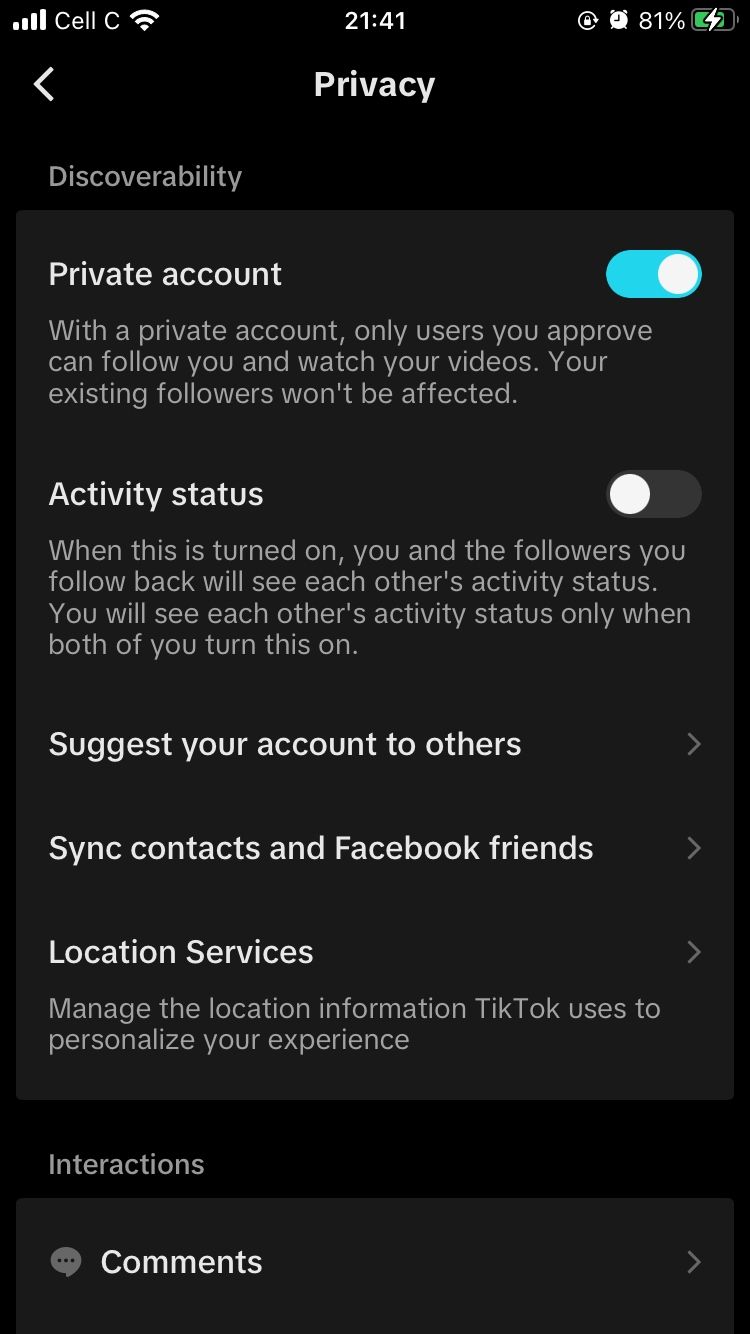
- Enforce Private Account Mode: Navigate to Settings and Privacy > Privacy, then toggle Private Account on. This ensures only manually approved followers can view your videos, Live broadcasts, and profile stories.
- Turn Off Discovery Suggestion: Disable "Suggest your account to others" across all subcategories, including Contacts, Facebook Friends, and People who open or send links to you. This keeps your profile off automated recommendation algorithms.
- Disable Video Downloads: Under the Safety sub-menu in Privacy, turn off direct video downloads. While this does not prevent external screen recording, it removes native high-resolution media saving for all followers.
- Audit Follower Lists Regularly: Private accounts lose their protective value if populated by hundreds of unverified accounts. Remove unfamiliar accounts or inactive handles that might have been compromised or transferred.
- Implement Hardware or App-Based 2FA: Never rely on SMS-based two-factor authentication, which remains susceptible to SIM swapping. Use an authenticator app (such as Google Authenticator or 1Password) to secure the master credentials.
Frequently Asked Questions (FAQ)
Can third-party viewer apps show private TikTok videos without following?
No. TikTok processes all media access requests through authenticated server-side checks. Without an approved follow request associated with the querying account token, the servers will not transmit the video data.
Are anonymous TikTok profile viewer sites safe to browse?
No. These websites typically subject visitors to deceptive affiliate survey loops, malicious browser notification prompts, or credential harvesting portals designed to capture personal login data.
Can account holders see who viewed their private TikTok profile?
If an account is set to private, strangers cannot view its profile content at all. Profile View History only tracks users who visit public profiles, provided both the visitor and the profile owner have enabled the feature in their account settings.
What should I do if I entered my password into a private viewer website?
Immediately open the official TikTok app, navigate to Settings and Privacy > Security, and change your password. Terminate all active logins under the "Manage Devices" menu and enable two-factor authentication using an authenticator app.
The Technical Realities of Digital Boundaries
The internet thrives on instant accessibility, leading many users to assume every digital wall can be bypassed with the right utility. When it comes to social platform permissions, that assumption creates prime opportunities for cybercriminals. TikTok's server architecture enforces clear separation between public feeds and locked user data.
Third-party viewer tools do not possess the keys to those protected databases. Instead, they monetize curiosity by packaging affiliate scams, phishing schemes, and malicious downloads as surveillance software. The choice is straightforward: respect the access boundaries built into the platform, or risk personal security chasing tools that cannot deliver.
