Color Theory Fact-Check: Can You Mix Blue from Other Colors, or Is It an Impossible Myth?
Every elementary school art class teaches the same rigid doctrine: red, yellow, and blue are the irreducible primary colors. According to this traditional rule, you can mix these three hues to yield every other color on the spectrum, but you can never create the primaries themselves from scratch. When amateur painters find themselves staring at an empty tube of blue on their palette, this rule suggests they are completely out of luck. Yet modern industrial printing presses churn out saturated blues every second using only cyan, magenta, yellow, and black inks.
The contradiction between schoolroom dogma and industrial reality exposes a widespread misunderstanding of physics and optical biology. Pop culture frequently leans into the emotional and cultural weight of color, a dynamic examined when analyzing signature color branding, such as the deliberate visual identity analyzed in The Fader Report. Just as historians at outlets like Slow Boring dismantled the myth that ancient Greeks were biologically blind to blue simply because Homer described the sea as "wine-dark," modern color science dismantles the idea that blue is fundamentally unmixable. Understanding how to produce blue requires stripping away 18th-century assumptions and examining how light interacts with matter.
📌 Key Takeaways:
- The Direct Answer: You can mix blue using subtractive pigments, but only if your starting primaries are pure cyan and process magenta rather than traditional red and blue.
- The Physical Mechanism: Cyan pigments absorb red wavelengths of light, while magenta pigments absorb green wavelengths, leaving only blue light to reflect back to the human eye.
- The Traditional Paint Dilemma: Standard red-yellow-blue (RYB) sets fail because standard reds contain green-absorbing yellow components that turn mixed paints into muddy brown rather than clean blue.
The Schoolroom Fallacy of the RYB Color Model
The belief that blue cannot be mixed comes directly from the historical Red-Yellow-Blue (RYB) color model. Developed by early theorists like Jacob Christoph Le Blon in the 1700s and later popularized by Johann Wolfgang von Goethe, the RYB framework was an earnest attempt to categorize artist pigments. At the time, chemical manufacturing was in its infancy. Natural minerals and plant dyes served as the only raw materials for paint. Because early artists possessed no single mixture that could replicate lapis lazuli or azurite, they declared blue an elementary building block.
That assumption survived into 20th-century curricula despite being disproven by modern optics. The human eye does not process color through red, yellow, and blue channels. Instead, retinal cone cells respond to red, green, and blue (RGB) wavelengths. When working with physical substances, such as acrylic paint, watercolor, or printing ink, we operate under subtractive color mixing principles. Subtractive mixing means that each pigment added to a mixture absorbs, or subtracts, specific wavelengths of light while reflecting the remainder.
Traditional red paint reflects both red and significant amounts of orange and yellow light. If you attempt to mix standard cadmium red with another pigment to extract blue, the red pigment will absorb the very blue wavelengths you need to see. The classical RYB wheel is not an immutable law of nature. It is an outdated approximation based on the limited chemical palettes of the Renaissance.
The CMYK Solution: Mixing Cyan and Magenta
Commercial printers solved this dilemma over a century ago through the CMYK subtractive mixing model. If you inspect an industrial four-color process press, you will not find a reservoir of dark blue ink. The machine relies on Cyan (C), Magenta (M), Yellow (Y), and Key/Black (K).
To produce a deep, vivid royal blue, the printer deposits precise halftone dots of pure cyan directly over dots of magenta. The mechanics rely entirely on selective light absorption:
- Cyan pigment: Absorbs long-wavelength red light (roughly 600, 700 nanometers) while allowing green and blue light to reflect.
- Magenta pigment: Absorbs medium-wavelength green light (roughly 500, 580 nanometers) while reflecting red and blue light.
When cyan and magenta lie on top of one another, the cyan cancels out the red reflection, and the magenta cancels out the green reflection. The only remaining visible band of the spectrum free to bounce back to your retina is short-wavelength light: blue (roughly 400, 490 nanometers). If you own tubes of Process Cyan (often labeled PB15:3 by pigment code) and Process Magenta or Quinacridone Magenta (PR122), you can mix them on an acrylic paint mixing palette to create a distinct, vibrant blue.
Subtractive vs. Additive Color: Wavelengths and Pigment Realities
The rules governing color creation shift completely depending on whether you manipulate physical matter or direct light emissions. Digital monitors, smartphones, and television screens operate on additive color principles. They begin with pure darkness and project light directly into the eye. In the additive RGB system, blue is indeed an unmixable primary. Green and red light combine to form yellow, while blue light combined with green creates cyan.
The confusion between additive screen light and subtractive physical pigments creates widespread misunderstandings. Just as the BBC recently debunked popular assumptions surrounding how nighttime smartphone blue light impacts human sleep architecture, everyday artists routinely conflate additive light rules with physical pigment chemistry. The two systems mirror each other as exact inverted pairs.
| Color System | Primary Colors | How Blue is Produced | Common Practical Use |
|---|---|---|---|
| Additive (RGB) | Red, Green, Blue | Emitted directly via 450, 485 nm light-emitting diodes or phosphors | OLED displays, studio lighting, camera sensors |
| Modern Subtractive (CMY) | Cyan, Magenta, Yellow | Mixed physically: Cyan (absorbs red) + Magenta (absorbs green) | Offset lithography, inkjet printing, professional painting |
| Historical Subtractive (RYB) | Red, Yellow, Blue | Treated as an impossible-to-mix elemental base | Traditional art academies, grade-school art instruction |

Pigment Chemistry: Why Ultramarine and Cobalt Resist Kitchen-Table Mixing
While cyan and magenta chemically combine to produce a generic optical blue, specialized inorganic pigments cannot be replicated on an artist's palette through simple mechanical mixing. The history of fine art is largely a story of inorganic chemistry.
During the Middle Ages and Renaissance, true ultramarine was more valuable than gold. Sourced exclusively from lapis lazuli mines in the Badakhshan province of Afghanistan, the stone contained a complex sulfur-bearing aluminosilicate mineral called lazurite. When French chemist Jean-Baptiste Guimet synthesized artificial ultramarine in 1828 (classified as Pigment Blue 29), he recreated this intricate crystal lattice structure.
Similarly, cobalt blue (Pigment Blue 28), formulated by Louis Jacques Thénard in 1802, consists of cobalt(II) oxide-aluminum oxide sintered at over 1,000 degrees Celsius. These specialized inorganic pigments achieve their depth because their molecular bonds isolate narrow reflectance bands that organic dye mixtures cannot mimic.
When you mix cyan and magenta paints, the resulting blue often lacks the luminous clarity of pure single-pigment ultramarine or phthalocyanine blue. Every mechanical mixture introduces microscopic impurities and broad absorption profiles that dull the reflected light. While you can mix blue functionally, you cannot easily mix the brilliance of single-pigment mineral formulations.
Practical Palette Strategies for Acrylic and Oil Painters
If you run out of blue paint while working on a canvas, your options depend entirely on what tubes remain in your kit. If your palette holds only Cadmium Red Medium, Lemon Yellow, and Burnt Sienna, mixing a blue is physically impossible. Those warm reds and yellows absorb the entire blue spectrum.
However, if you stock modern synthetic organic pigments, you can generate serviceable shades of blue through deliberate pairing:
1. The High-Chroma Mix: Combine Phthalo Green (PG7) with a cool, violet-leaning quinacridone red such as Quinacridone Magenta (PR122) or Dioxazine Purple (PV23). Phthalo green provides intense blue-green reflectance. Blending it with purple or quinacridone magenta eliminates unwanted green wavelengths without muddying the mixture with yellow, leaving a deep navy tone.
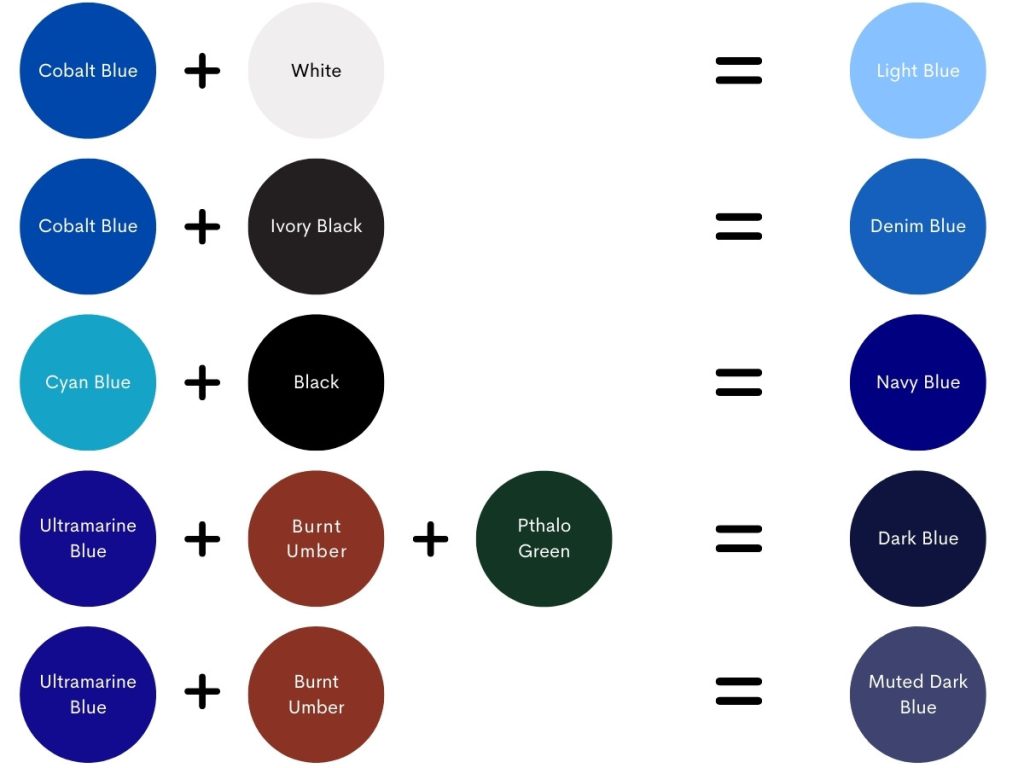
2. Shifting Blue Temperatures: Working with an existing base blue allows extensive modification without purchasing dozens of dedicated tubes:
- Sky Blue: Blend Phthalo Blue with Titanium White and a microscopic pinprick of Yellow Ochre to counter excessive synthetic glow.
- Deep Ocean Navy: Mix Ultramarine Blue with Burnt Umber to create a desaturated chromatic black-blue without relying on deadening carbon black.
- Warm Turquoise: Introduce small amounts of Cadmium Yellow Light to Cerulean Blue (PB35) to swing the temperature warm while maintaining high opacity.
Frequently Asked Questions (FAQ)
Q1: Can you mix red and yellow to make blue?
A1: No. Red and yellow pigments absorb medium and short wavelengths of visible light. When combined, they reflect only orange and red wavelengths. It is physically impossible to produce blue by combining red and yellow.
Q2: Why does mixing blue and yellow paint turn green?
A2: Blue paint absorbs red light and reflects blue and green light. Yellow paint absorbs blue light and reflects red and green light. When mixed, the blue absorbs the red, the yellow absorbs the blue, and green is the only shared wavelength left to reflect back to the eye.
Q3: Which two paints make true blue?
A3: Process Cyan (PB15:3) and Process Magenta (PR122 or PV19) mixed together produce a visible blue. If using standard paints, mixing Phthalo Green (PG7) with Dioxazine Purple (PV23) yields a deep midnight blue.
Modern Color Literacy Beyond Elementary Dogma
The persistent myth that blue cannot be mixed under any circumstances is a relic of outdated art curricula that fail to track real-world optics. Scientific thinking routinely sheds old pedagogical assumptions when better physical models arrive, an evolution highlighted by historians at Big Think who trace how science discards oversimplified narratives in favor of empirical reality. In color science, clinging to the 18th-century RYB wheel ignores over a century of advances in optical physics and organic chemistry.
Blue can be mixed using physical pigments, provided those pigments are cyan and magenta rather than traditional scarlet red and yellow. Understanding how pigments selectively absorb and reflect distinct bands of the electromagnetic spectrum allows painters, designers, and print technicians to master color mixing with precision rather than relying on obsolete rules.
