Dragon Ball Z or Kai? The Brutal Truth Behind Which Version Actually Holds Up Today

Four decades after Akira Toriyama introduced the world to his signature martial arts saga, newcomers and lifelong fans face an identical barrier to entry: choosing between two fundamentally conflicting versions of the same story. You can commit to the sprawling 291-episode television broadcast produced by Toei Animation between 1989 and 1996, or you can watch Dragon Ball Z Kai, the 167-episode high-definition revision tailored for modern audiences. As tracked in the franchise viewing guide from the IGN Report, selecting a path shapes your entire experience with the series, dictating everything from story structure to character motivations.
The split runs deeper than a simple arithmetic problem of runtime. Opting for Dragon Ball Z gives you an unvarnished time capsule of 1990s broadcast culture, complete with synthesizer-heavy Western music, hand-drawn film grain, and prolonged pauses designed to let manga chapters catch up. Choosing Kai gives you a radically modernized, tightly scripted production that corrects thousands of translation errors while discarding iconic filler arcs. Navigating these two productions requires looking past nostalgia to weigh script fidelity, audio engineering, visual restoration, and narrative efficiency.
📌 Key Takeaways:
- Pacing Realities: Dragon Ball Z Kai eliminates 124 episodes of anime filler, condensing the 291-episode original to 167 episodes while adhering directly to Akira Toriyama’s manga narrative.
- Dubbing Accuracy: The 1990s Funimation dub heavily altered dialogue and character personalities, whereas Kai features re-recorded voice work, accurate scripts, and seasoned acting across the principal cast.
- Visual Trade-offs: The original series preserves authentic 4:3 cel-animation grain, while Kai introduces selective digital redraws and a controversial 16:9 crop during The Final Chapters.
The Filler Tax and the Frieza Saga Pacing Crisis
The fundamental reason Kai exists is production logistics. When Toei Animation produced Dragon Ball Z in the late 1980s and early 1990s, the anime rapidly caught up to Akira Toriyama’s weekly manga serialization in Weekly Shonen Jump. To keep the show on the air without passing the source material, animators engineered long stretches of stalling tactics. Characters powered up across multiple consecutive weeks, repeated attack animations filled runtime, and writers produced standalone filler episodes out of thin air.
This dynamic reached its breaking point during the Namek arc. The Frieza saga pacing in original Dragon Ball Z stretched Frieza’s "five minutes until Namek explodes" across nearly ten full episodes, bogging down high-stakes combat with reaction shots and debris falling in slow motion. Entire episodes elapsed with characters exchanging only a handful of blows. Beyond inflated fight choreography, the original run diverted into lengthy, non-canonical detours: Gohan stranded with orphans, the detour to "Fake Namek," and the Garlic Jr. saga, an entire eleven-episode filler arc inserted between Namek and the arrival of Future Trunks.
Kai systematically dismantled that bloat. By trimming roughly 43 percent of the broadcast material, Kai brought the pacing comparison back in line with Toriyama’s original panel flow. The Frieza battle transforms from an exhausting endurance test into an urgent, kinetic confrontation. The entire Saiyan arc, which took 35 episodes in 1989, resolves in just 18 episodes in Kai. For modern viewers accustomed to fast-paced seasonal anime, this narrative velocity makes Kai infinitely easier to finish.
Yet, that efficiency comes at a cost for fans who treasure character downtime. The original Dragon Ball Z used filler to grant the supporting cast brief moments of ordinary life. Episode 125, where Goku and Piccolo learn to drive automobiles at Chi-Chi's insistence, remains one of the most beloved standalone episodes in anime history. In Kai, that comedic detour is excised entirely, leaving behind a strictly plot-driven train that never leaves the main track.
Script Accuracy and the Funimation Dub Overhaul
Voice acting forms the sharpest dividing line between the two releases. When Funimation localized the original Dragon Ball Z for American television syndication and Cartoon Network's Toonami block in the late 1990s, dubbing standards were loose. Localizers frequently rewrote scripts to insert American slang, added constant jokes during quiet moments, and fundamentally altered Goku’s characterization. The English dub portrayed Goku as a conventional superhero akin to Superman, best exemplified by his famous speech declaring himself "the hope of the universe." Toriyama, by contrast, always wrote Goku as a selfish martial artist motivated primarily by personal challenge rather than moral righteousness.
When the cast returned to the studio for Kai in 2009, Funimation prioritized strict manga accuracy. Christopher Sabat stepped away from several minor background roles to focus on delivering nuanced, grounded performances for Vegeta and Piccolo, abandoning the raspy, cartoonish affectations of his early twenties. The script for Kai translates the original Japanese dialogue faithfully, returning Goku’s lines to their direct, martial-arts-focused intent.
Original DBZ Script (1999):
"I am the ally to good! I am the nightmare to you!"
Kai Script Translation (2010):
"I am the Saiyan who came all the way from Earth for the sole purpose of beating you."
Cast changes also reshape the listening experience. In Kai, Colleen Clinkenbeard stepped into the role of young Son Gohan, replacing Stephanie Nadolny with a performance that emphasizes emotional vulnerability over gravelly aggression. More crucially, the late Chris Ayres took over the role of Frieza, replacing Linda Young’s raspy performance with an icy, aristocratic British theater cadence that redefined the galactic tyrant for Western audiences. Viewers who demand faithful translations and refined voice work will find Kai objectively superior. Those driven by late-night Toonami nostalgia, however, will miss the chaotic charm of the original recording sessions.
The Soundtrack Showdown: Bruce Faulconer vs. Japanese Orchestration
Music remains the most polarizing debate surrounding these adaptations. When Funimation distributed Dragon Ball Z in North America, they replaced Shunsuke Kikuchi’s vintage brass-and-strings score with an electronic, industrial metal soundtrack composed by Bruce Faulconer and his production studio.
The Bruce Faulconer score left an undeniable imprint on an entire generation of viewers. Tracks like "Vegeta’s Super Saiyan Theme," "Gohan’s Anger," and the atmospheric bells of the "Cell Theme" provided an aggressive, driving energy that defined Western anime culture in the early 2000s. Crucially, the Faulconer score ran wall-to-wall. Contractual obligations demanded near-continuous audio, which meant ambient synth pads played over scenes that were originally dead silent.
Kai abandoned the Faulconer score entirely, aligning with modern international broadcast conventions. The production initially featured a modern orchestral score by Kenji Yamamoto, but Toei replaced most of his compositions with classic Shunsuke Kikuchi tracks following a 2011 copyright infringement scandal involving Yamamoto's melodies.
The orchestral approach gives Kai a traditional cinematic cadence. Silence is used intentionally to build dread, letting punches resonate and winds howl across desolate landscapes. Viewers raised on the driving synthesizers of the original American broadcast often find Kai jarringly quiet. Conversely, those who prefer classical composition and deliberate sound mixing argue that the original Japanese orchestration suits the narrative far better.
Visual Restorations, Cropping, and The Final Chapters Disparity
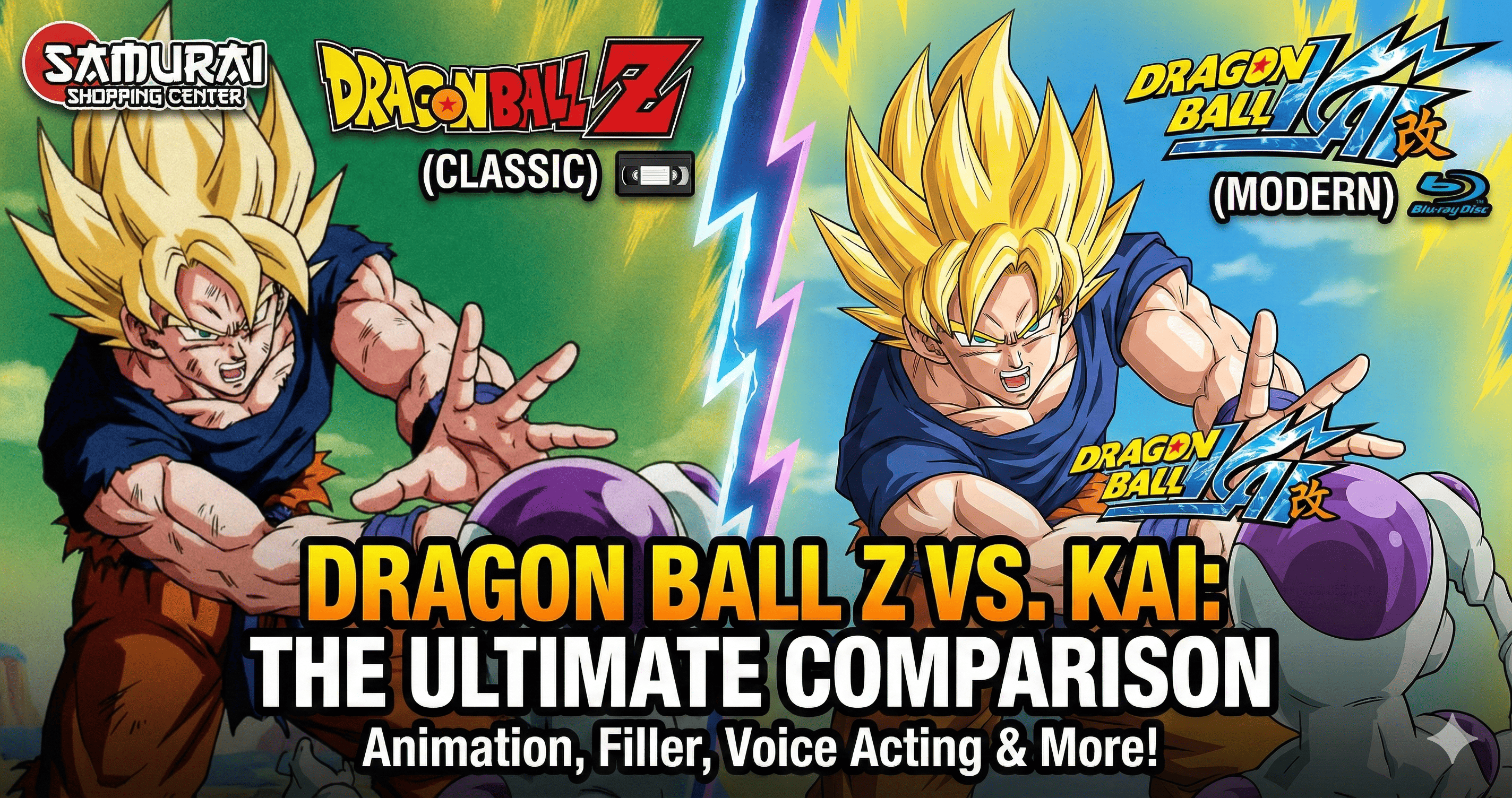
The visual presentation of Kai is a patchwork of high-definition restoration and controversial editing. Toei created the series by scanning the original 16mm film master reels, cleaning up dust, scratches, and chemical degradation. In scenes where the original frames were damaged beyond repair, animators digitally traced over the artwork, producing jarring moments where vibrant, flat digital drawings clash with 30-year-old hand-painted cel animation.
The technical differences become especially visible when evaluating aspect ratio differences and distribution releases:
| Technical Metric | Dragon Ball Z (Original 1989, 1996) | Dragon Ball Z Kai (2009, 2015) |
|---|---|---|
| Total Episode Count | 291 episodes | 167 episodes (98 Saiyan, Cell, 69 Buu) |
| Aspect Ratio | Native 4:3 Full Frame (Hand-drawn cel) | 4:3 Pillarbox (Eps 1, 98) / 16:9 Cropped (The Final Chapters) |
| English Dub Audio Options | Faulconer Synth Score or Kikuchi Japanese Score | Kikuchi/Yamamoto Mix (Eps 1, 98) / Sumitomo Score (Buu) |
| Manga Script Fidelity | Loose, localized jokes, hero tropes | Direct translation, character-accurate intent |
| Content Rating Handling | Uncut home video vs heavy TV syndication edits | Uncut home video vs minor TV blood censorship |
The visual situation degraded during the production of The Final Chapters, the standalone continuation covering the Majin Buu saga. While the first 98 episodes maintained their native 4:3 aspect ratio with crisp color correction, The Final Chapters was cropped to widescreen 16:9, cutting off roughly 20 percent of the visual information from the top and bottom of the frame.
Furthermore, Toei applied an aggressive, heavy green tint across the color grading of The Final Chapters, leaving the Buu saga looking visibly murky compared to the vibrant primary colors of the Cell saga. Original Dragon Ball Z releases, particularly high-end Blu-ray sets that retain the original 4:3 presentation, preserve the organic warmth of hand-painted cels far better than The Final Chapters.
Censorship, Uncut Edits, and Franchise Watch Order
A persistent misconception among casual anime fans is that Kai is an inherently censored version of Dragon Ball Z. This myth stems from the show's initial television run on Nickelodeon's Nicktoons in the United States, where broadcast standards forced severe edits. In those early airings, blood was removed, blue laser burns replaced gaping chest wounds, and Mr. Popo was digitally recolored teal.
On home video and modern streaming platforms, however, Kai exists as an uncut release. Raditz's death retains its graphic brutality, characters swear within reason, and the violence mirrors Toriyama's manga panels. While the original Dragon Ball Z uncut releases are slightly more graphic in terms of prolonged hand-drawn gore, Kai on Blu-ray preserves the visceral impact of the series without childish sanitization.
Establishing an optimal franchise watch order requires deciding how these shows connect to the broader canon. The classic television series Dragon Ball GT was produced by Toei as a direct sequel to the original 291-episode run of Dragon Ball Z, carrying forward its filler lore and aesthetic sensibilities.
Conversely, modern canon material, including Dragon Ball Super, aligns directly with the pacing and script choices established in Kai. In Super, Goku's character traits, the voice cast dynamics, and the canonical continuity ignore filler concepts like Gregory the cricket on King Kai’s planet or the mechanics of the afterlife seen in the Other World Tournament arc. For viewers treating their marathon as a stepping stone to Dragon Ball Super, Kai provides a clean, seamless ramp.
Frequently Asked Questions (FAQ)
Q1: Does Dragon Ball Z Kai include the Bruce Faulconer music?
No. *Kai* was produced exclusively with Japanese-composed orchestral scores, including compositions by Shunsuke Kikuchi, Kenji Yamamoto, and Norihito Sumitomo. If you want the Faulconer score, you must watch the original *Dragon Ball Z* release with the Funimation English audio track selected.
Q2: Is the original Dragon Ball series required before watching Z or Kai?
While *Dragon Ball Z* and *Kai* function as standalone narratives, watching the original 153-episode *Dragon Ball* series provides crucial context. The arrival of the Saiyans carries far more emotional weight when you have watched Goku grow from a child into an adult alongside Krillin, Yamcha, Tien, and Piccolo.
Q3: Why did Funimation recast Gohan and Frieza for Kai?
Funimation wanted vocal performances that matched the age and demeanor of the manga characters. Colleen Clinkenbeard replaced Stephanie Nadolny to give Gohan a more natural, youthful voice, while the late Chris Ayres replaced Linda Young to bring sophisticated theatricality and menace to Frieza's dialogue.
The Deciding Factor for Your Next Marathon
Deciding between Dragon Ball Z and Dragon Ball Z Kai comes down to how you consume media and what you demand from a story's pacing. The original 1989 run functions as a grand, slow-burning period piece. If you want to experience the synthesizer-driven soundtrack, revel in the warmth of uncropped 4:3 cel animation, and take your time living inside Toriyama's universe across 291 episodes, the original series remains deeply rewarding.
If your priority is respecting your personal time, hearing accurate translations, and watching character motivations align with Akira Toriyama’s vision, Kai is the superior adaptation. It strips away hundreds of hours of production stalling to deliver a focused, impactful shonen experience. Choose the original cut to revisit the television era of your youth; choose Kai to experience the story as its creator designed it.
