Fact-Checking Deer Island, NY: Trespassing Laws, Public Access, and Urban Legends Debunked
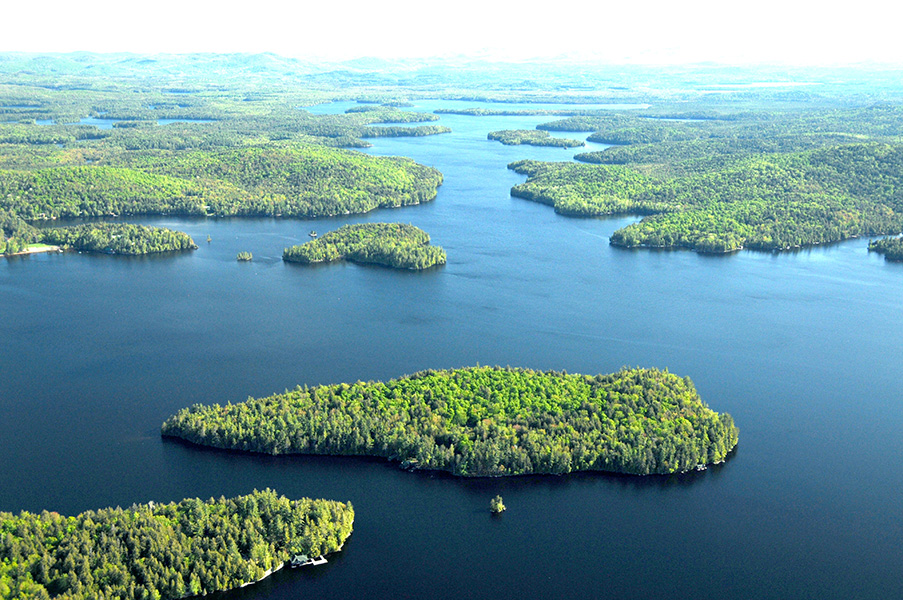
Motorboats cutting through the cold blue channels of the Saint Lawrence River often drop throttle two miles northeast of Alexandria Bay, New York. Sightseers scan the shoreline of a dense, 40-acre island sitting quietly in the American span of the Thousand Islands, framed against the international shipping channel. This is Deer Island, the secluded northern retreat of the Russell Trust Association, the private business and real estate entity behind Yale University’s secretive Skull and Bones collegiate society. While remote enclaves regularly spark viral headlines over environmental and administrative battles, a dynamic highlighted in The New York Times Report covering island oversight and wildlife tensions, Deer Island commands attention for an entirely different reason: elite mystique paired with strict exclusion.
Decades of internet speculation have turned the island into an urban legend generator. Online forums portray it as an occult temple, an underground bunker complex, or a high-tech redoubt for political kingmakers. The reality, preserved in Jefferson County assessment records and river patrol logs, is far simpler. Understanding Deer Island requires stripping away sensational folklore and examining property deeds, maritime boundaries, and the legal limits of Upstate New York private islands.
📌 Key Takeaways:
- Strict Public Access Prohibition: Deer Island is 100% private property owned by the Russell Trust Association; unauthorized landings constitute criminal trespass under New York Penal Law.
- Waterway Navigation Protection: Federal maritime doctrines and New York State navigation laws protect the public right to boat, paddle, and fish around the island up to the ordinary high-water mark without interference.
- Myth Versus Physical Fact: Assessment files and ground accounts confirm the island holds no subterranean vaults or ceremonial fortresses, featuring instead modest cabins, overgrown trails, and simple residential docks.
The Secret Society Footprint on the Saint Lawrence River
Deer Island’s connection to Yale University began in 1906, when prominent Albany businessman and Bonesman George Douglas Miller purchased the land and gifted it to the Russell Trust Association. Miller envisioned the parcel as a communal rustication retreat. Members could fish, chop wood, boat, and step away from East Coast professional pressures. The property spans approximately 40 acres, wrapped in mature hemlocks, white pines, and granite outcroppings that characterize the Thousand Islands ecosystem.
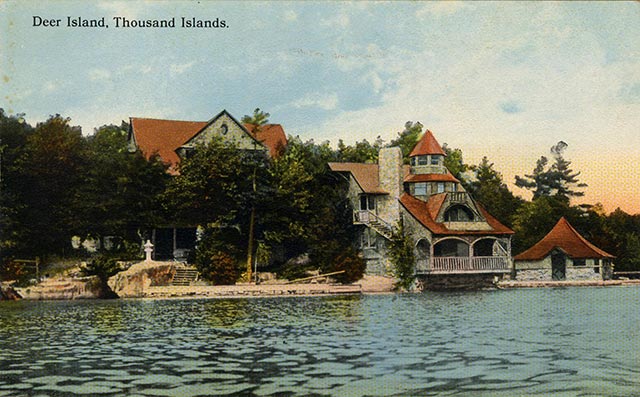
During the early twentieth century, the retreat maintained multiple stone cottages, service buildings, tennis courts, and a prominent main lodge. Subsequent decades proved harsh on the infrastructure. Severe winter freezes, spring ice flows, and isolated fires in 1949 and the 1970s destroyed several key structures. Rather than rebuilding grand estates, the Russell Trust maintained a low-profile maintenance posture. Today, the parcel functions primarily as an unpretentious summer outpost for collegiate Bonesmen and occasional alumni work retreats.
Can You Visit Deer Island? Trespassing Laws vs. Public Access
The short answer is no: the general public cannot visit, tour, or dock at Deer Island under any circumstances. The parcel carries no public easements, recreational trails, or state conservation access agreements. The island is strictly monitored private property, and the Russell Trust Association actively enforces perimeter restrictions.
Under New York Penal Law § 140.05 (Trespass) and § 140.10 (Criminal Trespass in the Third Degree), entering or remaining unlawfully upon real property enclosed by fencing or clearly marked with no-trespassing signage is a prosecutable misdemeanor. The Jefferson County Sheriff’s Office and the New York State Police Marine Detail regularly patrol Alexandria Bay waters. Property caretakers do not offer informal warnings to visitors caught wandering the shorelines; they initiate immediate trespass complaints with local law enforcement.
The Factual Record: Property Filings Versus Internet Myths
Online creators frequently claim Deer Island contains high-voltage perimeter defenses, concealed helipads, and underground catacombs where global policies are orchestrated. Real-world architectural surveys, aerial municipal imaging, and local building permits present a far more austere environment.
| Structural / Legal Element | Widespread Online Myth | Verified County & Historical Record |
|---|---|---|
| Island Infrastructure | Subterranean bunkers, secure meeting halls, luxury executive suites | Small, weathered wood-frame cabins, utility sheds, basic docks, dense brush |
| Property Tax Valuation | Multi-million-dollar exempt tactical asset | Assessed across modest recreational tiers ($175,000, $450,000 historical bands) |
| Security Measures | Armed guards, private patrol cutters, motion-tracking sensors | Standard posted no-trespass notices, trail cameras, on-site summer caretaker |
| Public Navigational Right | Exclusion zone extending 500 feet into open water | Zero maritime exclusion; public may boat directly off the high-water line |
Decades of field documentation, including photographs compiled by local historians and investigative journalists from regional outlets, reveal an unpolished summer camp. The interior trails are choked with stinging nettles, mosquitoes, and fallen branches. Facilities consist of simple bunk accommodations, basic woodstoves, and modest boat slips. The contrast between global conspiracy theories and peeling cottage paint remains stark.
Waterway Navigation Rights Around Alexandria Bay
While landing on the island brings swift legal consequences, admiring Deer Island from the water is completely legal. Under both federal admiralty law and the Public Trust Doctrine upheld by New York State, the waters of the Saint Lawrence River are public navigable waterways. The Russell Trust’s private ownership ends at the mean high-water mark along the shoreline.
Boaters, personal watercraft operators, and kayakers possess absolute rights to idle, drift, fish, and cruise the perimeter. You cannot tie a line to the docks, drive pilings into the shoreline, or stand on submerged rocks that sit above the legal water line. Commercial Thousand Islands boat tours departing from Alexandria Bay routinely steer within a couple hundred yards of the western shore, narrating the island's collegiate ties to tourists en route to neighboring landmarks.
Boldt Castle Proximity and Regional Geography
Deer Island sits in an extraordinarily visible pocket of the Saint Lawrence River. Located less than two miles downstream from Heart Island, home to the famed, turreted Boldt Castle, Deer Island sits directly adjacent to one of the most traveled recreational corridors in Upstate New York. Canadian border markers run through the shipping channel just yards to the north, exposing the area to routine oversight by both the U.S. Coast Guard and U.S. Customs and Border Protection.
This geographic reality shreds theories of secret paramilitary gatherings or covert operations. The river surrounding Deer Island hosts thousands of private vessels every weekend from Memorial Day to Labor Day. Any irregular maritime movement, construction project, or unauthorized event faces immediate visibility from commercial skippers, fishing charters, and Canadian border patrol vessels.
Frequently Asked Questions (FAQ)
Q1: Can I anchor my boat off Deer Island to go swimming?
A1: Yes, as long as you remain entirely in navigable waters and do not touch, anchor to, or wade onto the shoreline or any private docks. The Saint Lawrence River is a public waterway subject to the Public Trust Doctrine, meaning open-water recreation off the shore is completely legal.
Q2: Do commercial boat tours stop at Deer Island?
A2: No commercial boat tours dock or discharge passengers at Deer Island. Several cruise outfits operating out of Alexandria Bay and Clayton route past the island, offering historical commentary from the river before continuing to Boldt Castle or the Rock Island Lighthouse.
Q3: What happens if an unauthorized boater steps ashore by accident?
A3: Caretakers and local law enforcement enforce strict zero-tolerance policies. Trespassers will be ordered to vacate immediately, and repeat or deliberate incursions routinely result in formal criminal trespass citations filed through the Alexandria Town Court.
The Boundary Between River Lore and Legal Reality in 2026
The aura surrounding Deer Island endures because secrecy creates a blank canvas for human imagination. When an organization like Skull and Bones, which counts American presidents, Supreme Court justices, and corporate leaders among its alumni, holds a secluded island for more than a century, public curiosity naturally boils over. The reality is unglamorous. Decades of county assessment records, environmental reports, and maritime laws depict a rugged, low-maintenance parcel of river woodland functioning as a private retreat. Boaters are welcome to admire the shoreline from the public current of the Saint Lawrence, but the island itself remains closed to the world, protected by state property laws that separate historical folklore from legal boundaries.
