Fact-Checking 'Is Dora Blind?': What Official Nickelodeon Canon Really Confirms
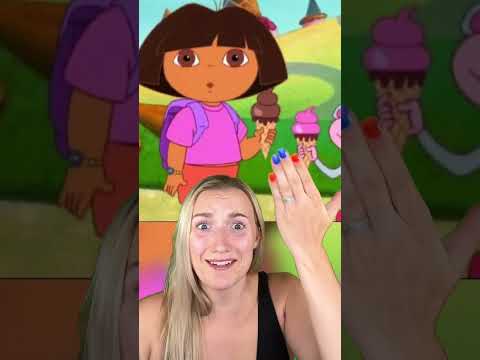
Social media video platforms frequently reinvent classic children's television through morbid, revisionist lenses. One persistent urban legend claims that Dora Marquez, the intrepid bilingual adventurer from Nickelodeon's flagship animated franchise, navigates her animated world with profound visual impairment. When viral clips reignited the claim across short-form video platforms, pointing to Dora's wide-eyed forward stare, her reliance on anthropomorphic navigation aids, and her apparent inability to spot a rustling masked fox behind a knee-high bush, millions of viewers accepted the interpretation without question. As documented in a distractify.com Report, the claim evolved rapidly from observational comedy into an earnest fan theory that continues to trigger debates across digital communities.
The assertion contradicts decades of production records, creator statements, and early childhood developmental research. Nickelodeon launched Dora the Explorer in August 2000, running the original series across eight seasons and 178 episodes through 2019, followed by multi-million-dollar CGI reboots in 2024. Throughout that entire broadcast history, series creators Chris Gifford, Valerie Walsh Valdes, and Eric Weiner designed Dora's behavior around empirical cognitive science rather than an unstated disability. Unraveling the myth reveals how standard conventions of educational animation get distorted when viewed through cynical adult internet culture.
📌 Key Takeaways:
- The Canon Record: Official production documentation and series creators confirm Dora Marquez is not visually impaired; the blindness rumor is an unverified internet myth.
- Cognitive Architecture: Dora's wide-eyed gaze, prolonged silence, and fourth wall breaks were engineered to give two- to five-year-old viewers time to process visual stimuli and vocalize answers.
- Utility of Companions: Supporting characters like Boots the Monkey and The Map serve specific pedagogical roles in spatial reasoning and sequence planning, not as assistive medical guides.
How TikTok Algorithms Resurrected the Cartoon Disability Theory
Dark fan theories thrive on subverting cheerful childhood nostalgia. Between 2021 and 2026, TikTok creators and pop-culture channels on YouTube built an entire genre around reimagining beloved cartoons as psychological allegories or medical tragedies. Speculative commentary framed Dora's behavior as classic symptoms of severe myopia or total blindness.
Advocates of the theory compile selective video montages to argue their case. They point to Dora asking the viewer where the Big Yellow Mountain is while standing directly in front of it. They analyze her shouting questions at empty space, her rigid forward posture, and her dependence on vocal confirmations from Boots the Monkey. By stripping away the educational format, content creators recast her deliberate, instructional pauses as disorientation. The framing caught on because it provided simple, dramatic explanations for stylized animation choices that look bizarre to adults watching outside the intended demographic.
Online forums like Reddit's r/FanTheories amplified the narrative, cross-referencing it with theories that The Map functioned as an audible GPS unit for the disabled and Boots operated as a certified guide animal. While entertaining as creative fiction, none of these claims reflect the actual production mandate established by Nickelodeon Animation Studio.
The Production Reality Behind Dora's Iconic Fourth Wall Breaks
The creative origins of Dora the Explorer centered on active audience engagement, not passive viewing. In the late 1990s, Nickelodeon set out to build an interactive preschool show that paired basic Spanish language acquisition with problem-solving skills. To pull young children into the story, animators borrowed visual language from early point-and-click computer games.
Dora does not look past obstacles because her eyes fail her. She looks through the screen because she is addressing the player on the other side of an invisible computer monitor. The show frequently superimposes a digitized mouse cursor on screen, clicking on objects after Dora asks children to identify them. Her direct, unblinking eye contact mimics the interface of early educational CD-ROM software like Living Books or JumpStart.
Every instance where Dora asks, "Do you see the bridge?" while staring straight ahead is a scripted prompt for toddler participation. Animators purposely isolated Dora from the background scenery during these exchanges to keep early viewers focused on her facial expressions and oral cues. Removing visual distractions ensured that young children, whose selective attention spans are still developing, would not miss the educational prompt.
The Map, Boots, and Swiper: Narrative Scaffolding vs. Medical Aids
The dark fan theory relies heavily on reinterpreting Dora's companions as assistive tools. In this reading, The Map becomes a vocal mobility cane, Backpack becomes a braille storage system, and Boots the Monkey steps in as a service animal. In reality, preschool curriculum specialists built these characters as narrative scaffolding tools.
| Show Element | Internet Fan Theory Claim | Educational Design Reality |
|---|---|---|
| The 3, 5 Second Freeze | Visual disorientation or sensory cognitive lag | Wait-time latency allowing preschool processing and speech response |
| The Map | Audio-guided accessibility screen reader | Teaches 3-step procedural logic, sequencing, and spatial navigation |
| Boots the Monkey | Trained guide animal for physical direction | Audience surrogate mirroring toddler enthusiasm and emotional reactions |
| Swiper's Concealment | Inability to register obvious visual threats | Visual discrimination exercise developing figure-ground perception |
The Map introduces fundamental sequencing skills. Every episode follows a strict three-location formula: location one, location two, destination. By singing a repetitive jingle and breaking journeys into visual milestones, The Map trains children to remember steps in order, a cornerstone of early childhood executive function.
Boots serves as the emotional proxy for the young audience. When Dora asks a question, Boots mirrors the viewer's anticipated reaction, giving children social validation while they process the problem. Swiper the Fox serves as a visual tracking challenge. Placing Swiper behind trees or rocks encourages toddlers to distinguish between foreground and background imagery, a fundamental milestone in visual development known as figure-ground perception.
The Cognitive Science Behind Dora's Dramatic Pauses
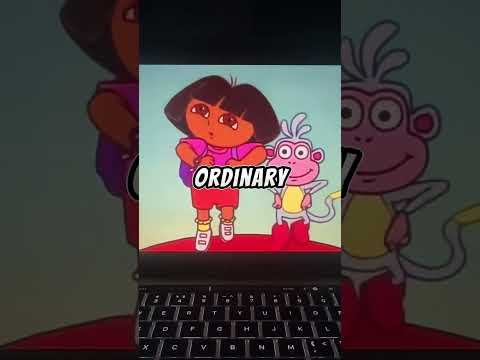
The primary piece of "evidence" cited in TikTok cartoon conspiracies is Dora's agonizing pause after asking a basic question. She looks into the camera, blinks silently for up to five seconds, smiles, and says, "Right! The red door!" To a teenager or an adult, this silence seems awkward, robotic, or indicative of an impairment.
Developmental psychologists call this mechanism preschool wait-time latency. Research pioneered by educational consultants during the production of Blue's Clues and Dora the Explorer revealed that children aged two to five process spoken information much slower than older audiences. When television characters ask a question and immediately provide the answer, toddlers disengage, shifting into passive viewing habits.
By inserting a three- to five-second silence, producers created an authentic interactive window. Field testing in preschool classrooms showed that children need that buffer to decode the question, visually scan the animated frame, formulate a verbal response, and shout it at the television. The technique boosted comprehension and self-esteem among preschool viewers. What cynical social media users interpret as blindness is actually an evidence-based pedagogical pause that helped turn the show into a $1 billion-plus global merchandising powerhouse.
Why Dark Cartoon Conspiracies Dominate Social Feeds
The persistent popularity of the blind Dora narrative highlights a broader digital phenomenon: dark nostalgia. Audiences who grew up with earnest, educational media during the 2000s often use subversive humor to engage with their childhood memories as young adults.
Internet algorithms naturally favor scandalous reimaginings of innocent media over mundane educational realities. A short-form video declaring "Dora Was Secretly Blind the Entire Time" generates higher engagement, more comments, and faster sharing metrics than a clinical breakdown of early childhood instructional design. Similar fan theories routinely circulate about Caillou dying of terminal cancer, the babies in Rugrats being figments of Angelica's grief, or Courage the Cowardly Dog living in a regular neighborhood viewed through canine paranoia.
These urban legends spread rapidly because they exploit nostalgia while offering an edgy, revisionist revelation. Audiences love discovering hidden depths in simplistic shows, even when those discoveries ignore clear, publicly accessible production facts.
Frequently Asked Questions (FAQ)
Q1: Did Nickelodeon ever officially state that Dora is visually impaired?
A1: No. Nickelodeon, series creators Chris Gifford, Valerie Walsh Valdes, and Eric Weiner, and the network's production documents have never presented Dora as blind or visually impaired. The character was designed as a sighted, adventurous seven-year-old child.
Q2: Why does Dora ask the audience where things are when they are right behind her?
A2: The show uses this technique to prompt active viewer participation. By pretending not to notice an object immediately, Dora gives preschool children the opportunity to identify the item, build spatial awareness, and vocalize their answers.
Q3: Does Dora's design incorporate any actual accessibility or disability representation?
A3: While Dora herself is not disabled, the wider franchise has featured diverse guest characters with varied physical capabilities, including storylines highlighting sign language and adaptive equipment. However, the core cast's exaggerated habits stem from educational television mechanics, not accessibility needs.
The Lasting Impact of Nickelodeon's Trailblazing Design
Far from hiding an unconfirmed physical disability, Dora the Explorer achieved historic success by mastering the mechanics of early childhood development. Every controversial design choice, the frozen eye contact, the methodical repetition, the deliberate delays, and the reliance on visual roadmaps, was calculated to turn television from a passive babysitter into an active learning environment.
Viewing the show through the lens of modern digital irony misses the intentional craft behind its production. Dora looked straight at the camera because she was designed to see, engage, and empower the young child sitting on the living room floor. Her gaze was not a symptom of blindness; it was an open door to active learning.
