Frontier GoWild Booking Calendar Visual Guide: Flight Windows, Pass Validity, and Seat Caps

Frontier Airlines disrupted the low-cost aviation market by slashing introductory rates on its seasonal flight passes down to $199, creating an unprecedented entry point for ultra-budget domestic and regional travel. Yet converting an unlimited flight subscription into actual boarding passes requires decoding one of the most restrictive reservation systems in the industry. According to an official news.flyfrontier.com Report, Frontier structured its seasonal releases, including the fall and winter pass covering up to seven continuous months alongside the summer pass, around aggressive flash pricing designed to monetize otherwise empty mid-week capacity.
For travelers eyeing the pass, the headline price is only the starting line. Unlocking actual value hinges on understanding rigid reservation calendars, hidden inventory restrictions, and strict departure timelines that govern every single route.
📌 Key Takeaways:
- Domestic Timing: Flights can only be booked starting at 12:01 AM (in the departure city's time zone) the day before departure, forcing travelers into last-minute confirmations.
- International Rules: Cross-border routes to Mexico, the Caribbean, and Central America allow a wider 10-day advance booking window.
- Mandatory Friction: Base fares drop to $0.01, but government taxes, carrier fees starting at $15.11 per segment, and strict seat availability caps govern every departure.
The $199 Price Collapse and Frontier's Capacity Math
Frontier’s pricing strategy for the GoWild program shifted dramatically throughout 2026. Originally marketed as a premium subscription costing upward of $599 to $1,999 annually, the carrier restructured the pass into targeted seasonal segments priced at an introductory $199. The summer pass validity period ran for more than five months from May through September, while the subsequent fall and winter pass opened immediate booking access through February 2027.
This aggressive discounting was not an act of corporate goodwill. Budget carriers face substantial financial penalties when operating flights with empty middle seats during off-peak windows. By locking in hundreds of thousands of upfront subscription payments, Frontier banks on three predictable passenger behaviors: unredeemed passes, add-on baggage fees, and seat selection charges. Industry monitors track that ancillary revenue accounts for more than 50% of Frontier's total operating income. The GoWild pass functions primarily as a customer acquisition engine designed to channel travelers into ancillary fee funnels.
The Domestic Booking Window and Last-Minute Confirmation Rules
The standard domestic flight booking rules impose a tight constraint on travelers: pass holders cannot confirm a domestic seat until the day prior to departure. Specifically, inventory unlocks at 12:01 AM in the departure city's local time zone. If you plan to fly from Denver to Orlando on a Thursday morning, the booking window does not open until 12:01 AM on Wednesday.
This single constraint reshapes the entire travel experience. Spontaneous travelers and remote workers who maintain fluid schedules can exploit empty Tuesday and Wednesday flights between secondary hubs. However, standard vacationers cannot lock in return legs simultaneously. When departing on a Friday, the Sunday return flight remains completely inaccessible until Saturday morning. If the Sunday return flight fills up with full-fare retail passengers in the interim, the pass holder is stranded or forced to buy a last-minute retail ticket on a competing carrier.
Frontier occasionally rolls out an early booking promotion, allowing pass holders to reserve seats weeks or months in advance for an added fee, typically running $20 to $45 per segment. While these promotions eliminate scheduling anxiety, they directly undercut the core economic premise of an unlimited flight pass.
Comparing Pass Windows, Blackout Dates, and Booking Constraints
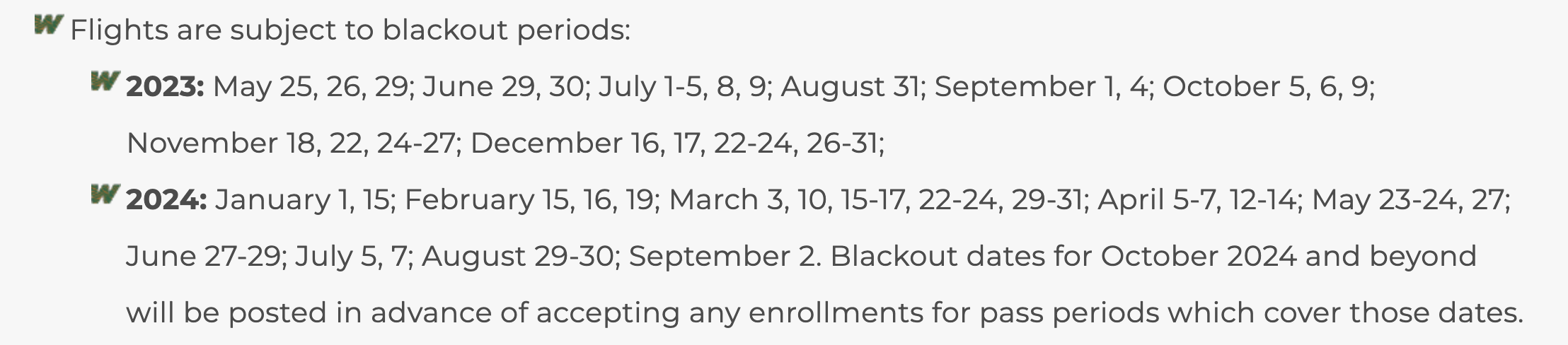
Managing the Frontier calendar requires tracking three distinct operational variables: pass validity, reservation windows, and mandatory blackout dates. During peak holiday corridors, GoWild seats are completely blacked out across the network.
| Pass Model | Pass Validity Period | Reservation Window | Published Blackout Windows |
|---|---|---|---|
| Summer Pass | May 1, September 30 (5 Months) | Domestic: 24h priorInternational: 10 days prior | Memorial Day weekend, late June corridors, July 3, 7, Labor Day weekend |
| Fall & Winter Pass | August 4, February 28 (Nearly 7 Months) | Domestic: 24h priorInternational: 10 days prior | Labor Day, mid-October breaks, Thanksgiving week, Dec 18, Jan 5, MLK weekend, Presidents' Day |
| Annual Pass | Rolling 12-Month Access | Domestic: 24h priorInternational: 10 days prior | All domestic holiday spikes, Sunday evenings during peak summer, spring break corridors |
Blackout dates effectively eliminate holiday travel. Thanksgiving week, Christmas through New Year's Day, and peak summer weekends do not offer standard GoWild seat redemptions. Attempting to search the calendar on those dates yields zero inventory or diverts users to standard retail pricing.
International Flight Advance Booking and Regional Routes
The rules ease significantly once Frontier crosses national borders. For international routes, including non-stop routes into Cancun, Punta Cana, Montego Bay, and San José, the international flight advance booking period extends to 10 days.
This 10-day runway changes the risk profile. Securing a week-long international trip allows travelers to lock down lodging and ground transit without fearing a complete inventory lockout the night before departure. Because international flights generally carry higher base margins, Frontier allocates a modest batch of pass seats earlier to stimulate passenger taxes and international facility fees.
The catch lies in international departure taxes and carrier fees. While the domestic base fare is suppressed to a penny, foreign governments levy heavy entry and exit charges. An international GoWild round-trip ticket between Miami and Jamaica or Mexico rarely costs $30; instead, international airport authorities levy taxes ranging from $80 to $165 per passenger. The pass waives the airline's standard airfare, but sovereign customs fees remain unavoidable.
Seat Availability Caps and Revenue Management Algorithms
Holding a valid pass does not guarantee a seat on every non-blackout flight. Frontier applies dynamic seat availability caps across its entire route network. The airline’s automated yield management systems evaluate route demand continuously, releasing GoWild inventory only when probability models show that a seat will depart empty.
On high-traffic vacation routes, such as Philadelphia to San Juan on a Friday afternoon, the carrier often allocates exactly zero GoWild seats, even if five physical seats remain unsold. Frontier’s revenue algorithms hold those remaining seats for late-booking business passengers or desperate retail travelers willing to pay full fare. Verified discussions on frequent-flyer forums indicate that GoWild inventory on popular leisure corridors typically caps out at 2 to 4 seats per aircraft, and those seats vanish within seconds after the midnight reservation window opens.
Connecting flights compound this friction. A multi-leg journey from Cleveland to Phoenix connecting through Denver requires two separate GoWild seat clearances. If the second leg has reached its availability cap, the entire itinerary fails to price as a pass fare, leaving travelers stranded halfway through the booking engine.
Taxes, Carrier Fees, and Frontier Miles Elite Status
Every GoWild transaction processes as a $0.01 base fare plus mandatory taxes and carrier fees. For a standard nonstop domestic flight, government security fees, facility charges, and segment fees push the out-of-pocket cash minimum to $15.11 per direction. Multi-segment connecting itineraries double that floor to at least $30.22.
The true cost escalation hits at the baggage counter. Frontier strictly enforces a 40-pound weight limit on checked luggage and charges anywhere from $45 to $75 per segment for standard carry-on bags. A round-trip flight secured for $30.22 in base taxes quickly balloons past $150 if you bring a standard wheeled suitcase.
This is where holding Frontier Miles elite status upends the equation. Travelers with elite status (such as Elite 20K, 50K, or 100K earned through flight activity or branded credit card spend) unlock game-changing fee exemptions. Status holders receive free carry-on bags, waived seat-assignment charges, and priority boarding. When combined with the GoWild pass, an Elite 50K member genuinely flies across the United States for flat $15.11 segments, transforming an unpredictable budget pass into a legitimate commuter tool.
Frequently Asked Questions (FAQ)
Q1: Can I book a round-trip domestic flight at the same time using the GoWild pass?
A1: Generally, no. Domestic booking rules restrict reservations to the day before departure. Unless your entire trip lasts less than 24 hours, you must wait until the day before your return flight to secure your return seat, running the risk that return inventory is sold out.
Q2: What happens if a flight is canceled or severely delayed?
A2: Frontier will rebook pass holders on the next available Frontier flight with GoWild inventory. However, the airline does not interline with legacy carriers like Delta, United, or American, meaning they will not rebook you on a competitor’s aircraft. If subsequent Frontier flights are fully booked for days, you are responsible for your own interim accommodations.
Q3: Do GoWild flights earn Frontier Miles or count toward elite status?
A3: No. Because the base fare is reduced to $0.01, GoWild flights earn neither redeemable Frontier Miles nor qualifying segments toward elite tier status. Ancillary purchases made during the booking (such as seat assignments or paid baggage) also do not earn tier points.
Q4: Can children or minors travel on an adult’s GoWild pass?
A4: The pass is strictly non-transferable and applies solely to the named individual. Every family member, regardless of age, must own their own active GoWild pass and pay individual taxes and fees per flight segment.
Navigating the Ultra-Low-Cost Booking Equation
Frontier's seasonal flight passes can generate remarkable savings, but they require uncompromising flexibility. Remote professionals based near major Frontier hubs, such as Denver, Orlando, Las Vegas, or Atlanta, who travel light with a compact backpack can recoup the $199 purchase price within two round-trip journeys. For this demographic, moving mid-week without fixed calendar deadlines makes the pass a high-yield travel asset.
Conversely, travelers bound to corporate schedules, families traveling with children, and vacationers aiming for rigid weekend breaks face constant friction. Between seat availability caps, recurring $15.11 to $30+ segment fees, and severe holiday blackouts, the hidden operational costs can rapidly outpace the savings. Evaluating the GoWild pass is not about the headline price tag; it requires auditing how comfortably your schedule tolerates 24-hour booking windows and network-wide inventory caps.
