Full Windsor vs Half Windsor: Visual Comparison, Step Breakdown, and Collar Fit
Every morning across corporate boardrooms, diplomatic corridors, and formal gatherings, men make a silent calculation in front of the mirror. The choice between a full Windsor knot and a half Windsor knot dictates the entire silhouette of a tailored jacket and shirt. While modern tailoring has leaned into softer lines, the debate over neckwear proportions returned to the cultural surface following coverage in the Milwaukee Journal Sentinel Report on foundational neckwear methods, alongside a sharp menswear critique published by GQ questioning whether oversized corporate knots deserve their untouchable reputation.
A necktie knot does not exist in isolation. It anchors the collar points, mirrors the lapel width, and establishes visual balance across the chest. Choosing incorrectly produces an awkward disparity: an undersized knot that rattles inside wide collar points, or an aggressive bulge that pries the collar stand apart. Getting the knot right requires understanding geometry, fabric weight, and how your shirt collar was constructed.
📌 Key Takeaways:
- Collar Proportions: The full Windsor fills the substantial space of a spread collar shirt or extreme cutaway collar, while the half Windsor fits standard point and semi-spread collars.
- Internal Architecture: A full Windsor uses a dual-wrap base around both collar bands to achieve exact triangular symmetry, whereas a half Windsor wraps around only one side to yield a medium, slightly asymmetrical profile.
- Fabric Matching: Heavy wool, knitted silk, and thick 7-fold jacquards overwhelm a full Windsor; thin printed twill or lightweight silk foulard make it sit flush and clean.
The Royal Myth and the Menswear Backlash
The namesake of both knots, the Duke of Windsor (King Edward VIII), never tied a full Windsor knot in his life. Menswear historians long ago documented that the Duke favored a standard four-in-hand knot tied with heavy, custom-woven silk neckties produced by Savile Row tailors. The substantial thickness of his custom fabric created volume naturally without complex wrapping. Observers who wished to mimic his look created the double-wrapping method to replicate that volume using ordinary neckwear fabric.
By the late 1930s, the wide tie knot gained international acclaim as the benchmark of modern executive style. Over decades, that authority transformed into corporate conformity. As GQ highlighted in early 2025 during an editorial re-examination of power dressing, the oversized, football-shaped knot became synonymous with mid-2000s finance excess and ill-fitting television punditry. That cultural baggage pushed purists back toward natural nonchalance. Understanding the mechanics allows you to deploy the knot with intentional precision rather than mindless habit.
Engineering the Knot: Symmetry, Volume, and Step Breakdowns
The technical distinction between the two styles rests entirely on the foundational wraps. The full Windsor builds two symmetrical wedges against the collar band before creating the horizontal face. The half Windsor establishes only one internal wedge, resulting in roughly 25% to 30% less volume at the neck.
To tie a full Windsor knot:
- Drape the tie over your shoulders with the wide end roughly 12 inches (30 cm) lower than the narrow end.
- Cross the wide end in front of the narrow end to the left.
- Bring the wide end up through the neck loop from underneath, then down to the left side.
- Pull the wide end underneath behind the narrow end to the right side.
- Bring the wide end up over the neck loop on the right, and tuck it down through the loop to the right side. You now have two distinct triangular wedges facing outward.
- Wrap the wide end horizontally across the front from right to left, creating the visible face.
- Bring the wide end up underneath through the neck loop one final time.
- Guide the wide end down through the horizontal face loop created in step six.
- Hold the narrow end, pull the knot upward flush against your collar stand, and seat a crisp necktie dimple directly beneath the knot face.
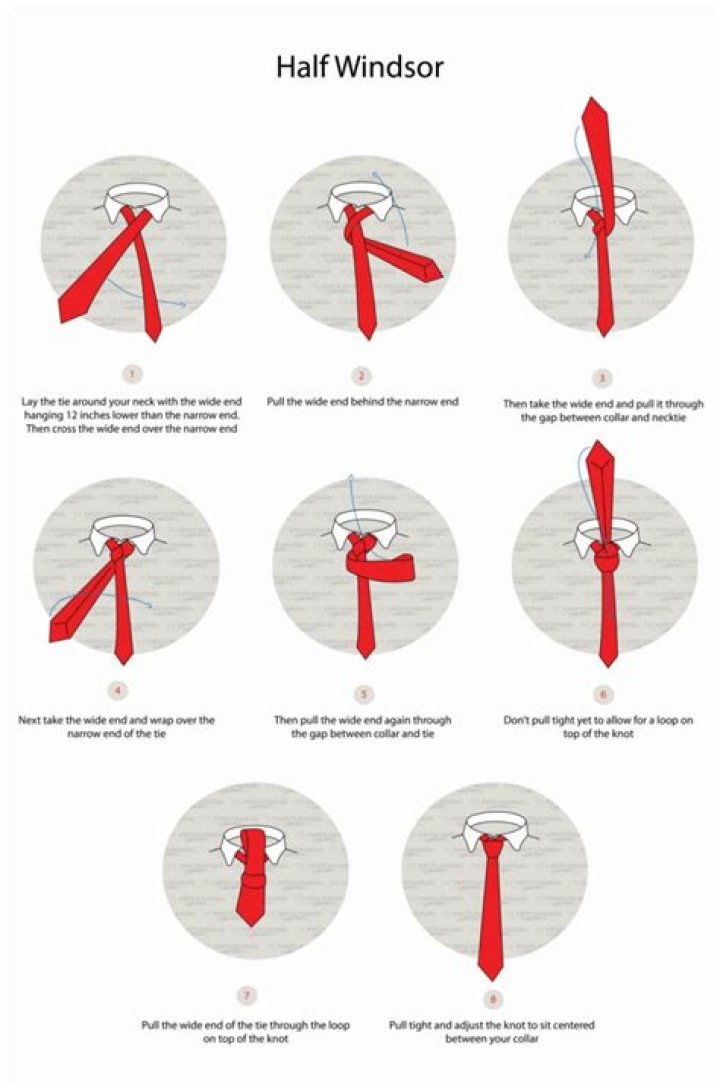
To tie a half Windsor knot:
- Position the wide end about 8 to 10 inches (20 to 25 cm) lower than the narrow end.
- Cross the wide end in front of the narrow end toward the left.
- Take the wide end behind the narrow end to the right.
- Bring the wide end straight up over the center and push it down through the neck loop to the left.
- Pull the wide end horizontally across the front from left to right to build the front face.
- Bring the wide end upward behind the neck loop from underneath.
- Thread it downward through the front loop.
- Cinch the knot snugly toward the neck, pressing your index finger into the center to lock in the dimple.
Collar Gap Alignment: Matching Knot Width to Collar Spread
Collar geometry dictates knot selection. When collar leaves extend downward at sharp angles, as seen on standard forward-point collars or narrow English tab collars, the open spread measures roughly 2.5 to 3.0 inches. Forcing a wide tie knot into that narrow triangle forces the collar points to lift away from your chest, destroying the flat silhouette of your shirt.
A spread collar shirt or a cutaway collar features tips positioned 4.5 to 6.0 inches apart. Leaving that space open with an asymmetrical four-in-hand exposes the tie band circling the neck, revealing an untidy collar stand. The full Windsor fills the gap from edge to edge, resting neatly against both collar tips without forcing them open. The half Windsor functions as the most versatile middle ground, fitting comfortably across semi-spread collars measuring 3.5 to 4.5 inches between points.
| Stylistic Variable | Full Windsor Knot | Half Windsor Knot |
|---|---|---|
| Internal Wraps | 2 wraps (dual balance) | 1 wrap (single internal anchor) |
| Geometric Profile | Triangular symmetry, wide base | Medium triangle, subtle angle |
| Ideal Collar Style | Wide spread, cutaway, Windsor collar | Semi-spread, classic point, button-down |
| Collar Gap Width | 4.5, 6.0 inches | 3.0, 4.5 inches |
| Tie Length Consumption | High (requires longer silk tail) | Moderate (balanced tail length) |
| Formality Level | Strict formal menswear, weddings | Business professional, versatile smart-casual |
Tie Fabric Thickness and Knot Density
Fabric weight directly alters the diameter of your finished tie. A knot calculation that looks sharp with a 36-ounce printed silk twill turns into an unmanageable mass when executed in winter flannels or knitted grenadine weaves. Mathematical knot studies highlighted by MEL Magazine demonstrated that the complexity of necktie configurations must account for interlining bulk. Heavy canvas linings inside wool-blend ties make dual internal loops completely impractical.
For a full Windsor, select lightweight silks with thin wool interlinings. The multiple loops compress smoothly, generating an elegant inverted triangle that stays flat under the chin. If you are wearing a textured tweed suit with a woven wool tie, use a half Windsor or four-in-hand instead. The single wrap handles dense yarns cleanly, allowing the fabric to form a sharp fold without bulging uncomfortably against your throat.
The Necktie Dimple: Perfecting the Finishing Detail
A knot tied flat across the face looks lifeless. The central fold known as the necktie dimple introduces visual depth, catching the light and directing the eye downward through the chest. It signals intentional craftsmanship over hasty dressing.
Achieving a crisp dimple requires steady finger placement during the final cinch. As you guide the wide blade down through the front loop, place your index finger in the center of the silk just beneath the knot. Pinch the outer edges upward with your thumb and middle finger to form an intentional "W" or inverted trough. Maintain light tension on that pinch while pulling down on the wide blade with your opposite hand. When pulled taut, the dimple locks beneath the knot collar, remaining centered through hours of wear.
Who Should Tie the Full Windsor vs Who Should Skip It
Selecting your knot requires honest self-assessment regarding body frame, neck circumference, and shirt style. No single knot serves every wearer equally.
Ideal Candidates for the Full Windsor:
- Men with wide necks measuring 16.5 inches (42 cm) or larger, whose proportions naturally balance a broad knot base.
- Professionals wearing custom shirts featuring extreme spread or cutaway collars.
- Grooms and guests attending black-tie-optional or highly traditional formal ceremonies.
- Men using thin, unlined vintage silk neckties that lack natural body.
When to Avoid the Full Windsor:
- Tall men over 6 feet 2 inches (188 cm) using standard 57-inch ties, because the double wrap consumes too much fabric and leaves the tie tip hovering above the belt line.
- Slender men with narrow collar sizes under 15 inches, where the knot overwhelms the jawline.
- Anyone wearing standard button-down collars or forward-point collar shirts.
- Ties constructed from heavy tweed, flannel wool, or knitted fabric.
Frequently Asked Questions (FAQ)
Q1: Why does my full Windsor knot end up too short on my torso?
A1: The full Windsor wraps around the collar band twice, which consumes roughly 3 to 4 inches more silk than a four-in-hand knot. Tall men or individuals with broad necks should use an extra-long tie (usually 61 to 63 inches) to ensure the tip reaches the center of the belt buckle.
Q2: Is the full Windsor knot considered out of style in modern tailoring?
A2: It is not out of style, but it is no longer the automatic default. Modern menswear favors tailored balance over rigid symmetry. When paired with a wide spread collar, the full Windsor remains the premier choice for formal wear, whereas pairing it with a narrow point collar appears outdated.
Q3: Can I tie a full Windsor knot on a standard button-down collar?
A3: No. American button-down collars have soft rolls and narrow point gaps designed specifically for smaller, asymmetrical knots like the four-in-hand. A full Windsor will force the collar buttons to pull and make the collar points flare awkwardly.
Balancing Proportions for Contemporary Menswear
A well-tailored suit succeeds on the balance of its proportions, not the rigid application of traditional rules. The enduring utility of the full Windsor knot lies in its ability to anchor expansive, formal shirt architecture when nothing else fits the collar gap. The half Windsor remains the indispensable, daily companion for standard business shirts, managing structure without overwhelming the collar band.
Mastering both styles gives you total control over your appearance. Review your collar width, feel the heft of your tie fabric between your fingers, and pick the knot designed to complement the cut. Balanced neckwear shows that your clothing was assembled with care, precision, and an eye for proportion.
