Hermes in EPIC vs. Hadestown: Dissecting Two Iconic Musical Portrayals

The messenger god of antiquity has traded his marble caduceus for pop synthesizers and jazz brass. Across modern theater, two wildly different cultural juggernauts have revitalized the Olympian herald: Jorge Rivera-Herrans' video-game-paced internet sensation EPIC: The Musical and Anaïs Mitchell’s Tony-winning folk-opera Hadestown. While theater critics celebrating the stage-to-screen journey of Mitchell's opus, such as the recent MacGuffin or Meaning Report, note how myth endures through ritual repetition, the explosion of EPIC reveals a radically different creative appetite.
Where Mitchell constructs an ancient, world-weary orator who carries the grief of humanity on his tailored lapels, Rivera-Herrans unleashes a hyperkinetic trickster who drops into the narrative like a high-level video game patron offering cheat codes. This collision of forms marks a generational shift in how classical texts migrate into contemporary pop consciousness.
📌 Key Takeaways:
- The Dual Archetypes: Rivera-Herrans paints Hermes as an eccentric, self-serving immortal playing 4D chess, while Mitchell frames him as an empathetic, communal griot bound to an inevitable tragedy.
- Musical DNA: *EPIC* anchors Hermes in hyperactive video-game synthpop and playful vocal runs ("Wouldn't You Like"), contrasting sharply with the New Orleans jazz swagger created by André De Shields on the original Broadway cast recording.
- Narrative Utility: In *EPIC*, Hermes acts as a tactical catalyst pushing the Odysseus character arc forward; in *Hadestown*, he functions as the philosophical architect holding the fourth wall together.
From TikTok Rough Cuts to Concept Musical Dominance
The ascent of Hermes in EPIC: The Musical did not begin in a Broadway rehearsal room. It erupted out of social feeds. Jorge Rivera-Herrans, an independent composer who began workshopping his Homeric adaptation online during the 2020 lockdowns, bypassed traditional commercial theatrical pipelines entirely. By structuring EPIC into self-contained "sagas" released across digital streaming platforms, Rivera-Herrans turned the concept musical album format into an episodic blockbuster.
By the time listeners navigated past The Troy Saga and reached the release of The Circe Saga in 2024, anticipation for the divine messenger archetype had reached fever pitch. Rivera-Herrans did not present Hermes as an aloof, ethereal entity. Instead, the composer voiced Hermes himself, infusing the character with manic, syncopated vocal inflections and an intoxicating mix of juvenile arrogance and ancient calculation.
The strategy paid off. Songs engineered around dynamic rhythm shifts and viral hooks found an instant audience among Gen Z and millennial listeners who had spent their childhoods reading Rick Riordan and playing indie roguelikes like Supergiant’s Hades. EPIC proved that theatrical storytelling no longer requires a physical proscenium arch to cultivate an obsessive global following.
"Wouldn't You Like" and the Glitch-Hop Trickster
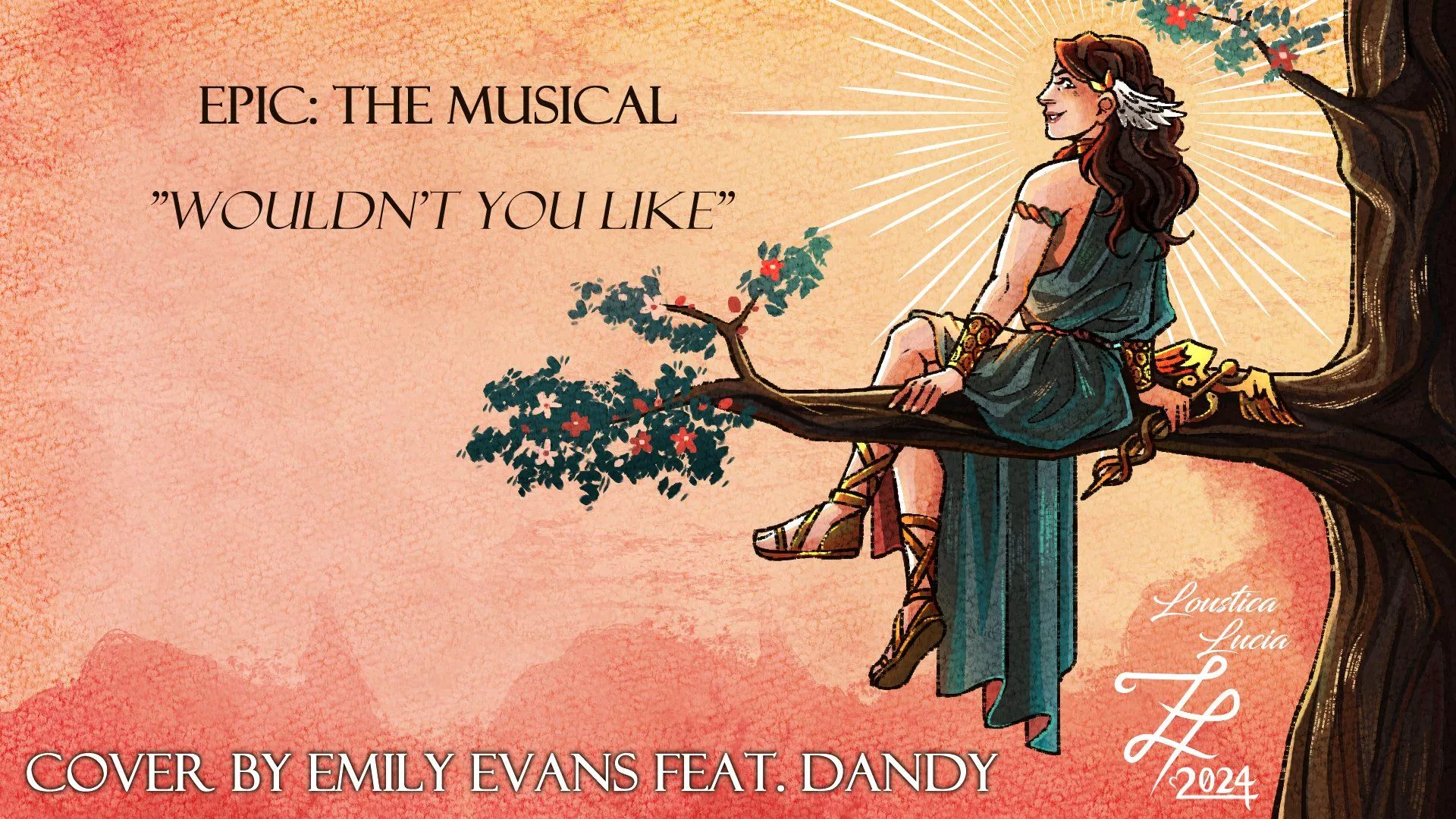
When Hermes materializes on Circe’s island of Aeaea, he does not deliver solemn omens. He practically dances across the beat. In "Wouldn't You Like," the signature track from The Circe Saga, Rivera-Herrans deploys bright synthesizers, crisp percussion snaps, and rapid-fire lyricism that feel closer to contemporary electronic dance music than traditional Broadway show tunes.
The track functions as a psychological pivot for Odysseus. Circe has turned his scouts into swine; despair has brought the Ithacan king to his knees. Enter Hermes, balancing playfully on the edge of mortal doom:
"Wouldn't you like a taste of the power? / Wouldn't you like to use more than words? / Deep in the night, the fight can be ours / Wouldn't you like a taste of the divine?"
Here, the holy root moly is treated less like an agrarian blessing and more like a tactical power-up. Hermes gives Odysseus the means to counter Circe’s sorcery, but Rivera-Herrans ensures the transaction crackles with danger. Hermes is not intervening out of noble compassion; he is bored, amused, and testing whether a mortal mind can survive playing with godly fire. The vocal performance bends notes, leans into half-spoken chuckles, and maintains a breakneck tempo that mirrors the adrenaline spike of hand-to-hand combat.
The Griot on the Train: Anaïs Mitchell’s Silver-Tongued Elder
To measure the audacity of Rivera-Herrans’ portrayal, one must look at the Broadway giant that preceded it. In Hadestown, conceived by singer-songwriter Anaïs Mitchell and directed by Rachel Chavkin, Hermes occupies an entirely different moral universe.
Originated on Broadway by André De Shields in a performance that earned him the 2019 Tony Award for Best Featured Actor in a Musical, this Hermes is a dapper, paternal figure rooted in American folk traditions, jazz clubs, and post-industrial mythmaking. When De Shields stepped onstage in a gleaming silver suit, feather tucked into his lapel, his presence commanded silence with a wave of a hand.
Mitchell does not present Hermes as an instigator of chaos, but as the custodian of memory. In "Road to Hell," he sets the rules of the cosmos:
"It’s an old song / It’s a sad song / But we sing it anyway."
Hermes in Hadestown knows the ending before the curtain rises. He knows Orpheus will turn around. He knows Eurydice will descend into the factory depths. Yet he remains bound to tell the story with love, acting as an uncle figure to Orpheus while serving as a sober witness to the brutal economic machinery of Hades' underworld. Mitchell’s lyrics rely on slow, drawn-out brass motifs, poetic repetition, and deep baritone warmth. This is Hermes as an elder who has seen empires rise, sweat, and fall, holding the hand of mortals as they walk toward their inevitable undoing.
Contrasting Two Eras of Classical Reinterpretation
The divergence between EPIC and Hadestown reflects a split in how modern creators adapt Greek mythology for twenty-first-century audiences. One roots itself in the mechanics of modern quest fiction and interactive narrative; the other builds upon the legacy of political fable, blues music, and Brechtian theatrical alienation.
| Core Dimension | Hermes in EPIC: The Musical | Hermes in Hadestown |
|---|---|---|
| Originator & Composer | Jorge Rivera-Herrans | Anaïs Mitchell (Originated by André De Shields) |
| Musical Genre & Soundscape | Fast-tempo synthpop, electronic orchestral, video-game motifs | New Orleans hot jazz, blues, acoustic folk Americana |
| Signature Musical Piece | "Wouldn't You Like" (*The Circe Saga*) | "Road to Hell" / "A-G-O-N-Y" (revisions) |
| Dramaturgical Function | Active quest companion, instigator, item-provider | Omniscient chorus master, narrator, psychopomp |
| Distribution Architecture | Digital streaming concept albums, social video drops (2022, 2026) | Broadway stage, national tours, live pro-shot release (2019, 2026) |
| Relationship to Mortals | Mischievous, self-amused, transactional, unpredictable | Paternal, mournful, protective, resigned to fate |
Pushing the Odysseus Character Arc Through Divine Mischief
In Homer’s Odyssey, divine interventions often arrive as clinical mandates. Zeus commands; Hermes executes. Rivera-Herrans disrupts this cold mechanics by turning Hermes into a psychological mirror for Odysseus himself.
Throughout The Troy Saga and The Cyclops Saga, Odysseus clings to an ethos of compassion, believing that human reason can overcome cruelty. That philosophy shatters against Polyphemus and Poseidon. By the time Hermes arrives in The Circe Saga, Odysseus has hit rock bottom. Hermes does not simply give Odysseus an herbal defense; he gives him permission to discard his polite hesitation.
Hermes treats the impending slaughter on Aeaea as entertainment, laughing as he hands over the root. That detachment serves as an essential stepping stone in the Ithaca king’s psychological evolution toward total ruthlessness, an evolution that culminates later in The Underworld Saga and The Thunder Saga. Odysseus learns from Hermes that survival among the divine requires matching their speed, their cunning, and their lack of sentimentality.
In Hadestown, Hermes plays the inverse role. Instead of encouraging ruthlessness, he tries to teach Orpheus how to endure without losing his humanity. When Orpheus questions why the world is broken, Hermes answers with quiet patience. He does not offer a sword; he offers advice on how to listen to the rhythm of the wind.
While Rivera-Herrans uses Hermes to strip away Odysseus’ naivety and forge a killer, Mitchell uses Hermes to preserve Orpheus’ innocence for as long as the brutal underworld allows.
The Changing Mechanics of Mythological Theater
The dual success of Hadestown on physical stages and EPIC on streaming platforms highlights an evolving distribution paradigm. Mitchell spent over a decade developing Hadestown through community theater runs in Vermont, off-Broadway workshops at New York Theatre Workshop, and a pre-Broadway engagement in London. The piece was forged through slow dramaturgical revision, adjusting meter and character intentions over years of physical staging.
Rivera-Herrans developed EPIC in the direct spotlight of digital engagement. Every demo snippet, instrumental stem, and animatic contest generated real-time feedback from millions of online listeners. This audience helped shape the energy of the final tracks, demanding dense musical leitmotifs that could be picked apart in breakdown videos.
The resulting interpretations of Hermes directly reflect their mediums. Mitchell’s Hermes needs the lingering pauses, deliberate stage walks, and physical stillness of an actor commanding an 1,100-seat theater. Rivera-Herrans’ Hermes requires the compressed sonic punch of headphones: rapid panning effects, hyper-articulated vocal phrasing, and soaring electronic hooks designed for repeat digital streaming.
Both approaches demonstrate the endless mutability of ancient literature. Homer and the tragedians never treated these characters as static stone monuments. Greek mythology was built on competitive, public retellings where each poet altered character motivations to match the cultural realities of their city-state. Two and a half millennia later, Rivera-Herrans and Mitchell are simply doing what the ancient bards did: adjusting the trickster's tune to suit the ears of their own tribe.
Frequently Asked Questions (FAQ)
Q1: Who plays Hermes in EPIC: The Musical?
Jorge Rivera-Herrans, the creator and primary composer of EPIC: The Musical, voices and sings the role of Hermes on the official studio concept recordings, most prominently in The Circe Saga track "Wouldn't You Like."
Q2: How does the role of Hermes in Hadestown differ from EPIC?
In Hadestown, Hermes is the show's master of ceremonies, an omniscient, older narrator who guides both Orpheus and the audience through a tragic folk-jazz parable. In EPIC, Hermes is an active participant in Homer’s story, appearing as a playful, hyperactive trickster god who provides Odysseus with the magical moly herb to defeat the enchantress Circe.
Q3: What musical genres define Hermes in each production?
Hermes in EPIC is defined by high-tempo synthpop, orchestral percussion, and dynamic electronic arrangements influenced by anime scores and video-game soundtracks. Hermes in Hadestown is anchored in acoustic New Orleans jazz, blues, and traditional American roots music.
Q4: Is EPIC: The Musical currently a staged Broadway production?
As of 2026, EPIC: The Musical exists primarily as a series of commercially successful digital concept musical albums, accompanied by widespread internet animatics, social media releases, and specialized concert presentations, though discussions regarding physical theatrical adaptations continue.
The Immortal Caduceus in the Modern Imagination
The enduring power of Hermes lies in his refusal to belong entirely to any single camp. He is neither hero nor villain, mortal nor tyrant. He walks the borders between worlds, shifting his dialect to match whoever is listening.
Whether he is embodied by an elder jazz showman reminding an audience why broken songs must still be sung, or an electric video-game wanderer offering a desperate captain the tools to outsmart a witch, Hermes remains classical antiquity's most durable export. Theater does not need to choose between the gravitas of Broadway traditions and the kinetic urgency of internet-native concept albums. Both productions demonstrate that as long as humanity struggles against impossible odds, the trickster god will always show up at the crossroads with a song and an offer.
