How Many Pounds in a Stone? The Ultimate Unit Conversion & FAQ Guide
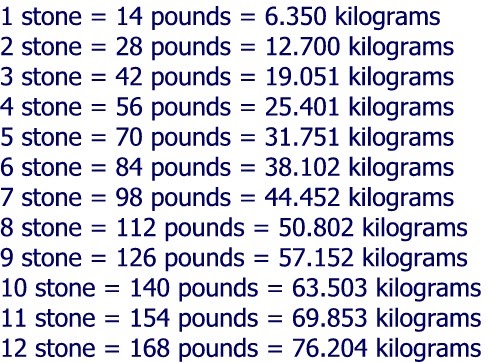
One imperial stone equals exactly 14 pounds (or 6.35029 kilograms). If you step on a British weighing scale and see a reading of 11 stone 4 pounds, your total mass is 158 pounds. While modern scientific research and hospital protocols, from metabolic assessments to clinical kidney evaluations highlighted in the Harvard Health Report, rely strictly on kilograms, the stone remains deeply entrenched across the United Kingdom and Ireland as the standard everyday measure of human body weight.
The abbreviation for stone is st, while pounds are designated as lb (derived from the Roman libra). Because digital health platforms, smart fitness scales, and international travel frequently mix American pounds, British stones, and metric kilograms, knowing how to convert between these units quickly prevents costly health-tracking errors and confusing scale readouts.
📌 Quick Summary:
- The Direct Ratio: Exactly 14 pounds equal 1 stone (1 st = 14 lb = 6.35029 kg).
- The Conversion Rule: Multiply stones by 14 to get total pounds; divide total pounds by 14 to extract stones and leftover pounds.
- Common Point of Confusion: Decimal readings on digital scales (such as 10.5 st) represent 10 stone and 7 pounds, not 10 stone and 5 pounds.
The Mathematics of Stone to Pounds Conversion
Converting between stones and pounds requires basic arithmetic anchored to the number 14. To convert full stones directly into pounds, multiply the stone value by 14:
$$\text{Total Pounds (lb)} = \text{Stones (st)} \times 14$$
When working with combined stone and pound figures, the standard UK body weight measurement format, multiply the whole stone value by 14 and add the remaining pounds. For instance, an individual weighing 12 st 9 lb calculates their mass as (12 × 14) + 9, which equals 168 + 9, or 177 pounds.
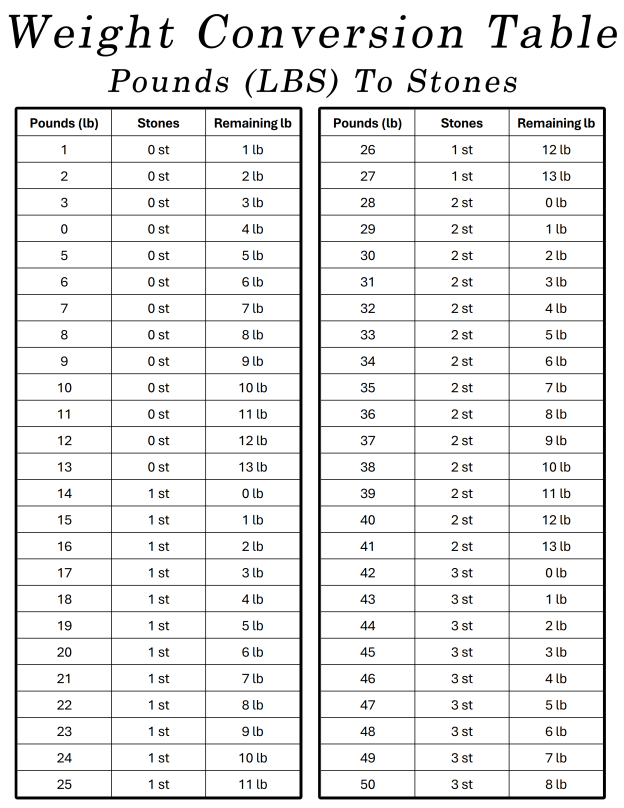
Reversing the process requires integer division. If an American fitness tracker reports a weight of 190 pounds, dividing 190 by 14 yields 13 with a remainder of 8. That equates to 13 st 8 lb. In pure decimal form, 190 divided by 14 is approximately 13.57 stones.
Decimal stone readings trip up many users of connected smart scales. Because the stone is base-14 rather than base-10, 0.5 stone does not mean 5 pounds; it represents half of 14, which is 7 pounds. A measurement of 11.25 st translates to 11 stone and 3.5 pounds (0.25 × 14 = 3.5).
How Medieval Agricultural Trade Standardized the 14-Pound Stone
The concept of using a stone as a mass benchmark dates back thousands of years to ancient agrarian civilizations, where standardized stones served as counterweights on balance beams. Craftsmen picked smooth river rocks to calibrate trade balances for grain, metal, and fleece.
The modern 14-pound unit solidified during the reign of King Edward III in the fourteenth century. English commerce depended heavily on wool exports to Flanders and Florence. Wool was measured in "sacks" and smaller increments called "cloves." Edward III set the wool stone at 14 pounds in 1350 to ensure that two stones made an exact 28-pound quarter-hundredweight, and eight stones formed a 112-pound hundredweight (cwt).
Before legal standardization, a "stone" varied wildly across British markets depending on the commodity. A stone of beef in London butcher stalls often weighed 8 pounds, allowing butchers to account for bone waste, while a stone of glass stood at 5 pounds, and a stone of lead reached 12 pounds. The British Weights and Measures Act of 1824 and subsequent revisions in 1835 formally abolished these regional trade discrepancies. Parliament established a unified imperial system across the British Empire, legally defining the stone as exactly 14 standard avoirdupois pounds.
Conversion Chart: Stones, Pounds, and Kilograms
This conversion table details common adult weight ranges, contrasting the traditional British stone and pound values with total pounds and metric kilograms.
| Stones & Pounds (st / lb) | Total Pounds (lb) | Metric Mass (kg) | Decimal Stone Value |
|---|---|---|---|
| 8 st 0 lb | 112 lb | 50.8 kg | 8.00 st |
| 9 st 7 lb | 133 lb | 60.3 kg | 9.50 st |
| 10 st 0 lb | 140 lb | 63.5 kg | 10.00 st |
| 11 st 4 lb | 158 lb | 71.7 kg | 11.28 st |
| 12 st 7 lb | 175 lb | 79.4 kg | 12.50 st |
| 13 st 0 lb | 182 lb | 82.6 kg | 13.00 st |
| 14 st 2 lb | 198 lb | 89.8 kg | 14.14 st |
| 15 st 0 lb | 210 lb | 95.3 kg | 15.00 st |
| 16 st 10 lb | 234 lb | 106.1 kg | 16.71 st |
Configuring Digital Scales and Health Platforms
Most consumer weighing scales and health ecosystems, including Apple Health, Google Fit, Withings, and Garmin Connect, support three primary unit settings: metric (kg), US customary (lbs), and British imperial (st + lb). Operating across regional ecosystems requires careful attention to unit presets.
When selecting your measurement standard on a bathroom scale:
- Look for physical toggle switches: Many digital bathroom scales feature a small mechanical button on the underside. Tapping this cycles the LCD between kg, lb, and st:lb.
- Distinguish between decimal stone and split units: Several mobile apps display mass as "12.4 st". This is decimal notation, not 12 stone 4 pounds. To get the remaining ounces or pounds from a decimal stone reading, multiply the digits after the decimal point by 14 (0.4 × 14 = 5.6 lb).
- Syncing cross-border medical portals: While British residents track their personal progress in stones and pounds, the National Health Service (NHS) logs records exclusively in kilograms. Entering pounds or stones into a field expecting kilograms will throw off body mass index (BMI) calculations and dosage algorithms by more than half.
Why the Stone Survived British Metrication
The UK began its formal transition to the metric system in 1965, yet the stone has shown remarkable cultural staying power. While British grocery stores sell produce by the kilogram and fuel stations dispense petrol by the liter, human mass remains tied to tradition.
The persistence of the stone parallels how American drivers view miles per hour or how British pubgoers order pints of ale. Weighing people in stones groups numbers into smaller, cognitively manageable blocks. To a British ear, describing someone as weighing "twelve stone" feels as natural as describing height as "six foot," whereas "seventy-six kilograms" or "one hundred sixty-eight pounds" feels disconnected from daily vernacular.
In contrast, the United States discarded the stone early in its colonial history. While the US adopted the British avoirdupois pound, it never formally adopted the 14-pound stone for trade or personal metrics. As a result, Americans express all human body weight strictly in total pounds, making the stone a source of confusion whenever transatlantic sports broadcasts, boxing weight classes, or UK reality programs air in North America.
Frequently Asked Questions (FAQ)
Q1: Why is the abbreviation for pound "lb" instead of "pb"?
A1: The abbreviation "lb" comes from the ancient Roman unit of weight, the libra, which translates to scales or balance. The full Latin phrase was libra pondo, meaning "a pound by weight." English retained the Germanic word "pound" for speech but preserved the Roman abbreviation "lb" for formal measurement writing.
Q2: How do I convert 160 pounds into stones and pounds?
A2: Divide 160 by 14. 14 goes into 160 eleven times (11 × 14 = 154), leaving a remainder of 6 pounds. Therefore, 160 pounds equals 11 stone 6 pounds (11 st 6 lb), or roughly 11.43 decimal stones.
Q3: Is a stone the same mass in the US and the UK?
A3: When used in the United States, a stone refers to the identical British value of 14 avoirdupois pounds (6.35 kilograms). However, the US legal code and commercial trade standards do not officially recognize the stone as an authorized unit of mass. American commerce operates exclusively using standard pounds and ounces.
Q4: How many stones are in a metric ton?
A4: One metric ton equals 1,000 kilograms (approximately 2,204.62 pounds). Dividing 2,204.62 by 14 yields approximately 157.47 stones.
Everyday Mass Tracking in an Interconnected World
The 14-pound stone serves as a living bridge between medieval commerce and modern health tracking. While scientific instruments, international athletic federations, and hospital databases operate entirely on kilograms, the stone remains a fixture of conversation and domestic scales across Britain and Ireland.
Whether you are recalibrating a smart scale, decoding a British fitness journal, or translating your weight for international medical forms, remembering the core formula, 14 pounds to a stone, and roughly 6.35 kilograms per stone, keeps your numbers precise across every border.
