How the 'Cut It Out' Meme Blew Up Overnight: A Chronological Retrospective
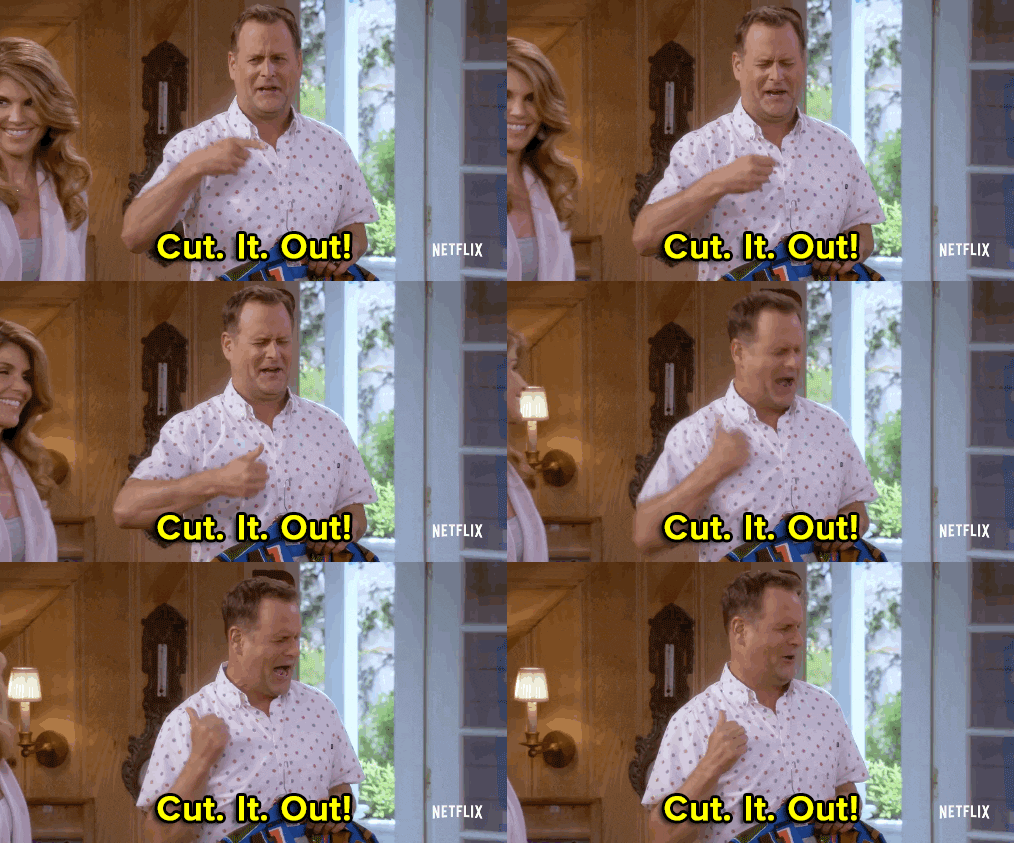
Every few months, the internet excavates a dormant relic of twentieth-century television and feeds it through the algorithmic woodchipper. This year, the collective gaze landed squarely on Dave Coulier’s three-part hand motion from the late 1980s. A three-second clip of Uncle Joey slicing two fingers together, pointing his thumb over his shoulder, and waving his open palm outward has evolved from an innocuous sitcom catchphrase into the undisputed visual shorthand for shutting down online absurdity.
The sudden explosion caught digital strategists off guard, though cultural critics saw the signs building late last year. As documented in The Cut Report, the modern media diet leans relentlessly on recycled millennial comfort viewing, creating an environment where vintage broadcast mannerisms quickly turn into weaponized irony. Within weeks, the gesture vaulted from forgotten rerun archives straight to the center of global short-form discourse.
📌 Quick Summary:
- The Spark: A chopped-and-screwed soundbite of Dave Coulier’s sitcom routine paired with deadpan reaction videos triggered over 450 million views on TikTok and Instagram Reels.
- The Mechanics: The combination of three distinct kinetic movements makes the clip visually stickier than standard reaction GIFs, turning it into a modular editing staple.
- The Cultural Shift: What began as wholesome family-friendly slapstick has been retooled by Gen Z creators as an icy, deadpan dismissal of corporate PR speak and bad internet takes.
From Nickelodeon Cable to Primetime Dominance
The phrase did not actually begin inside the painted Victorian walls of the Tanner household. Coulier developed the routine during his stand-up comedy sets in the early 1980s before bringing it to television on Nickelodeon’s chaotic sketch series Out of Control in 1984. When ABC cast him as Joey Gladstone in 1987, the producers encouraged Coulier to weave his personal stage bits into the show's scripts. The routine, scissors with the index and middle finger, thumb cocked over the shoulder, flat palm waved forward, became an inescapable playground staple between 1987 and 1995.
For roughly eight seasons, Coulier delivered variations of the line across 192 episodes. It was designed for eight-year-olds. It relied on rhythmic body language that worked even if the television volume was turned down low. That precise mechanical quality, originally built to capture the attention of Saturday-morning cartoon watchers, turned out to be the exact structural formula required to survive forty years later inside high-frequency smartphone feeds.
How TikTok Audio Remixed a Sitcom Relic
The modern resurgence bypasses television syndication entirely. In late 2025, an independent producer layered Coulier’s compressed 1989 vocal track over a distorted Jersey club beat, stripping away the live studio audience laughter. The isolated phrase, snappy, dry, and rhythmically abrupt, became an irresistible audio template for creators staging mundane interpersonal boundary checks.
By early 2026, the audio remix trend had detached itself from its origin story. Teenagers who had never watched an episode of broadcast television began recreating the precise physical sequence to mock awkward overshares, unsolicited career advice, and AI-generated recipe fails. The routine functions identically to older dismissal formats like "Bye Felicia" or facepalms, but Coulier’s rhythmic, tripartite motion offers higher visual retention than a static image or a silent shrug.
The Evolution of the Routine: Broadcast to Platform Native
Tracing the lifespan of this single joke reveals how digital culture reclaims physical comedy. Where nineteenth-century vaudeville routines traveled by road and twentieth-century bits traveled by network syndication, modern comedic physical ticks rely entirely on algorithmic velocity.
| Era & Timeframe | Primary Delivery Medium | Intended Social Function | Estimated Audience Scale |
|---|---|---|---|
| 1984, 1986 | Cable sketch TV (Nickelodeon) | Slapstick playground catchphrase | 1M, 3M households |
| 1987, 1995 | Primetime network TV (ABC) | Family-friendly commercial break cue | 14M, 17M live viewers weekly |
| 2012, 2020 | Web forums & Slack (Reaction GIFs) | Low-stakes workplace frustration marker | Tens of millions of GIF loads |
| 2025, 2026 | TikTok, Reels, YouTube Shorts | Deadpan conversational boundary setting | 450M+ combined algorithmic views |

Why the Visual Mechanics Outperform Other 90s Tropes
Most vintage one-liners fail to transition into algorithmic environments because they depend on narrative context. Steve Urkel's "Did I do that?" requires an escalating disaster scene. Bart Simpson's "Eat my shorts" carries dated rebellious slang. Coulier’s delivery, however, functions as pure choreography.
The sequence operates in three clean beats:
First comes the chop. Two fingers open and close horizontally across the chest, mimicking a pair of shears cutting through invisible fabric. Second comes the hinge: the hand forms a hitchhiker's thumb and tilts backward over the shoulder. Third comes the wipe: an open palm pushes outward toward the camera, flat and uncompromising. Because each gesture corresponds to a single spoken syllable ("Cut. It. Out."), mobile video creators can speed it up, slow it down, or split-screen it against complex visual essays without losing coherence.
Platform engineers design recommender algorithms to prioritize watch time and physical mimicry. When a user mimics a trending physical challenge, user engagement metrics surge. The routine requires zero props, zero makeup, and zero comedic timing experience. Anyone holding a smartphone can execute the three beats in two seconds flat.
Nostalgia Recycling in Modern Platform Economics
The reappearance of older media properties across digital platforms is rarely accidental. As entertainment conglomerates search for ways to monetize sprawling back-catalogs on streaming platforms, older IP is constantly mined for social engagement. Yet the resurgence of Coulier's gesture feels less like corporate marketing and more like folk archiving.
Coulier himself has re-entered public conversation recently, speaking openly about his health battles and appearing on long-form podcasts to reflect on the television industry. That renewed public presence naturally softened algorithmic resistance, allowing vintage clips to recirculate organically. When internet users encounter an earnest, wholesome bit of television from an era before mobile notifications existed, they adopt it not out of reverence for the original show, but as a form of conversational armor. The gesture offers a polite yet decisive way to say: enough.
Frequently Asked Questions (FAQ)
Where did the hand motion originally come from?
Dave Coulier invented the gesture during his stand-up comedy sets in Detroit and Los Angeles during the early 1980s. He brought it to national television on Nickelodeon's Out of Control in 1984 before turning it into a signature character trait on Full House in 1987.
Why is the clip suddenly everywhere on short-form video in 2026?
A viral audio edit combining Coulier's vocal delivery with a distorted bassline sparked a wave of reaction posts in late 2025. The three-beat physical gesture proved unusually effective at holding mobile viewer attention, pushing it deep into discovery feeds across TikTok, Instagram, and YouTube.
Does the modern meme require knowing the television show?
No. The vast majority of views and creator recreations treat the movement as an abstract social boundary cue rather than an explicit television reference. The routine has largely broken free from its broadcast origins, operating simply as kinetic internet slang.
The Staying Power of Kinetic Television Comedy
Internet trends cycle through public attention faster than ever, yet physical comedy from the multi-camera sitcom era repeatedly proves immune to decay. The revival of Dave Coulier’s routine shows that good physical gags outlast their original broadcast mediums. Stripped of laugh tracks, studio lighting, and network logos, a well-timed cut, point, and wave still delivers precisely what it promised in 1987: an unmistakable signal that the conversation is officially over.
