How the Rainbow Kiss Trend Resurfaced Online: A Complete Timeline of the Buzz

Every few months, a dusty corner of online subculture gets dredged up by social video algorithms, sparking millions of bewildered search queries and theatrical reaction videos. The term "rainbow kiss" is perhaps the most persistent example of this cycle. As documented in a recent Happy Mag Report detailing its latest online resurgence, the phrase represents a crossover between vintage shock-lexicon entries and contemporary algorithmic curiosity, driving spikes in traffic whenever a creator films themselves discovering the definition for the first time.
Behind the theatrical grimaces and TikTok comment wars lies a very specific sexual act that intersects taboos around period sex, fluid bonding, and internet sensationalism. Understanding why the term keeps returning requires separating its clinical realities and sexual health risks from the deliberate shock value that fuels social feeds.
📌 Key Takeaways:
- The Definition: A rainbow kiss refers to a sexual act where two partners engage in mutual oral sex during menstruation, retaining menstrual blood and semen in their mouths before kissing to blend the fluids.
- The Viral Driver: The phenomenon exploded not because millions suddenly adopted the practice, but because TikTok reaction formats turned lookups on Urban Dictionary into viral engagement bait.
- The Clinical Risk: Directly swapping blood and seminal fluids across oral mucous membranes carries elevated risks of STI transmission, including hepatitis B, hepatitis C, syphilis, and HIV.
Defining the Term: Semen, Menstrual Blood, and Oral Sex
At its core, the slang describes a choreographed encounter between a male partner and a menstruating female partner. The couple performs oral sex on each other simultaneously, typically in the 69 position. The male partner ingests or holds menstrual blood in his mouth, while the female partner holds his ejaculate. Immediately after climax, the partners kiss passionately, mixing the menstrual blood and semen between their mouths.
The visual contrast between red menstrual fluid and white semen gives the act its colorful moniker. While the name sounds playful, the actual description tends to provoke immediate visceral responses from general audiences unaccustomed to fluid play. In clinical and sex-positive communities, the act is recognized as a hyper-specific form of fluid bonding, an intimate practice where partners intentionally exchange bodily fluids as a demonstration of trust or kink preference.
For most internet users, however, the concept exists purely as an abstract curiosity. The act is far more frequently discussed, joked about, and searched than it is practiced in real bedrooms.
From 2000s Message Boards to Short-Form Video Feeds
The phrase did not originate on modern social networks. Early entries on crowdsourced platforms like Urban Dictionary date the term back to the early 2000s, where shock-slang compilations flourished alongside terms like "cleveland steamer" and "rusty trombone." In 2006, Scottish playwright Simon Farquhar even titled his Royal Court Theatre play Rainbow Kiss, leveraging the phrase's underground notoriety to frame an edgy, dark drama about contemporary urban alienation.
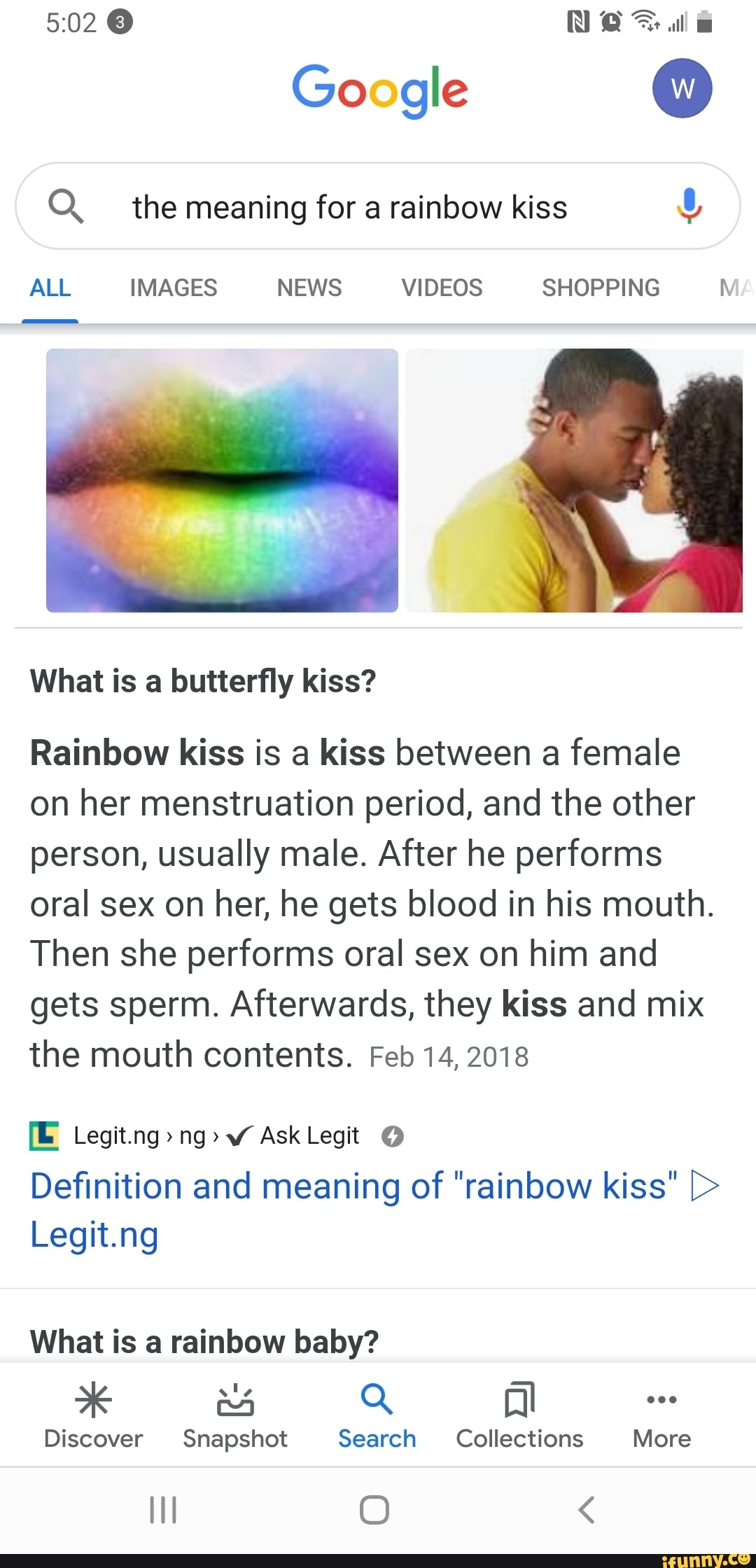
The phrase lay dormant in mainstream culture until the rise of short-form video algorithms. Around 2021, TikTok creators stumbled upon the concept as a formula for viral content: users recorded themselves reading the definition on their phones, hiding the screen while their facial expressions shifted from light amusement to unvarnished horror. The videos carried minimal captions, directing followers to "Google rainbow kiss and stitch this with your reaction."
The trend generated tens of millions of views across repeated cycles in 2022, 2023, and through 2026. The algorithm rewards retention and search referral; by deliberately withholding the definition in the video, creators forced viewers into search engines, triggering search engine spikes that news outlets and digital culture blogs routinely rush to explain.
The Evolution of Internet Shock Trends: A Digital Timeline
The persistence of the phrase illustrates how shock-value vocabulary travels from fringe forums to hyper-speed video feeds. Below is a breakdown of how the term migrated through mainstream internet culture over the past two decades.
| Timeframe | Primary Platform / Event | Cultural Driver & Impact |
|---|---|---|
| 2002, 2006 | Urban Dictionary & Indie Theatre | First recorded digital definitions; Simon Farquhar premieres his theatrical drama Rainbow Kiss in London. |
| 2012, 2018 | Reddit & Niche Sex-Positive Forums | Discussed intermittently within kink and fluid-bonding discussions; largely absent from mainstream media. |
| 2021, 2023 | TikTok & Instagram Reels | Explosion of "Google this term" reaction formats; billions of combined impressions drive international search volume. |
| 2024, 2026 | Lifestyle Publications & Explainer Outlets | Mainstream health reporters and sex educators address the clinical risks and myths created by viral reaction culture. |
Clinical Realities: Sexual Health Risks and Fluid Exposure
Stripping away the internet sensationalism leaves clear physiological realities. While period sex itself is completely natural and widely practiced, combining menstrual blood with semen inside the mouth and exchanging it presents concrete health variables that medical professionals emphasize.
The primary concern is the transmission of sexually transmitted infections (STIs). Mucous membranes lining the oral cavity, gums, and throat are vulnerable to microscopic tears, especially if individuals have gingivitis, ulcers, or recently brushed their teeth. Blood is one of the most efficient vectors for pathogen transfer. Exchanging menstrual blood orally creates an elevated pathway for bloodborne infections:
- Hepatitis B and Hepatitis C: Both viruses spread readily through blood-to-blood and blood-to-mucosa contact. Hepatitis B is exceptionally resilient and transmissible through body fluids.
- Human Immunodeficiency Virus (HIV): While oral transmission of HIV without blood is relatively low-risk, the direct presence of menstrual blood mixed with semen substantially increases exposure potential if a partner is detectable.
- Bacterial STIs: Syphilis, gonorrhea, and chlamydia can all colonize oral tissues. Syphilis chancres can easily develop on the tongue or lips following direct contact with infected bodily fluids.
- Human Papillomavirus (HPV) & HSV: Oral contact with active lesions or shedding viral particles can result in oral herpes or oral HPV strains.
Physicians emphasize that practicing this act requires complete transparency regarding STI panels. Standard barrier methods like external condoms and dental dams fundamentally contradict the physical objective of the act, making mutual testing the primary clinical safeguard available.
Fluid Bonding, Stigma, and Safe Sex Realities
The reaction videos dominating feeds often lean heavily on disgust, inadvertently reinforcing deep-seated stigmas around menstruation and female anatomy. Menstrual blood is neither toxic nor dirty; it consists of shedding endometrial lining, vaginal secretions, and blood. Many consenting couples navigate period sex without hesitation, using towels or taking to the shower to manage cleanup.
The divide between standard intimacy and acts like this centers on intentional fluid exchange. For the minority of partners who actively choose to engage in it, the motivation typically relates to kink, intense power dynamics, or total fluid bonding, a psychological milestone where partners reject physical barriers to share biological vulnerability. Engaging in fringe practices safely requires clear, sober communication:
Profiles where engagement requires extreme caution:
- Casual partners or non-monogamous relationships without updated, comprehensive lab results.
- Individuals with active oral lesions, bleeding gums, canker sores, or compromised immune systems.
- Situations where peer pressure, digital dares, or algorithmic challenges push either partner past their comfort zone.
Prerequisites for risk reduction:
- Recent, verified STI panels covering both bloodborne pathogens and mucosal swabs for both individuals.
- Explicit, pre-negotiated consent that allows either person to pause or discontinue the act without judgment.
- Rigorous sexual hygiene, including avoiding abrasive toothbrushing immediately prior to the encounter to minimize micro-tears in the mouth.
Why Internet Shock Culture Keeps Recycling Forbidden Tropes
The trajectory of this trend reveals how online media ecosystems function. Digital platforms operate on engagement metrics that privilege raw emotion. Disgust, shock, and curiosity are among the fastest drivers of user comments, shares, and watch time.
When creators frame an esoteric sexual practice as a forbidden mystery, they manufacture an algorithmic feedback loop. Viewers who search the phrase feel compelled to leave comments, which in turn signals to recommendation systems that the video is provocative and worthy of broader distribution. The reality, that only an infinitesimal fraction of the population ever attempts the act, is irrelevant to the algorithm. The spectacle of disgust generates value entirely on its own.
Frequently Asked Questions (FAQ)
Q1: Is a rainbow kiss safe to perform?
A1: It is not inherently toxic, but it carries high risks for STI transmission if either partner has an untreated infection. Because barriers like condoms or dental dams prevent the fluid exchange required by definition, it should only ever be considered by deeply committed partners who have verified negative STI screens and healthy, lesion-free oral tissues.
Q2: Does ingesting menstrual blood make you sick?
A2: Swallowing small amounts of one's own or a healthy partner's menstrual blood does not cause poisoning. However, consuming larger volumes of blood can cause stomach irritation or nausea due to its high iron content. The main health danger remains pathogen transmission rather than toxicity.
Q3: Why did this become a major trend on TikTok?
A3: The phenomenon gained traction through reaction videos where creators filmed themselves searching the definition on Urban Dictionary without explaining it. This curiosity gap forced viewers to search the term themselves, driving millions of searches and elevating the phrase back into global internet discourse.
Q4: How does it differ from standard period sex?
A4: Period sex involves typical penetrative, manual, or oral intimacy while one partner is menstruating. The slang describes a specific, deliberate sequence requiring simultaneous 69 oral sex, retention of both menstrual blood and semen in the mouth, and an exchange of those mixed fluids via kissing.
The Cultural Shelf Life of Algorithmic Shock
Internet trends built on shock value follow a predictable arc. An obscure term gets pulled from an online archive, algorithms turn human disgust into engagement currency, and the public scrambles to separate fact from hyperbole. While the viral frenzy paints the act as a widespread craze, the reality remains grounded in basic human behavior: it is a rare, niche kink that happens to serve as perfect fuel for the internet's ongoing obsession with the bizarre.
