How to Hold a Guitar Pick: Complete Step-by-Step Guide for Tone, Comfort, and Speed
Guitarists spend thousands of dollars auditioning boutique amplifiers and swapping out pickups, yet the primary contact point between the musician and the instrument remains a tiny piece of nylon, celluloid, or Delrin. How a player holds that small sliver of plastic dictates dynamic range, articulation, attack speed, and whether practicing for an hour ends in fluid progress or debilitating forearm cramping. As highlighted in the recent GuitarPlayer.com Report on beginner fundamentals, establishing a functional picking hand early prevents the technical plateaus that derail developing players years down the line.
A plectrum grip is never completely static. Elite players constantly modulate thumb pressure, tilt, and depth depending on whether they are digging into a rhythmic acoustic groove or navigating a sweep-picked arpeggio. Unlocking effortless speed and pure acoustic tone requires dissecting the biomechanics of the hand, eliminating involuntary tension, and letting physics do the heavy lifting.
📌 Key Takeaways:
- The Structural Foundation: Resting the plectrum along the lateral side of the index finger creates an immovable bridge beneath the thumb pad without straining joint tendons.
- Dynamic Tension: Clamping down causes pick rotation and hand fatigue; retaining roughly 30% to 40% resting grip pressure tension preserves wrist elasticity.
- Attack Geometry: Incorporating edge picking and a subtle pick slant angle eliminates string drag, converting raw mechanical effort into fluid alternate picking speed.
The Biomechanics of Finger Placement: Pad-to-Side Versus Pad-to-Pad
Most players who struggle with wandering picks share the same initial habit: pinch-gripping. They pinch the plectrum between the soft, fleshy pad of the thumb and the flat pad of the index finger. While intuitive, this pad-to-pad orientation creates an unstable pivot point. The meat of the fingertip compresses under string resistance, forcing the player to squeeze progressively harder to keep the pick upright. That reflexive squeeze tightens the flexor muscles in the forearm, destroying fluid wrist movement.
The gold standard among professional clinicians and session players is the pad-to-side plectrum grip technique.
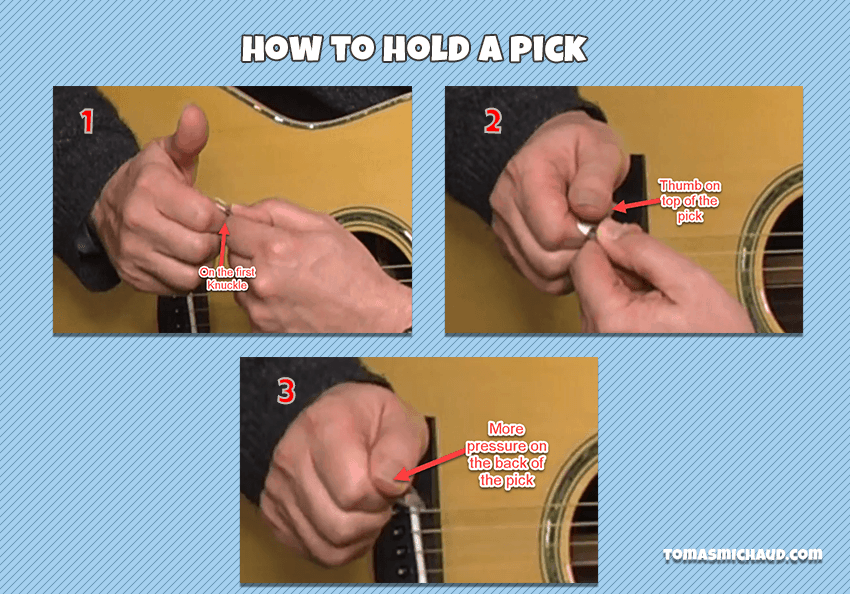
To set this position, curl the index finger naturally into a loose fist, as if resting the hand on a tabletop. Place the flat base of the pick against the outer, radial edge of the index finger’s top knuckle, roughly midway between the fingernail and the first joint. Lay the pad of the thumb flat across the top surface of the pick, creating a firm cross-shape with the index finger. The tip of the pick should protrude roughly 3 to 5 millimeters past the edge of the thumb.
This structural alignment rests the pick against bone support rather than spongy flesh. The thumb position acts as a securing clamp, while the index finger placement provides a rigid platform that absorbs string resistance without yielding. This mechanical lock allows the player to relax their grip, maintaining stability without clenching the hand into a rigid claw.
Solving Pick Rotation and Slip Without Stifling Tone
A pick that drifts, rotates, or flies across the room usually suffers from an overabundance of muscular tension, not a lack of it. When a pick strikes a steel string flat, the string pushes back against the leading edge. If the player clamps down to fight that push, sweat builds up, blood flow restricts, and the plastic slides along the skin like a bar of soap.
Hand fatigue prevention begins with micro-adjustments in grip pressure tension. On a scale of 1 to 10, where 1 is dropping the pick on the carpet and 10 is turning your knuckles white, aim for a resting pressure between 3 and 4. The pick should feel seated, not trapped.
When strumming or picking, the pick should yield slightly against the string, tilting backward on the downstroke and forward on the upstroke. This microscopic flex allows the plectrum to glide over string windings rather than crashing into them head-on.
Player communities on guitar forums frequently debate textured grips versus smooth celluloid. Materials featuring matte Delrin finishes, cross-hatch knurling, or raised logos can help players dealing with hyperhidrosis. However, material texture remains a secondary patch for poor biomechanics.
Relaxing the extrinsic hand muscles allows skin oils and natural friction to hold the pick in place. When the thumb is not starved of circulation by hard pinching, the skin maintains a natural tactile grip that prevents unwanted rotation.
Pick Slant Angle and Edge Picking for Rapid Alternate Strokes
Striking a string with the pick completely parallel to the fretboard creates maximum surface friction. The flat face of the pick collides with the string, catches on the wound edge, and forces the picking hand to exert disproportionate force to pull through. The result is a harsh, percussive click, followed by string drag that completely derails precision lead playing.
High-efficiency players rely on two interconnected angular adjustments: edge picking and pick slant angle.
Edge picking refers to rotating the pick slightly along its long axis so that the edge, rather than the flat face, strikes the string. Angling the pick between 15 and 30 degrees relative to the string creates a beveled ramp. The pick slices across the wire, generating a smoother acoustic envelope, a fatter fundamental tone, and vastly reduced string drag.
Pick slanting, by contrast, refers to tilting the body of the pick relative to the guitar's top soundboard:
- Downward Pickslanting: The top edge of the pick tilts toward the player's chin, allowing upstrokes to escape clean into the air above the strings.
- Upward Pickslanting: The top edge tilts toward the floor, permitting downstrokes to clear the string plane effortlessly.
Integrating edge picking with controlled slanting transforms alternate picking technique from a choppy chore into a frictionless slicing motion. Fast players do not move their hands faster; they simply eliminate the physical obstacles that slow the pick down.
| Plectrum Gauge Range | Optimal Grip Tension | Mechanical Behavior | Target Musical Application |
|---|---|---|---|
| Thin (0.46, 0.60 mm) | Light (2/10) | Pronounced material flex; bright snap; built-in natural compression. | Acoustic strumming control, broad rhythm backing. |
| Medium (0.70, 0.88 mm) | Moderate (3, 4/10) | Balanced spring-back; moderate dynamic headroom; mid-range presence. | Versatile pop/rock rhythm, moderate lead passages. |
| Heavy (1.00, 1.20 mm) | Calibrated (4, 5/10) | Zero material flex; high string transfer; rich bottom end; immediate response. | Precision lead playing, hard-rock tracking, jazz single-note clarity. |
| Extra Heavy (1.50, 2.50 mm+) | Firm yet relaxed (4/10) | Absolute rigidity; requires edge picking to avoid string stalls; fat tone. | High-speed metal tracking, gypsy jazz, modern technical prog. |

Wrist Rotation Versus Forearm Movement: Isolating the Picking Engine
A sound grip collapses if the wrong motor system drives the hand. In guitar biomechanics, the central debate focuses on wrist rotation vs forearm movement.
Many self-taught guitarists lock their wrist into a rigid block and swing their entire forearm from the elbow. This mechanic offers raw kinetic power, which works well for wide acoustic downstrokes or aggressive punk down-picking. For intricate single-note lines, however, elbow-driven picking introduces high inertia. The forearm is heavy, and reversing its direction 16 times a second at high tempos wastes energy.
The most efficient picking engines decouple the wrist from the elbow.
Hold the forearm stable over the lower bout of the guitar, anchoring lightly with the forearm flesh rather than the wrist joint. Drive the pick using wrist deviation, a side-to-side motion like waving goodbye, or forearm rotation, which mimics the twisting motion of turning a doorknob.
A mobile wrist delivers rapid directional shifts with minimal muscular effort. It also keeps the pick's depth of attack consistent across different strings, preventing "string-hopping," where a player jumps over strings instead of tracking through them.
Calibrating Pick Gauge Thickness Across Acoustic Strumming and Lead Lines
There is no single pick gauge thickness that serves every musical task equally. Players often lock themselves into arbitrary rules, assuming thicker picks automatically equal superior musicianship. In reality, pick gauge acts as an equalization filter and dynamic limiter.
For acoustic strumming control, picks in the 0.50 to 0.73 mm range act as mechanical shock absorbers. When sweeping across six heavy bronze strings, the pick gives way slightly on impact. This physical flex naturally balances the volume between the low E string and the treble strings, preventing the boominess that often plagues microphone recordings. The resulting acoustic sound is crisp, shimmering, and rhythmically consistent.
In contrast, single-note runs and tight alternate picking collapse beneath flexible picks. When a thin pick strikes a string at speed, it bends, pauses, and snaps back late. That split-second latency disconnects the player's brain from the physical string impact.
Switching to a gauge of 1.0 mm or thicker removes mechanical latency entirely. The point of the pick moves in direct, 1:1 synchronization with the hand, giving precision lead playing instant feedback and massive dynamic range.
Professional guitarists solve this split requirement by stocking their cases with multiple gauges. A studio session tracking double-tracked acoustic rhythms calls for an entirely different plectrum than an evening performance demanding rapid scalar runs.
Frequently Asked Questions (FAQ)
Q1: Why does my guitar pick keep rotating clockwise while I play?
A1: A rotating pick usually points to two mechanical culprits: a pad-to-pad grip that lacks lateral bone support, and striking the string flat instead of using edge picking. When the flat surface of the pick hits the string, the string forces the pick backward. Shifting the pick to the lateral side of the index finger and angling the pick edge roughly 20 degrees will immediately stop unwanted rotation.
Q2: Should my pinky and ring fingers be anchored against the guitar body or curled into a loose fist?
A2: Both approaches appear among elite guitarists, but curling the unused fingers loosely into the palm minimizes tension in the extensor tendons. If you prefer anchoring, lightly touch your pinky pad against the pickguard rather than planting it firmly. Heavy, rigid anchoring limits wrist mobility and causes tension to travel directly into the carpal tunnel.
Q3: How much of the pick point should stick out past my fingers?
A3: For single-note picking and technical lead runs, expose only 2 to 4 millimeters of the tip. Keeping the tip tucked close to the fingers improves spatial control and enables effortless pinch harmonics. For loose, full-chord acoustic strumming, expose 6 to 8 millimeters so the pick can glide across the strings without your thumb catching the wound wire.
Refining the Right Hand for Long-Term Mastery
Mastering the physical interaction between hand, plectrum, and string is an ongoing calibration rather than a one-time exercise. Muscle memory takes weeks to rewrite, especially for players who have relied on excessive grip tension or awkward pad-to-pad mechanics for years. The transition requires deliberate, slow practice with focused attention on the physical feedback of the right hand.
Begin each session by playing simple chromatic lines or open-string patterns with a metronome at half tempo. Watch your thumb knuckle to ensure it remains stable without locking backward into hyperextension. Pay close attention to the forearm flexors: if the muscles on the underside of your arm feel tight, stop, release your fingers, shake out the wrist, and reset your grip pressure tension to a light baseline.
Great guitar tone starts at the contact point. By trading rigid finger clamping for bone-supported alignment, leaning into edge picking, and selecting the right pick gauge for the musical task at hand, you free your technique to sound clear, fluid, and completely unhindered.
