How to Say 'De Nada' in English: The Ultimate 2026 Guide for Every Real-Life Situation

Spanish speakers stepping into international workplaces or casual English conversations quickly encounter an unexpected linguistic trap: translating "de nada" literally or relying entirely on "you're welcome." While textbook curricula still treat "you're welcome" as the universal counterpart, native English speakers use an expansive array of situational responses depending on age, hierarchy, and geography. As bilingual pop culture moments continue to dominate global media, highlighted in a recent Just Jared Report tracking how artists like Rosalía seamlessly bridge Spanish idiom nuances for English-speaking audiences, grasping natural conversational English idioms has never been more relevant.
Relying on a single canned phrase can inadvertently signal coldness, excessive formality, or generational friction. Choosing the right English translation for de nada requires decoding the implicit social contract between the person expressing gratitude and the person receiving it.
📌 Quick Summary:
- Core Equivalents: Standard textbook English defaults to "you're welcome," but casual speech leans heavily toward "no problem," "no worries," and "anytime."
- Workplace Nuance: Corporate settings in 2026 favor proactive, collaborative phrasing like "happy to help" and "my pleasure" over curt traditional replies.
- Generational Divide: Baby Boomers and older Gen Xers often view "no problem" as dismissive, whereas Millennials and Gen Z interpret "you're welcome" as passive-aggressive unless softened by vocal warmth.
Beyond "You're Welcome": The Modern Shift in Everyday English
For decades, non-native speakers learned that "de nada" translates cleanly to "you're welcome." Grammatically, it does. Pragmatically, the ground has shifted beneath our feet.
In contemporary American and British English, "you're welcome" carries distinct tonal weight. Said with a bright, open cadence, it remains polite. Delivered flatly or briskly, however, younger native speakers often hear it as an implicit assertion of credit: I did something burdensome for you, and you ought to acknowledge it.
Sociolinguists trace this friction to a fundamental divide in social etiquette. Traditional etiquette views a favor as an imposition that requires formal debt-clearing ("I welcome your thanks"). Modern conversational norms treat small favors as standard baseline behavior ("It was no effort at all"). Consequently, casual English responses designed to downplay effort have largely supplanted rigid textbook formulas in day-to-day encounters.
Everyday Casual Alternatives: "No Problem," "No Worries," and "Anytime"
When holding an elevator, passing the salt, or sending a quick file to a peer, native speakers deploy low-friction idioms that minimize the obligation:
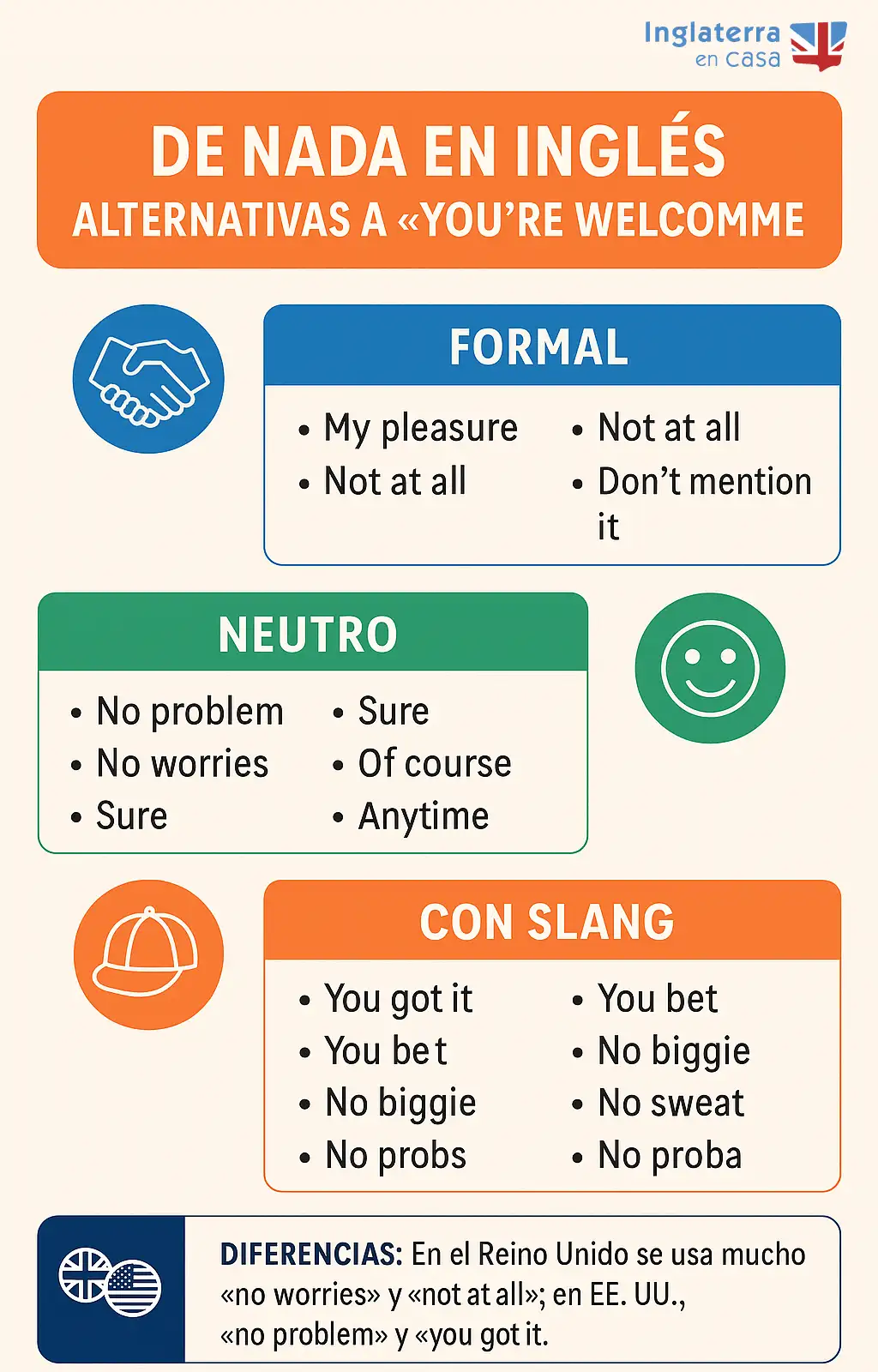
- "No problem": The default informal baseline across North America. It signals that your request caused zero disruption.
- "No worries": An Australian staple that has fully conquered the UK, Canada, and corporate tech hubs in the United States. It strikes an easygoing, friendly tone ideal for peer-to-peer exchanges.
- "Anytime": A warm, generous alternative that suggests genuine willingness to assist again in the future.
- "Don't mention it": A slightly older idiom that mirrors the Spanish "no hay de qué", effective when you want to brush off gratitude without sounding too slangy.
Context dictates effectiveness here. While a twenty-something barista will respond to your thanks with an instinctive "no problem," an executive assistant greeting a board director might choose a more deliberate phrasing.
Formal Workplace Etiquette: High-Value Alternatives for Executives and Clients
In client-facing emails, service industries, and professional workplace etiquette, casual phrasing can occasionally sound unpolished. Saying "no worries" to a client paying an enterprise retainer might unintentionally suggest that a problem was possible in the first place.
Professional settings require language that conveys competence, attentiveness, and mutual respect:
- "Happy to help": The undisputed champion of modern business correspondence. It frames your action as willing collaboration rather than a transactional burden.
- "My pleasure" (or "Pleasure"): The gold standard in luxury hospitality, client services, and executive leadership. It elevates the interaction by framing service as personal satisfaction.
- "Glad to be of assistance": Slightly more structured, fitting legal correspondence, government affairs, or formal customer support escalations.
- "Thank you": Counter-intuitively, reciprocating gratitude is often the strongest move in enterprise settings. If a client thanks you for completing a project phase, responding with "Thank you for your partnership on this" establishes peer-level equilibrium.
Contextual Framework: Matching the Response to the Relationship
Selecting the correct phrase requires weighing two variables: the social distance between speakers and the actual magnitude of the favor.
| English Phrase | Formality Tier | Ideal Social Context | Spanish Equivalent Nuance |
|---|---|---|---|
| You're welcome | Neutral / Formal | General use, elder conversations, ceremonies | De nada (estándar tradicional) |
| Happy to help | Professional / Collaborative | Slack, corporate email, cross-functional teams | Un placer ayudar / Con gusto |
| No problem / No worries | Informal / Social | Coffee shops, coworkers, casual encounters | No pasa nada / No hay problema |
| My pleasure | Formal / High-Touch | VIP clients, hospitality, personal favors | El gusto es mío / Es un placer |
| Anytime | Warm / Casual | Close colleagues, neighbors, friends | Cuando quieras / A la orden |
| Sure thing / Of course | Colloquial American | Fast exchanges, friendly peer requests | Faltaría más / ¡Claro! |
Tone of voice dictates perception. Even an impeccably chosen phrase falters if delivered without eye contact or with a clipped inflection.
Common Cross-Cultural Mistakes Spanish Speakers Make
Translating idiomatic politeness directly from Spanish often causes unintended confusion.
First, avoid translating "por nada" or "de nada" into literal English as "for nothing." While a Spanish speaker understands "por nada" as a polite minimization, saying "for nothing" in English is nonsensical and sounds like you are lamenting wasted effort.
Second, beware of over-apologizing when receiving thanks. In several Latin American regions, speakers respond to gratitude with "a ti" or "a usted" accompanied by a slight self-effacing gesture. In American or British boardrooms, simply say "happy to help" with a firm posture.
Third, recognize regional slang boundaries. While "cheers" functions as both "thank you" and "you're welcome" in London or Manchester, dropping "cheers" in a suburban Dallas diner will leave the server puzzled. Keep colloquial markers aligned with local geography.
Frequently Asked Questions (FAQ)
Q1: Is "you're welcome" considered rude now?
A1: No, it is not inherently rude, but its subtext has evolved. In modern informal speech, flatly stating "you're welcome" without a warm smile can sound rigid or self-satisfied. Adding enthusiasm, "You're very welcome!", or using "happy to help" eliminates any perceived edge.
Q2: What is the most polite way to say de nada in an email?
A2: "Happy to help" or "Glad I could assist" are the most effective options for professional email correspondence. For high-stakes executive or client messages, "My pleasure" works exceptionally well.
Q3: How do Australians and Britons say de nada?
A3: Australians overwhelmingly use "no worries" across both casual and professional environments. British speakers frequently use "no problem," "not at all," or an informal "cheers" depending on the setting.
Q4: Can I just nod or say "sure"?
A4: A quick "sure" or "sure thing" works perfectly for micro-interactions in the US, like holding a door or passing an item. In professional or formal situations, however, it can sound curt or indifferent.
Mastering Conversational Nuance in 2026
Fluency is measured not by how many grammar rules you recite, but by how accurately your words match the emotional tone of a room. Politeness remains a living social instrument. Moving past a one-size-fits-all approach to "de nada" allows your professional competence and personal warmth to register clearly, ensuring nothing is lost in translation.
