How to Tell When Salmon Is Perfectly Done: Visual Cues and Temp Tests

Overcooking salmon remains one of the most common kitchen errors. A fillet transitions from silky and succulent to dry, fibrous cardboard in ninety seconds. Much of this chronic overcooking stems from confusing advice: home cooks are caught between rigid government safety bulletins and the conflicting recommendations of professional chefs. In an extensive culinary survey highlighting this friction, a Simply Recipes Report consulted professional kitchen leaders who converged on strict thermal boundaries for oven-roasted fillets, demonstrating that precision, not guesswork, preserves delicate seafood texture.
Mastering the finish requires combining thermal science with close sensory observation. You must track internal heat with reliable tools while learning to recognize the visual changes in muscle fibers and surface fats.
📌 Key Takeaways:
- The Temperature Divide: The official USDA food safety guideline 145°F guarantees zero pathogen risk, yet culinary professionals almost universally pull salmon between 120°F and 125°F for a silky, moist interior.
- The Albumin Warning: Heavy white albumin protein seepage indicates excessive heat that squeezes moisture out of the muscle fibers.
- Thermal Inertia: Salmon continues cooking off the pan; removing fillets 5°F below your target temperature accounts for the inevitable carryover cooking effect.
The Great Temperature Debate: Federal Guidelines vs. Kitchen Reality
The standard USDA food safety guideline 145°F was established as an absolute safety threshold to eliminate foodborne pathogens such as Listeria monocytogenes and common parasites. At 145°F, fish protein is completely safe from a regulatory standpoint. It is also completely dry. By the time muscle tissue hits that threshold, moisture has escaped, the collagen matrix has collapsed, and the fish flakes into chalky crumbs.
Professional line cooks operate under a different standard. Most restaurant kitchens target medium-rare doneness 125°F for thick fillets, frequently pulling wild fish off the heat at 120°F. At 120°F to 125°F, salmon retains its structural moisture, displaying a translucent, tender core that yields under gentle pressure.
Salmon carries delicate proteins. Muscle fibers contract as internal heat rises, acting like a sponge being squeezed. Up to 120°F, proteins begin to denature without violently ejecting water. Beyond 135°F, muscle contraction accelerates rapidly, forcing cellular water out onto the baking sheet. If you purchase high-grade, commercially frozen fish, where deep-freezing kills parasites, cooking to culinary doneness rather than regulatory maximums provides a superior balance of safety and texture. Those using wild-caught, previously unfrozen fish or cooking for immunocompromised diners should remain closer to official recommendations.
Taking the Measure: How to Probe with an Instant-Read Digital Food Thermometer
Eyeballing a fillet rarely yields consistent results. Ambient kitchen heat, pan conductivity, and fillet thickness create too many variables. An instant-read digital food thermometer remains the only reliable tool for determining internal doneness.
CORRECT PROBE PLACEMENT:
Fillet Surface
=========================================== <-- Skin / Bottom
\ /
\ [Thermal] /
Probe --------> Core <----/ Probe enters from the side
\ /
==================
Technique matters as much as the instrument itself. Inserting a probe vertically into the top of the fillet often causes errors; thin cuts mean the probe tip easily punches through the center and reads the hot surface of the pan. Instead, insert the probe horizontally through the side, aiming directly for the thickest part of the fillet.
Keep the sensor seated in the exact thermal core. Push the probe slightly past the center, then draw it back slowly, monitoring the digital readout. The lowest temperature recorded is your true core heat. Pull pan-seared or baked fillets off the heat source once the digital screen reads 120°F for wild fish or 125°F for rich farmed cuts.
Species Matter: Farmed Atlantic Salmon vs. Wild Alaskan Sockeye
A single cooking rule cannot govern every variety of salmon. Fat content dictates heat tolerance, and species vary significantly in their lipid profiles.
Farmed Atlantic salmon fat content averages between 12% and 15% by weight. This rich intramuscular fat insulates the meat, providing a generous margin for error. Even when taken slightly past 130°F, farmed Atlantic fillets stay relatively juicy because melting lipids lubricate the muscle fibers.
Wild species require a much lighter touch. Wild Alaskan sockeye temperature must be monitored vigilantly because sockeye, coho, and pink salmon are lean, muscular fish built for endurance swimming. Sockeye contains roughly 5% to 7% fat. Cook a sockeye fillet to 140°F, and its lean protein strands knot into dense, parched flakes. Wild salmon performs best pulled from heat at 118°F to 122°F, relying on ambient warmth to ease the center toward an unctuous medium-rare.
| Variety | Average Fat Profile | Pull Temperature (Off Heat) | Resting Peak Target |
|---|---|---|---|
| Wild Sockeye / Coho | Low, Moderate (4%, 7%) | 118°F, 122°F | 125°F (Medium-Rare) |
| Farmed Atlantic | High (12%, 16%) | 125°F, 128°F | 132°F, 135°F (Medium) |
| Wild King (Chinook) | Very High (11%, 14%) | 122°F, 125°F | 130°F (Medium-Rare to Medium) |
| USDA Standard Target | Any | 140°F, 142°F | 145°F (Well-Done) |
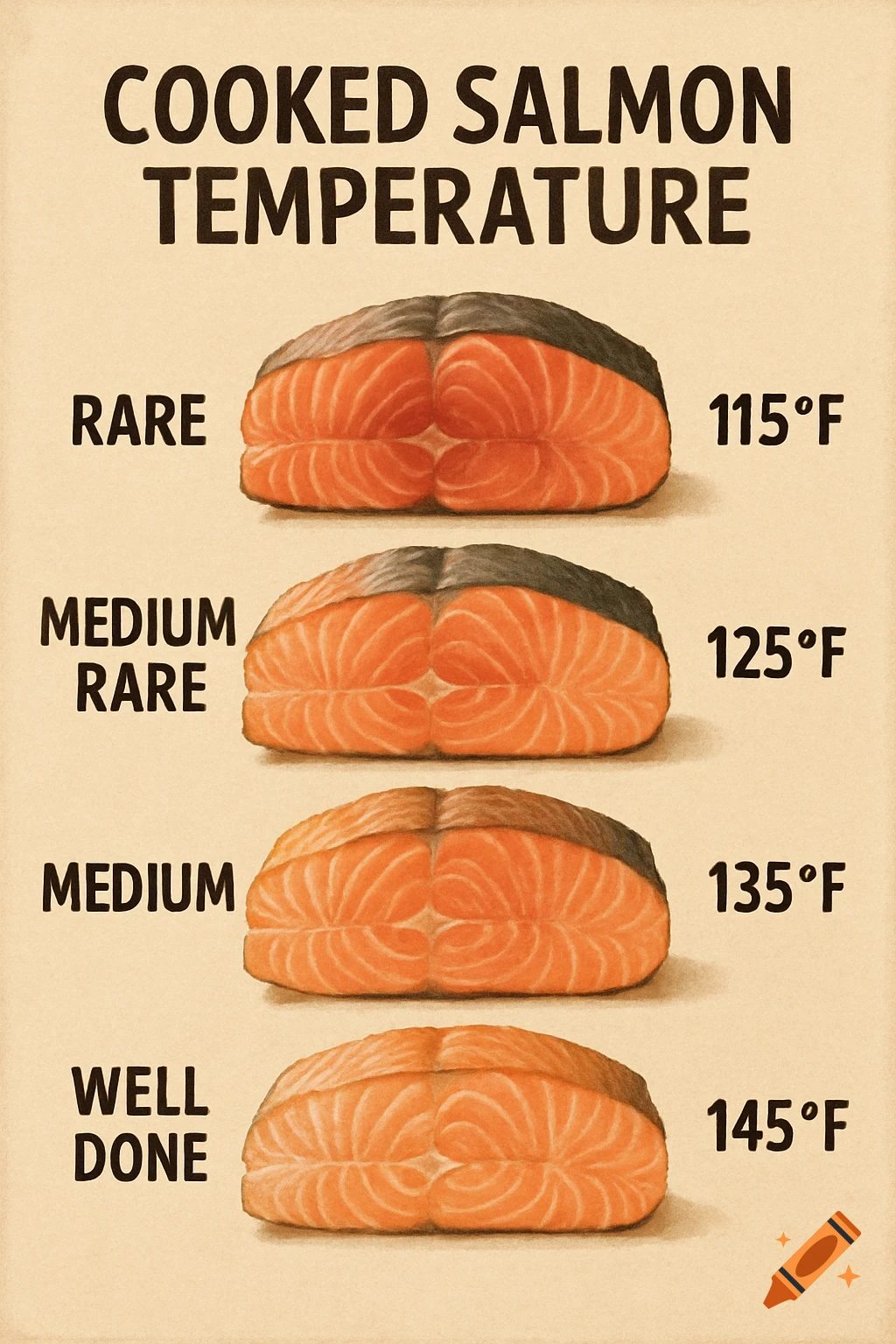
Reading the Pan: Fish Doneness Visual Cues and White Albumin Seepage
You do not always need a thermometer in hand to read the stage of your cook. Watching surface changes reveals clear details about heat penetration.
THE VISUAL SPECTRUM:
RAW MEDIUM-RARE OVERCOOKED
Deep translucent --> Soft pink exterior / --> Opaque, dull exterior
core, tight meat Translucent center Heavy white curds (Albumin)
The appearance of white albumin protein seepage provides immediate feedback. Albumin is a completely harmless, soluble liquid protein suspended inside raw fish tissue. As heat intensifies, muscle fibers contract violently and force this liquid toward the surface. When it contacts air and surface heat, it coagulates into an opaque white curd.
A few small beads of albumin around the edges are normal. Heavy pools of white curd spreading across the baking sheet indicate thermal distress: the heat was applied too fast, or the fish is overcooking.
To double-check doneness without a probe, use the flakiness fork test. Press the back of a fork or the pad of your clean finger onto the top center of the fillet. The fish should yield with gentle elasticity. If the individual muscle flakes separate cleanly along their white connective sheets, the fish is done. If the flesh feels mushy and resists separation, it needs more time. If it cracks open stiffly and feels dry to the touch, it has cooked past its prime.
Other reliable fish doneness visual cues include checking the side profile of the fillet. Heat travels from the pan up toward the top. The exterior pink opacity should creep roughly three-quarters of the way up the sides, leaving a thin ribbon of deeper, semi-translucent color running through the center.
Thermal Momentum: Oven Baking Temperatures and the Resting Window
Heat does not instantly vanish when fish leaves the pan. Ignoring kinetic heat after pulling the fillet often turns a well-timed cook into a dry dinner.
High-heat cooking methods, such as pan-searing on cast iron or roasting at a standard oven baking temperature of 400°F to 425°F, build considerable thermal energy in the outer layers of the fish. When removed from the heat source, that surface energy migrates inward toward the cooler core. This carryover cooking effect typically raises the center temperature by an additional 4°F to 8°F over several minutes.
CARRYOVER COOKING HEAT MAP:
Cooking (400°F Oven): [Hot Exterior (160°F)] ---> [Core (122°F)]
Resting on Board: [Cooling Outer (135°F)] ===> [Core Closes At (128°F)]
If you leave salmon in the oven until the thermometer reads 135°F, carryover momentum will push the final interior past 140°F before you take the first bite.
Factoring in a brief resting time before serving is vital. Allow fillets to rest undisturbed on a warm plate or cutting board for three to four minutes. This rest lets carryover heat gently finish cooking the center while the contracted muscle proteins relax, drawing escaping juices back into the cellular structure.
Frequently Asked Questions (FAQ)
Q1: Is it safe to eat salmon cooked to 125°F?
A1: For healthy adults consuming commercially sourced salmon, cooking to 125°F provides minimal risk while preserving texture. Commercial freezing kills common parasites like Anisakis. However, the USDA strictly advises high-risk groups, including pregnant individuals and those with compromised immune systems, to reach 145°F.
Q2: Why does salmon release so much white residue when baked?
A2: That white residue is albumin, an internal protein. It gets forced out when salmon cooks too quickly at high temperatures or stays in the heat too long. Brining fillets in a 5% salt-water solution for ten minutes before cooking minimizes this reaction.
Q3: Does using the flakiness fork test ruin the presentation?
A3: If done aggressively, yes. Instead of digging into the center, apply light downward pressure on the thickest ridge of the fillet with the flat tines of a fork. The muscle layers will cleanly slip along natural seam lines if ready, without tearing the meat.
Precision Over Habit in Modern Seafood Cooking
Ditching chalky salmon comes down to managing temperature rather than relying on arbitrary timer alerts. The difference between an uninspired meal and a restaurant-grade dinner is just a ten-degree window. Modern home cooking favors precision tools over guesswork. Keeping a digital probe nearby, understanding the fat differences between wild and farmed fish, and honoring the resting window gives you complete control over your results. Target the proper core heat, watch the surface cues, and pull the fillet before the pan turns moisture into steam.
