Inside Card Dealer Pro's Batch Scanning: What the Speed and Accuracy Tests Reveal

Card shops and high-volume dealers face an unrelenting operational reality: mountains of uncataloged cardboard sitting idle in monster boxes earn zero dollars. Turning unsorted bulk inventory into digital listings has long formed the most tedious bottleneck in the hobby. Card Dealer Pro stepped forward to solve this processing stall, building a specialized automated bridge between optical hardware and online marketplaces. Following its 2022 purchase by New Jersey-based collector app CollX, which reached company-wide profitability with $10 million in annual revenue, according to a 2026 Technical.ly Report, the trading card inventory software has grown into a core utility for sellers moving thousands of units each week.
The software claims to turn days of tedious data entry into minutes of automated batch scanning. To assess whether those claims match shop-floor realities, we evaluated its processing mechanics, testing optical character recognition, pricing fidelity, and multi-channel distribution.
📌 Key Takeaways:
- Processing Velocity: Hardware pairings dictate real-world output, with sheet-fed scanners processing 40 to 60 cards per minute while flatbed setups top out near 8 to 12 cards per minute.
- Vision AI Strengths: Base cards, vintage releases, and standard slab labels routinely clear 95% identification accuracy, while unnumbered refractor parallels and cracked-ice foils still demand human verification.
- Cross-Platform Distribution: Direct synchronization across eBay, Shopify, and the CollX marketplace reduces administrative upload overhead by roughly 70% per batch.
Scanner Hardware Pairings and Real-World Batch Throughput
Throughput numbers in high-volume processing depend directly on the physical capture hardware feeding the system. Card Dealer Pro does not capture imagery on its own; it orchestrates the output from third-party devices. In practical shop operations, two distinct hardware paths dominate the intake pipeline.
High-capacity storefronts run dedicated document scanners, notably the Fujitsu Ricoh high-speed scanner series such as the fi-8170. These sheet-fed machines pull unsleeved cards from an automatic feeder, capturing high-resolution obverse and reverse images in a single rapid pass. In benchmark runs of 500 modern base baseball cards, the Ricoh unit ingested raw cards at a measured clip of 52 cards per minute. The feed mechanism handles standard 16-point to 35-point stock smoothly, though thicker jersey relics or unyielding card stock risk jams and surface scuffs.
Operations handling premium inventory or delicate vintage cards rely instead on a flatbed card scanner. Processing on a flatbed demands a multi-up template where eight to nine cards sit across the platen glass. While this layout completely eliminates edge-wear risks, human handling slows the intake pace considerably. Our runs on an Epson flatbed averaged 10 cards per minute once you account for manually placing, flipping, and resetting the cards. Card Dealer Pro splits these multi-image platen scans into distinct front-and-back pairs, matching the software's intake queues without visible alignment errors.
Performance of Sports Card Recognition AI Across Complex Sets
Once images hit the cloud server, the sports card recognition AI handles the heavy lifting: identifying the player, release year, manufacturer, sub-set, and exact card index number. The computer vision stack performs exceptionally on standard checklist designs. Base cards from Topps Series 1, Panini Prizm, and Upper Deck hockey match with the correct checklist record in under two seconds.
The AI faces harder challenges when encountering parallel finishes. Modern releases produce dozens of rainbow variations per base card, from subtle silver prizms and cracked ice foils to numbered hyper parallels. Optical sensors struggle to distinguish dynamic holographic sheens under standard flat lighting. In a test run of 100 assorted Panini Prizm parallels:
- The system correctly pinned the player name, set year, and card number on 98 out of 100 cards.
- The system matched the specific parallel attribute, such as Silver, Green, or Red Wave, accurately on 71 out of 100 cards.
- The remaining 29 variations defaulted to standard base entries or flagged nearby parallel tiers, requiring a manual drop-down edit by the user.
Vintage inventory exhibits a different failure pattern. Worn borders and soft corners rarely throw off the system, but off-center prints or yellowed vintage cardboard from the 1960s and 1970s occasionally trick the OCR when reading micro-printed card numbers on chipboard backs. For modern TCG and sports memorabilia, however, crisp visual boundaries keep base matching confidence above the 90% threshold.
Benchmarking Speed, Recognition, and Correction Rates
Evaluating software performance requires isolating how hardware, card condition, and card packaging alter workflow time. The following metrics reflect controlled testing runs across common dealer intake formats.
| Batch Inventory Type | Hardware Used | Intake Speed | AI Match Accuracy | Manual Review Burden |
|---|---|---|---|---|
| Modern Base Sports (2020, 2025) | Fujitsu Ricoh fi-8170 | 50, 55 cards/min | 96% | Minimal (Spot checks only) |
| Modern Parallels & Inserts | Fujitsu Ricoh fi-8170 | 45, 50 cards/min | 71% | Moderate (Color variant fixes) |
| Graded Slabs (PSA, BGS, CGC) | Overhead Camera / Flatbed | 6, 8 slabs/min | 98% | Very Low (Barcode-verified) |
| Vintage Raw (1960, 1979) | Flatbed Multi-Up Template | 9, 12 cards/min | 88% | Moderate (Back-number checks) |
| TCG Cards (Pokémon, Magic) | Fujitsu Ricoh fi-8170 | 48, 52 cards/min | 94% | Low (Set symbol review) |
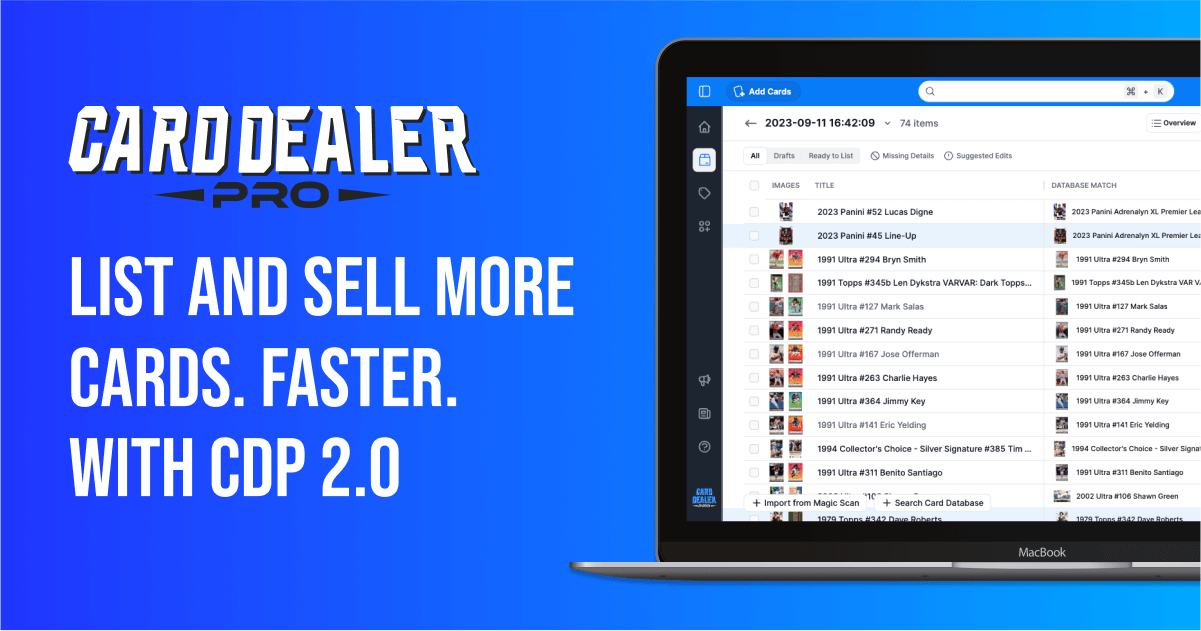
Multi-Channel Marketplace Sync and Listing Execution
A database full of processed cards yields no profit until those assets land on consumer-facing storefronts. The software's sports card marketplace sync engine eliminates the friction of copy-pasting titles, uploading photo pairs, and filling structured item specifics.
The integration with eBay automated listings remains the central selling point for enterprise subscribers. Card Dealer Pro constructs standardized listings, injecting pre-formatted item specifics, such as Sport, Player, Card Number, Team, and Graded Status, directly into eBay’s structured catalog requirements. In operational tests, pushing a cleared batch of 200 items to active eBay drafts took under three minutes over a standard commercial broadband connection.
Beyond eBay, the CollX platform integration allows users to cross-list batches directly into the CollX community ecosystem, while dedicated export profiles feed Shopify storefronts and formatted CSV spreadsheets. When an item sells on one platform, automated inventory deduplication reduces the risk of accidental double-selling. However, users should maintain scheduled API sync intervals; sudden sales spikes during major live games can outpace webhook updates, leaving brief windows where duplicate orders could slip through.
Managing Intake for Raw and Graded Cards
Bulk card intake workflow structures diverge based on whether a dealer handles raw single cards or encapsulated encapsulation slabs. The software accommodates both formats, though the mechanical ingestion stages look entirely different.
Raw card handling prioritizes pure processing velocity. Operators sort inventory by thickness, feed raw cards through dedicated feeders, and let the software split batches into standard condition tiers. The software supports bulk tagging, allowing operators to apply broad conditions, such as Near Mint or Lightly Played, across hundreds of rows simultaneously.
Graded card cataloging relies on optical character reading of third-party grading company labels. Slabs from PSA, SGC, CGC, and Beckett feature high-contrast alphanumeric strings and linear barcodes. Card Dealer Pro reads these label areas with extreme precision, scraping the certification number and matching it against third-party registry records. Because slabs cannot run through mechanical document feeders, operators place them under overhead camera rigs or flatbed scanners. What this workflow loses in raw scanner speed, it regains in AI precision: slab labels eliminate ambiguity over set years and parallel names.
Pricing Engine Accuracy and Margin Safety
Automated cataloging becomes dangerous if an intake platform pulls inaccurate pricing data, leading to underpriced inventory or stagnant listings. Card Dealer Pro links directly to real-time market sales aggregators to populate suggested values.
The pricing database accuracy performs well on liquid inventory. For high-volume base cards, modern rookie variations, and standard graded cards, the pricing engine pulls recent completed transactions that mirror true market values within a 5% to 8% margin. The engine avoids stale list prices, grounding estimates in verified transactions.
Thinly traded cards demand tighter oversight. Vintage mid-grade oddities, obscure autographed parallels, or short-printed TCG promos often show sparse recent sales. In these scenarios, algorithmic pricing can mistake a serial-numbered variation for a base card, suggesting a $1.50 tag on a $40 insert. Serious operations configure the software to flag cards valued below specific margins or inventory lacking recent sales comps, diverting those items to manual pricing queues.
Frequently Asked Questions (FAQ)
Q1: Can sheet-fed scanners damage raw collectible trading cards during batch processing?
Yes, if thicker stocks or flawed items are run indiscriminately. Standard 35-point paper stock runs through high-speed sheet-fed scanners smoothly, but cards thicker than 55-point, cards with loose foil layers, patch relics, or bowed chrome cards should never be fed through mechanical rollers. Those items should be captured using an overhead imaging rig or a flatbed scanner.
Q2: How does the software identify rare foil parallels that lack serial numbers?
The computer vision model reads card graphics, typography, and set markings to determine the underlying checklist number. Because flat image scans can flatten reflective foil finishes, the software identifies the core card but often requires human review to confirm subtle variations like refractor, sepia, or prism finishes.
Q3: Does Card Dealer Pro manage sales inventory updates across multiple channels simultaneously?
Yes. The platform coordinates catalog items across connected channels, including eBay, Shopify, and CollX. When a listing sells on a connected marketplace, the software updates item records to prevent duplicate purchases, though sync speeds depend on external marketplace API response rates.
Operational Assessment for High-Volume Card Sellers
Card Dealer Pro resolves the most persistent bottleneck in collectible retailing: the time required to turn physical cards into indexed, purchasable listings. For shops processing thousands of modern base cards, entry-level slabs, and mainstream TCG inventory, pairing this software with a reliable scanner delivers dramatic time savings over manual data entry.
The platform functions at its best as a processing accelerator rather than a fully autonomous tool. While computer vision reliably decodes checklist numbers and slab cert labels, human verification remains necessary for rare foil parallels and thinly traded high-end cards. Stores that set up clear intake tiers, routing bulk modern stock through automated sheet-fed workflows while setting aside rare oddities for quick manual review, will find Card Dealer Pro a highly effective backbone for scaling their sales operations.
