Is a #7 Guard Too Long for a Real Buzz Cut? Clipper Guard Measurements and Barber Realities

Is a #7 Guard Really a Buzz Cut? The Barber Truth on Lengths
Walking into a barbershop and asking for a "number 7 buzz cut" often earns a slight pause from an experienced cutter. Traditional military buzz cuts strip hair down to the bone, exposing skin and defining cranial geometry through stark minimalism. Yet modern men increasingly request high-number clipper attachments to capture the effortless reputation of an all-over buzz without shaving down to raw scalp. The tension lies in the measurement itself: clipper attachments do not simply shorten hair; they alter its structural behavior.
As barber analysis documented in the Man of Many Report shows, classical buzz styles peak at guard #4 before transitioning into entirely different silhouettes. When actor Connor Storrie stepped out with his sharp 2026 cropped haircut, a style change that immediately sparked viral fan discussion on Page Six, the public debate over where a tight crop ends and an actual buzz begins returned to center stage. Deciding whether the #7 clipper guard works for your aesthetic requires understanding clipper geometry, hair physics, and the visual mechanics of head shape.
📌 Key Takeaways:
- Physical Length: A #7 clipper guard leaves exactly 7/8 inch (22.2 mm) of hair, placing it well beyond the technical threshold of a traditional military buzz cut.
- The Silhouette Problem: Running a #7 guard uniformly over the entire head produces an unflattering, rounded "tennis ball" shape unless paired with a clean taper fade or scissor finishing.
- Density Dependency: Men with fine, straight hair will see soft separation at 7/8 inch, while coarse or curly hair creates significant bulk that mimics a short crew cut rather than a cropped buzz.
- The Golden Rule: Barbers treat the #7 as a foundational top length for modern textured fades rather than a true one-guard, all-over buzz cut.
The Mechanics of the #7 Guard and True Hair Length
Clipper guards follow an eighth-of-an-inch grading system across dominant manufacturing brands like Wahl, Andis, and Oster. The #7 clipper guard translates directly to 7/8 inch hair length, or roughly 22.2 millimeters. In isolation, that number seems modest. On a human skull, however, nearly an inch of growth fundamentally changes how individual strands interact.
A traditional induction cut relies on a #0 or #1 guard (1.5 mm to 3 mm), ensuring hair stands rigid and perpendicular to the follicle. At that microscopic stage, hair has zero structural flex. Once hair extends past a #4 guard (1/2 inch or 12.7 mm), gravity and strand weight take control. Hair begins to bend, curl, or lay flat against adjacent follicles.
Because standard Wahl guard sizes place the #7 just one step below the largest everyday attachment (the 1-inch #8 guard), calling this length a "buzz cut" stretches technical definitions to their breaking point. The electric clipper provides mechanical uniformity across the crown, but the resulting head of hair behaves like short scissor work. Scalp visibility drops to zero across nearly all hair types, completely eliminating the stark, high-contrast aesthetic that defines classic military crops.
Buzz Cut or Crew Cut? The Structural Boundary
The debate surrounding the 7 guard buzz cut centers on silhouette. A classic buzz cut maintains uniform shortness, emphasizing skull architecture, jawlines, and facial symmetry. In contrast, a crew cut introduces purposeful contrast: longer hair resting on the crown that gradually tapers into short, clean sides.
A uniform #7 cut sits awkwardly between these two styles. Because the hair measures nearly an inch long all over, the head loses angular definition. The skull appears spherical, creating an unintentional helmet effect often described by master barbers as the "fuzzy tennis ball" profile.
When you ask for a #7 guard all over, you receive a mechanized version of an unshaped crew cut. True low maintenance haircut appeal comes from intentional weight removal. The #7 guard provides length retention, but without calibrated tapering around the parietal ridge, the look quickly appears unkempt rather than deliberately minimalist.
| Guard Number | Length (Inches / mm) | Scalp Visibility | Styling Classification |
|---|---|---|---|
| #1 Guard | 1/8 in (3.2 mm) | High | Induction / Military Buzz |
| #2 Guard | 1/4 in (6.4 mm) | Moderate | Standard Butch Cut |
| #3, #4 Guards | 3/8 in to 1/2 in (9.5, 12.7 mm) | Low to None | Brush Cut / Long Buzz |
| #5, #6 Guards | 5/8 in to 3/4 in (15.9, 19.1 mm) | None | Short Ivy League / Crop Top |
| #7 Guard | 7/8 in (22.2 mm) | Zero | Textured Crop / Long Crew Base |
| #8 Guard | 1.0 in (25.4 mm) | Zero | Short Scissor Equivalent |
Rescuing the Cut: Fades, Tapers, and Edge Geometry
A single clipper guard running across the whole head rarely produces runway-ready results above a #4. To make a #7 guard look intentional, barbers convert it into a buzz cut fade or a modern textured crop.
The secret lies in the perimeter. Leaving 7/8 inch of length on the top while carving out a sharp skin taper down the temple points and neck creates structural tension. The eye reads the cut as clean, tight, and crisp, even though substantial hair remains up top.
Barbers utilize three specific adjustments to refine a #7 top:
- By dropping down to bare skin around the neckline and sideburns, the barber grounds the cut, keeping ears and collar areas sharp.
- Point Cutting on the Surface: A pure clipper cut leaves raw, flat blunt ends. Running shear tips through the dry 7/8 inch top creates a textured buzz cut that accepts styling powder or matte clay.
- C-Cup and Lineup Definition: Without a clean temple lineup, long buzz cuts blend indistinctly into facial hair. Crisp outlines give 7/8-inch hair the visual sharpness normally exclusive to shorter cuts.
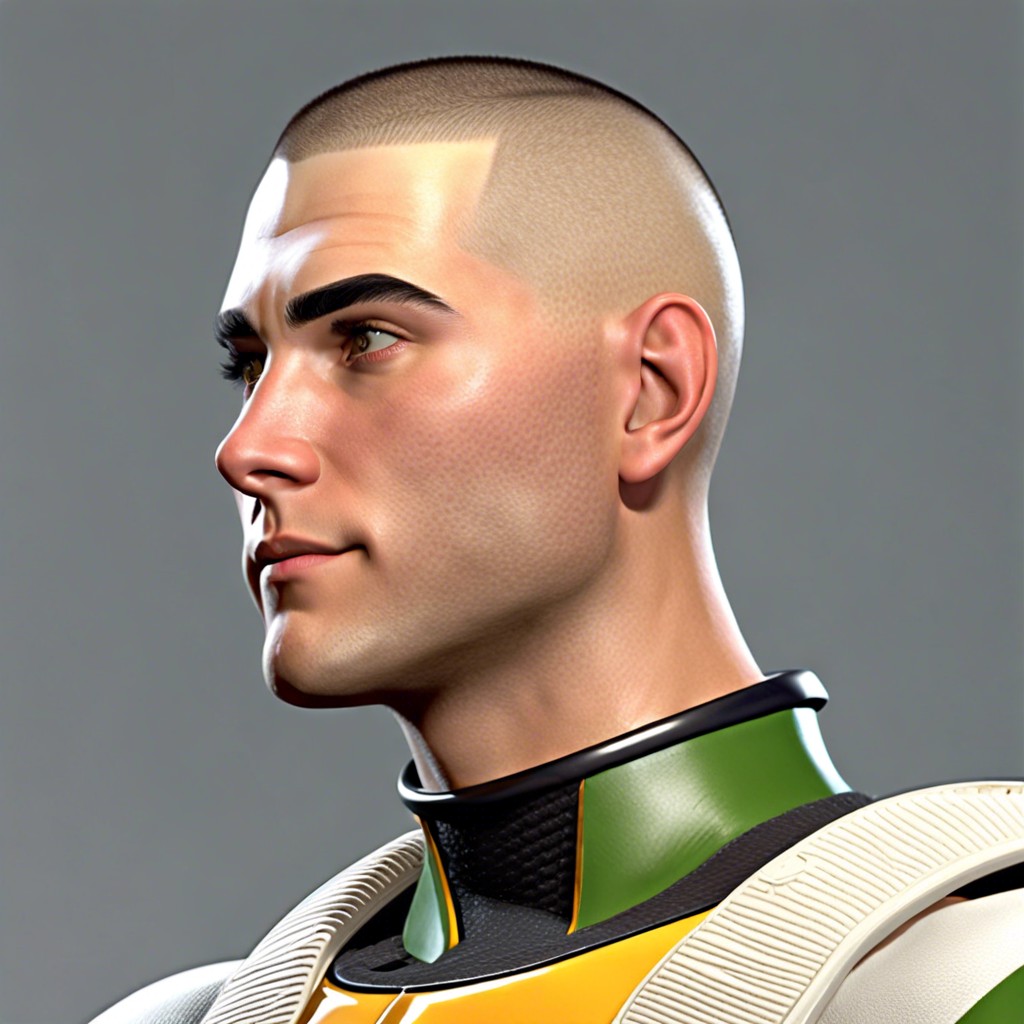
Hair Density and Texture Realities
The #7 guard behaves radically depending on follicle count and natural strand curl. You cannot predict the outcome of this haircut through measurements alone; hair density dictates how that 22.2 mm of growth sits against your head.
Men with straight, fine hair encounter directional drift. At 7/8 inch, fine hair does not have the rigidity to stand up, nor does it have enough weight to lie flat smoothly. It often parts unintentionally or separates in cowlicks. For fine hair, dropping down to a #4 or #5 guard yields a significantly cleaner profile.
For men with coarse, tightly coiled, or thick Afro-textured hair, the #7 guard functions as a short, sculpted afro base. The natural curl keeps the hair upright, creating density without droop. The barber can clip the top with the #7 against the grain, then blend the temples with a drop fade for an exceptionally clean, architectural finish.
If your crown features severe double cowlicks or thinning patches, the #7 guard requires caution. It provides enough length to highlight erratic growth patterns while lacking the weight needed to comb over thinning areas, occasionally accentuating sparse spots rather than concealing them.
What to Tell Your Barber Instead of Ordering an All-Over 7
If your goal is effortless grooming without exposing your scalp, ordering an "all-over #7" at the shop is the wrong move. Communicating your intended silhouette prevents the dreaded rounded head shape.
Start by specifying that you want the #7 clipper guard on top only. Request that your barber run the clipper with the grain along the back crown to prevent the hair from sticking straight up where the skull curves down. Next, choose a contrasting side profile: a #2 to #4 guard on the sides provides a subtle, conservative corporate blend, while a skin taper fade delivers modern athletic contrast.
Ask the barber to evaluate your hairline before cutting. If you have a receding hairline, a blunt #7 edge on top can create a heavy ridge that makes recession look more pronounced. In those scenarios, seasoned barbers typically recommend reducing down to a uniform #3 or #4, which harmonizes the density between the temples and the top of your head.
Frequently Asked Questions (FAQ)
Q1: Can I successfully give myself a #7 buzz cut at home?
A1: You can run a #7 guard over your own head using consumer clippers, but the results often look uneven. Because the teeth on large guards are long and flexible, clippers easily miss hairs that lie flat. You will need multiple passes in alternating directions, followed by careful hand-held mirror work to clean the neck and ears.
Q2: Does a #7 clipper guard qualify as low-maintenance?
A2: Yes and no. It eliminates the need for blow dryers, brushes, and heavy pomades. However, because 7/8 inch hair has enough length to show bedhead and erratic growth, you will need a quick splash of water and a dab of matte paste or texturizing dust every morning to keep it presentable.
Q3: How fast will a #7 guard cut grow out of shape?
A3: Human hair grows approximately 0.5 inches (12.7 mm) per month. Within two to three weeks, a #7 guard cut reaches 1.25 inches, crossing completely out of buzz cut territory and entering unstyled scissor-length territory. To keep the sides neat, you will need edge cleanups every 14 days.
The True Place of the #7 Guard in Men's Grooming
The #7 clipper guard is not an authentic buzz cut in the military or athletic tradition. It is a transitional clipper length that provides safety for men stepping away from medium-length hair who want simplicity without the shock of an exposed scalp.
Treating the #7 guard as a tool for uniform buzz cuts ignores the fundamental laws of hair weight and head shape. It achieves its best expression as the textured summit of a well-executed taper fade, offering practical speed, zero scalp exposure, and just enough length to give your hair dimension. When executed with deliberate perimeter fading and intentional texturing, it provides the clean practicality men seek, even if the barber catalog calls it something entirely different.
