Is the Square Root of 7 Rational or Irrational? Fact-Checking Common Math Myths
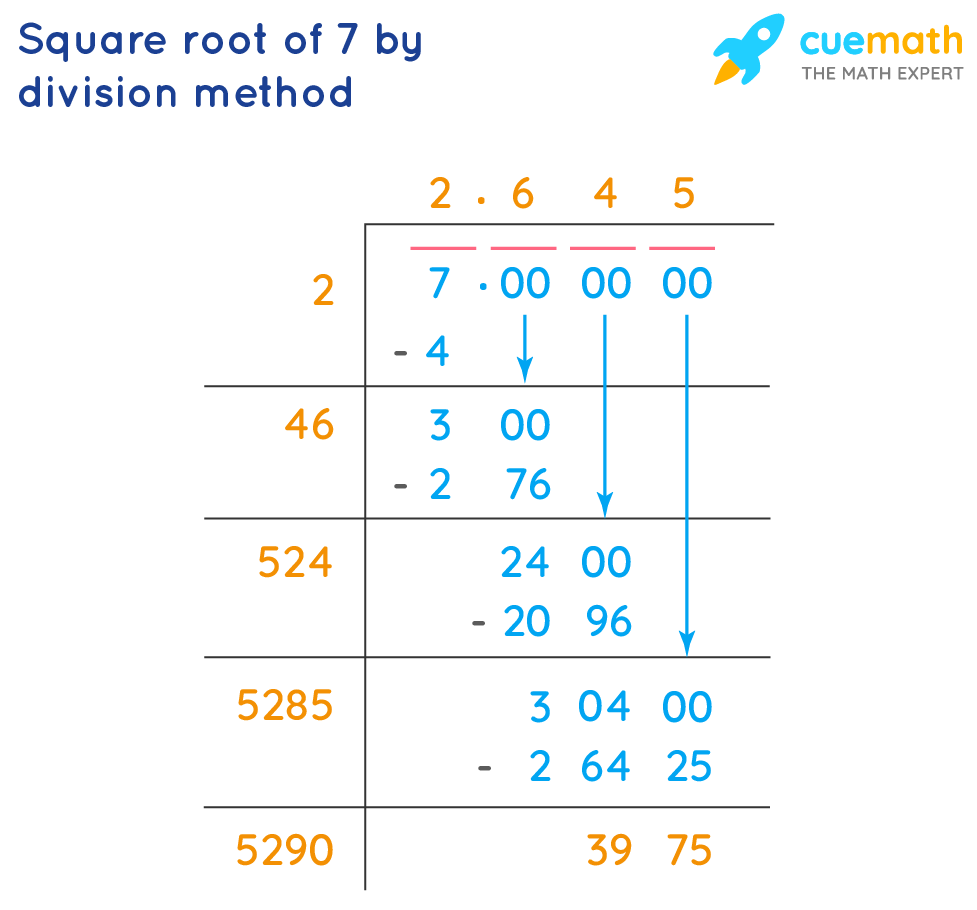
Every semester, forum discussions on Reddit and math communities across Stack Exchange revive an old debate: can the square root of 7 be expressed as an exact fraction, or is it fundamentally impossible? Algorithmic queries on the number spike routinely across search networks, even as everyday local updates like the community fitness launch documented in the Osprey Observer Report briefly share index weight alongside root-related search terms. Yet beyond linguistic overlap lies an enduring mathematical query that tests how people understand arithmetic fundamentals.
The short answer is unambiguous: the square root of 7 is definitively irrational. It cannot be written as a ratio of two integers, its decimal string never ends, and it never settles into a repeating loop. Despite this reality, online claims persist that obscure mathematical tricks or cutting-edge computing can turn it into a finite decimal. Dissecting the formal proof, manual calculations, and modern hardware algorithms reveals why those claims fall apart.
📌 Key Takeaways:
- The Core Verdict: The square root of 7 is an irrational, non-terminating decimal that cannot be reduced to a simple fraction.
- The Proof Mechanism: An indirect contradiction proof using Euclid's lemma confirms that squaring any hypothetical fraction $a/b$ leads to a logical impossibility.
- Modern Calculation: Truncated to 4 decimal places, the value of root 7 is 2.6458, generated across digital architectures via iterative square root algorithms.
Radical Form of 7 and Why It Resists Simplification
In standard algebra, writing the number as $\sqrt{7}$ represents the radical form of 7. Within the classification of surds and radicals, a surd is an expression containing an irrational root of an integer. Because 7 is a prime number, it has no square factors other than 1. You cannot pull out a factor to simplify it the way $\sqrt{8}$ becomes $2\sqrt{2}$ or $\sqrt{12}$ becomes $2\sqrt{3}$. It stands as a simplified radical in its purest state.
The number also belongs to the family of algebraic numbers. An algebraic number is any real or complex value that serves as a solution to a non-zero polynomial equation with integer coefficients. For $\sqrt{7}$, that equation is simple:
$$x^2 - 7 = 0$$
Because this polynomial has integer coefficients (1 and -7), $\sqrt{7}$ is strictly algebraic, unlike transcendental numbers such as $\pi$ or $e$. It occupies a distinct middle ground in number theory: impossible to pin down as a fraction, yet tightly anchored to polynomial mechanics.
The Rigorous Proof: Euclid's Contradiction Applied to Root 7
The mathematical consensus rests on a proof by contradiction, a technique dating back to ancient Greece. To test if $\sqrt{7}$ could ever be rational, mathematicians assume the opposite and see where logic breaks.
Assume $\sqrt{7}$ is rational. If true, it must equal an irreducible fraction $a/b$, where $a$ and $b$ are integers with no common factors other than 1 ($gcd(a, b) = 1$), and $b \neq 0$:
$$\sqrt{7} = \frac{a}{b}$$
Squaring both sides removes the radical:
$$7 = \frac{a^2}{b^2} \implies a^2 = 7b^2$$
This equation proves that $a^2$ is a multiple of 7. Under Euclid's lemma, if a prime number divides a square integer, it must also divide the integer itself. Therefore, 7 divides $a$. We can now rewrite $a$ as $7k$, where $k$ is an integer. Substituting this back into the formula yields:
$$(7k)^2 = 7b^2 \implies 49k^2 = 7b^2 \implies b^2 = 7k^2$$
Now $b^2$ is also a multiple of 7, which means 7 must divide $b$ as well. This creates a fatal contradiction: both $a$ and $b$ share 7 as a common factor, directly violating our original condition that $a/b$ was fully simplified. Because the premise collapses, $\sqrt{7}$ cannot be rational. The irrational number proof holds across all number systems.
Decimal Form Precision: Comparing Classical and Modern Algorithms
Expressed as an ongoing sequence, the square root of 7 in decimal form begins as 2.64575131106459... and stretches into infinity. Because it is a non-terminating decimal with no periodic cadence, engineers and computational systems must rely on numerical approximation methods to handle it practically. The root 7 value to 4 decimal places rounds to 2.6458.
Over centuries, the methods used to compute these digits have evolved from ink-on-paper calculations to silicon hardware pipelines. In 2022, research published in Nature detailed novel seed generation and quadrature-based square rooting algorithms, illustrating how computational science continues to refine precision scaling for high-performance processors.
| Method | Core Mechanism | Convergence Speed | Primary Use Case |
|---|---|---|---|
| Manual Long Division | Digit-by-digit root extraction via binomial expansion | Linear (1 digit per step) | Classroom pedagogy, manual verification |
| Newton-Raphson | Iterative tangent line calculation: $x_{n+1} = \frac{1}{2}(x_n + \frac{7}{x_n})$ | Quadratic (doubles correct digits per loop) | Standard floating-point software engines |
| Quadrature Seed Algorithms | Optimized lookup seeds with quadrature-based correction | Cubic or higher acceleration | Modern GPU and DSP arithmetic microcode |
For quick mental estimations, the linear approximation method around the nearest perfect square ($4$ or $9$) offers immediate clarity. Because 7 sits between $2^2 = 4$ and $3^2 = 9$, the value must lie between 2 and 3. Testing halfway, $2.5^2 = 6.25$, placing $\sqrt{7}$ comfortably above 2.6.
Calculating Root 7 by Hand Using the Long Division Method
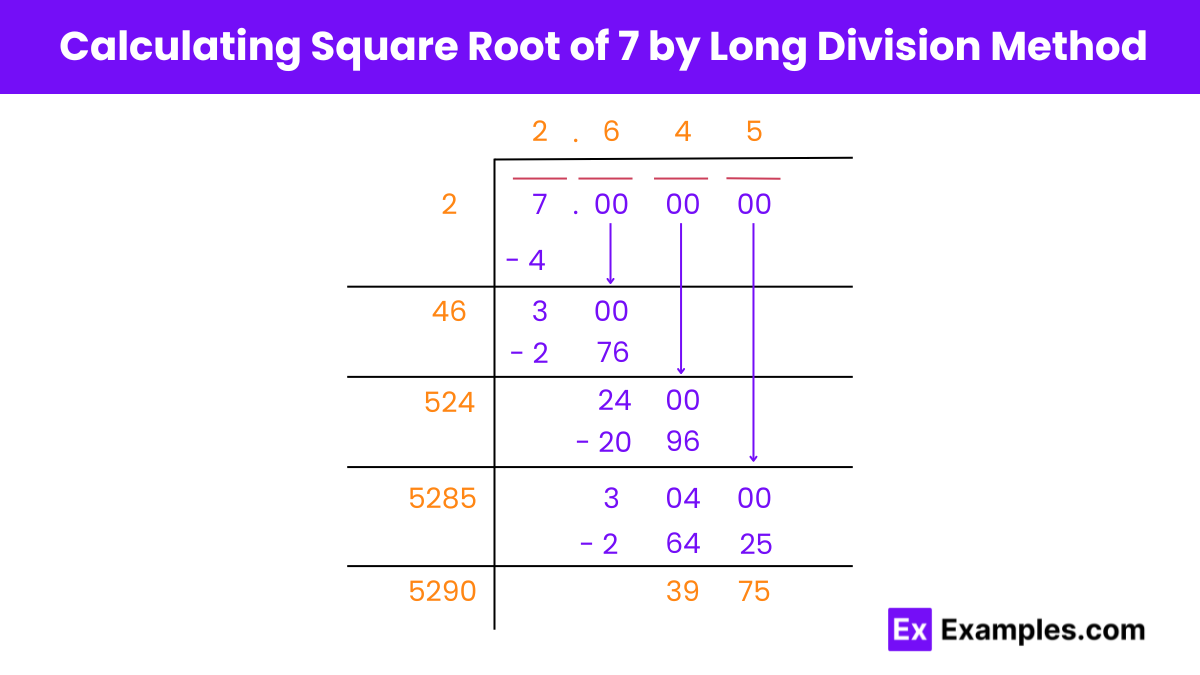
Before microprocessors existed, the long division method square root was the gold standard for manual precision. It extracts exact decimal digits one by one without guesswork.
To compute $\sqrt{7.000000}$ manually:
- Group the digits: Pair numbers starting from the decimal point: 7 . 00 00 00.
- Find the initial integer: Identify the largest whole square less than or equal to 7. That number is 2 ($2^2 = 4$). Place 2 in the quotient and subtract 4 from 7, leaving a remainder of 3.
- Bring down the first pair: Bring down 00 to turn the working dividend into 300.
- Double the running root: Take the current quotient (2), double it to get 4, and set up the slot: $(40 + x) \times x \le 300$.
- Solve for $x$: Choosing $x = 6$ gives $46 \times 6 = 276$. (Choosing 7 yields 329, which exceeds 300). Write 6 after the decimal point. Subtract 276 from 300, leaving 24.
- Repeat the process: Bring down the next pair 00, creating 2400. Double the entire quotient 26 to get 52. Solve $(520 + y) \times y \le 2400$. Here, $y = 4$ works ($524 \times 4 = 2096$).
Continuing this mechanical process confirms 2.6457... step by step. Each iteration demonstrates why the sequence never falls into a periodic cycle; the evolving divisor grows larger while the remainders fluctuate without pattern.
Debunking Computational Myths: Floating-Point Drift and Rational Traps
The belief that $\sqrt{7}$ might be rational usually stems from three widespread misunderstandings encountered in school and software engineering:
Myth 1: "Calculators show it ends at 10 digits."
When a handheld calculator displays 2.645751311, it does not mean the number terminates. It simply means the display hardware has run out of registers. The internal register truncates the irrational sequence to avoid infinite calculation loops.
Myth 2: "Fractions like 185/70 equal the square root of 7."
Fractions like $185/70$ (or roughly $2.6428$) and $537/203$ (roughly $2.6453$) are rational approximations. When squared, $185/70$ produces $6.9846$, falling short of 7. No fraction constructed from integers will ever square to exactly 7.
Myth 3: "Modern AI or supercomputers will find a repeating sequence eventually."
This misconception treats irrationality as an unsolved computational riddle rather than a settled mathematical law. Proofs by contradiction are absolute. A supercomputer running for a billion years can calculate billions of digits of $\sqrt{7}$, but it will never encounter a recurring block, because an infinite repeating decimal is mathematically identical to a rational fraction.
Frequently Asked Questions (FAQ)
Q1: What is the exact value of root 7?
The exact mathematical value is written simply as $\sqrt{7}$. It cannot be written precisely in base-10 numerical digits because its decimal expansion runs infinitely without repeating.
Q2: Why is the square root of 7 considered a surd?
It is considered a surd because 7 is a whole number that is not a perfect square, meaning its root results in an irrational number that cannot be reduced further into integers or simple fractions.
Q3: How does IEEE 754 floating-point handle the square root of 7?
In computing systems using standard 64-bit double-precision floating-point format (IEEE 754), $\sqrt{7}$ is stored as a 53-bit significand. This gives roughly 15 to 17 significant decimal digits of precision, introducing tiny round-off errors in intensive scientific simulations.
Computational Significance of Surds
The irrationality of the square root of 7 provides clear boundaries for numerical analysis and computational science. Whether programming hardware accelerators using quadrature methods or testing computer algebra engines, treating $\sqrt{7}$ as an irreducible symbol preserves mathematical truth where finite decimal approximations fail.
Understanding why $\sqrt{7}$ cannot be rational clarifies the fundamental architecture of the real number line. It serves as a reminder that numbers do not exist merely to serve clean decimal displays; some of the most essential values in algebra remain intentionally, beautifully infinite.
