Is 'Treacherous' a Legal Charge or Just an Insult? Fact-Checking the Word Behind Political Clashes
Political leaders and commentators sling the word "treacherous" across cable panels and campaign podiums with calculated fury. In 2026 congressional debates over leaked defense memos, diplomatic compromises, and intra-party revolts, the label functions as a rhetorical hand grenade. It sounds like an indictment. Yet beneath the theater lies a sharp divide between statutory jurisprudence and political hyperbole. While casual speakers use the word to describe someone deceitful and untrustworthy, legal frameworks tell a different story. In continental criminal law, as documented in the Wikipedia (en) Report on statutory homicide doctrines, treacherous conduct (Heimtücke, or killing by stealth) is an explicit qualifying element that elevates an unlawful killing to murder.
Understanding how a single word oscillates between a common insult, an environmental warning, and an aggravating factor in capital murder prevents rhetorical manipulation from passing as established fact.
📌 Key Takeaways:
- The Linguistic Boundary: The dictionary definition covers two distinct territories: physical hazards (unstable ice, deceptive currents) and moral violations involving an overt breach of trust.
- The Legal Architecture: In American jurisprudence, "treachery" is not an independent chargeable offense; in civilian penal codes, however, treacherous actions denote premeditated killings executed while exploiting an unsuspecting victim.
- The Political Conflation: Partisan debates routinely confuse personal perfidious behavior with constitutional treason, applying a quasi-legal sheen to what is merely standard political dissent.
The Split Personality of 'Treacherous' in English Usage
The root of the word traces back through Old French trichor (a deceiver) to the Latin notion of tripping or ensnaring someone through guile. In contemporary English, the adjective operates along two distinct tracks.
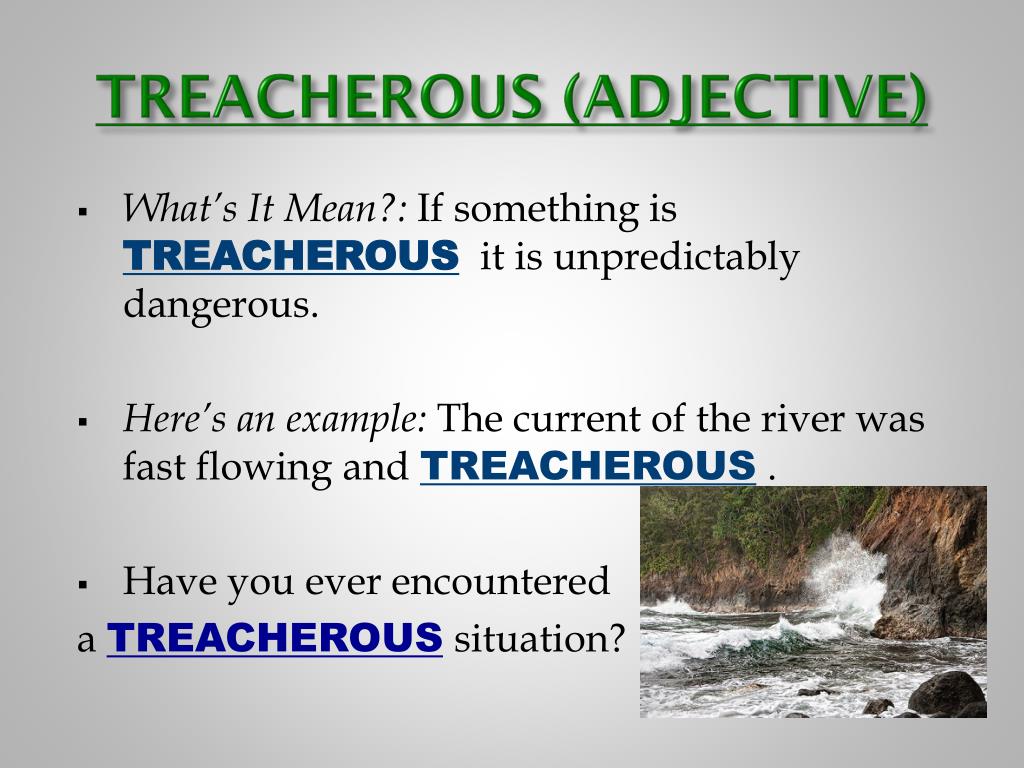
The first track describes physical environments that appear safe but conceal fatal risks. A frozen lake masked by fresh powder, a highway coated with black ice, or an offshore rip current are routinely described as hazardous conditions that turn treacherous. The defining element is not merely danger. A raging forest fire is lethal, but nobody calls it treacherous; the flames announce themselves openly. A calm sheet of river ice that collapses under 150 pounds of weight is treacherous because it projects safety while delivering peril.
The second track governs human relationships and institutional conduct. Here, the word requires betrayal. A stranger who robs a commuter on a subway platform acts violently, but not treacherously. The mugger made no prior pledge of loyalty. Treachery emerges only when an established bond, sworn allegiance, kinship, or professional duty, is weaponized to lower someone's defenses. It demands malice and deception operating under the protective disguise of fidelity.
Treachery Versus Treason: Why Cable News Blurs the Boundaries
Political discourse frequently treats "treacherous" and "treasonous" as interchangeable synonyms. They are not.
Treason carries an exceptionally narrow, constitutional definition in the United States. Under Article III, Section 3 of the U.S. Constitution, treason against the United States consists only in levying war against them, or in adhering to their enemies, giving them aid and comfort. It requires the testimony of two witnesses to the same overt act, or a confession in open court. It is the only crime defined directly within the text of the Constitution, intentionally framed with restrictive guardrails to prevent incumbent presidents from executing political rivals.
Treachery, by contrast, is an ethical designation. A senator who breaks a caucus vote after promising fidelity has committed political treachery. A corporate executive who sells proprietary software architecture to a non-adversary competitor commits corporate espionage or a breach of fiduciary duty. Neither has committed statutory treason. When pundits label domestic political dissent as treacherous, they deliberately borrow the gravitas of a capital crime without meeting any evidentiary burden.
| Concept | Primary Application | Governing Framework | Required Threshold |
|---|---|---|---|
| Treachery | Interpersonal, institutional, or physical betrayal | Lexical & Moral Norms | Luring a party into vulnerability through false trust |
| Treason | State sovereignty and national allegiance | U.S. Constitution (Art. III) / Federal Statute | War against the state or aid to an official enemy |
| Heimtücke (Murder) | Substantive criminal law (Civil Law Tradition) | German Penal Code (§ 211 StGB) | Concealed intent exploiting the victim's defenselessness |
| Perfidy | Armed conflict & law of war | Geneva Conventions (Protocol I) | Feigning protected status (e.g., surrender) to kill or injure |
Killing by Stealth: How Criminal Law Encodes the Treacherous Act
The treacherous legal meaning reaches its most rigorous expression within continental legal systems. Unlike common law systems that split unlawful homicide into degrees based primarily on general premeditation, civil law jurisdictions use specific behavioral indicators.
Under Section 211 of the German Criminal Code, an offender is guilty of murder rather than manslaughter if they kill through specific enumerated characteristics (Mordmerkmale). Chief among these is Heimtücke, translated into international legal analysis as killing "treacherously" or "by stealth."
German appellate jurisprudence defines this standard through a dual test: the victim must be unsuspecting (arglos) and, as a direct consequence, defenseless (wehrlos). If an assailant serves poisoned soup to a partner at breakfast, the crime falls squarely into this category. The victim suspected nothing due to domestic intimacy, lowering their natural self-preservation mechanisms. Conversely, an open street brawl where both parties exchange threats rarely qualifies, even if one combatant pulls a hidden knife midway through the fight; the mutual combat eliminated the condition of pure, unsuspecting peace.
Historical legal definitions in English common law mirrored this focus on stealth. The ancient concept of petit treason penalised a subordinate who murdered their superior, a servant killing an employer, or a wife killing her husband. The underlying offense was not merely the loss of human life. It was the catastrophic disruption of the social compact, executed under the shelter of assumed submission.

Perfidious Acts and Wartime Conventions
International humanitarian law sharpens these distinctions further when regulating armed conflict. Article 37 of the 1977 Additional Protocol I to the Geneva Conventions directly outlaws perfidious behavior, establishing clear boundaries between acceptable ruses of war and actionable war crimes.
Ruses of war are lawful. Military commanders routinely deploy camouflage, decoys, dummy artillery installations, and deliberate misinformation to mislead opponents. Deception alone does not violate the laws of armed combat.
Perfidy crosses into war crimes by exploiting legal protections. Article 37 prohibits acts inviting the confidence of an adversary to lead him to believe that he is entitled to, or is obliged to accord, protection under the rules of international law, with intent to betray that confidence. Common violations include:
- Feigning surrender under a white flag to draw enemy units into an open ambush.
- Concealing combatants or munitions inside ambulances bearing the Red Cross, Red Crescent, or Red Crystal insignia.
- Wearing civilian dress or neutral United Nations uniforms while executing offensive military strikes.
Combatants rely on these symbols for humanitarian survival. When an armed force misuses them, they poison future encounters, guaranteeing that future adversaries will shoot surrendering soldiers or shell humanitarian convoys out of self-defense. That systemic destruction of trust is the core mechanics of perfidious conduct.
Choosing the Right Word: Synonyms and Semantic Precision
Precision matters in investigative reporting and everyday speech. Lumping every hostile action under the banner of treachery flattens critical differences in motivation, relationship, and legal liability.
Synonym Matrix: Nuances of Untrustworthiness
──────────────────────────────────────────────────────────
Perfidious → Deliberate, conscious breach of a formal pledge.
Insidious → Danger that advances gradually, unnoticed until lethal.
Faithless → Apathetic failure to honor obligations or oaths.
Disloyal → Active abandonment of an allegiance for another cause.
Treacherous → Hidden, active malice operating behind a veil of safety.
──────────────────────────────────────────────────────────
If an intelligence contractor defects to a foreign power out of ideological sympathy, the action is disloyal. If an engineer knowingly builds a hidden backdoor into encrypted voting infrastructure while presenting the code as hardened, the conduct is treacherous. One constitutes an exit from an alliance; the other exploits the alliance to sabotage it from within.
Frequently Asked Questions (FAQ)
Can a citizen be charged with the standalone crime of "treachery" in the United States?
No. There is no statutory crime titled "treachery" in federal or state penal codes. Prosecutors bring charges based on specific statutory actions: treason, espionage, perjury, wire fraud, or first-degree murder involving stealth or ambush.
What is the difference between an insidious threat and a treacherous condition?
An insidious threat spreads invisibly over time before symptoms appear, such as radiation poisoning or systemic corporate corruption. A treacherous condition presents an immediate physical hazard disguised as safe ground, like a structurally compromised bridge that appears freshly paved.
Why do defense attorneys dispute the "treacherous killing" classification in European courts?
Because establishing *Heimtücke* (killing by stealth) automatically elevates a homicide to murder, removing judicial discretion to hand down a reduced manslaughter sentence. Defense lawyers routinely argue that previous arguments, domestic strife, or threats meant the victim was not truly unsuspecting (*arglos*) at the time of the fatal attack.
Navigating Accusations in Public Discourse
Words that evoke existential betrayal are rarely deployed by accident. When politicians, commentators, or corporate boards apply the label "treacherous," they are reaching for the moral finality of capital treason while avoiding the courtroom standards required to prove it.
Clear thinking requires dismantling that rhetorical sleight of hand. When encountering the term in political headlines or legal commentary, look past the visceral outrage. Identify the relationship: Was there a genuine duty of loyalty, or merely an expectation of partisan compliance? Identify the method: Did the actor strike through an exploitation of safety, or through open opposition? Separating genuine perfidy from standard conflict restores accuracy to our language, and prevents political theater from redefining our legal realities.
