Julie's Pangea: Visual Symbolism and the Mindscapes of 'The Maxx'
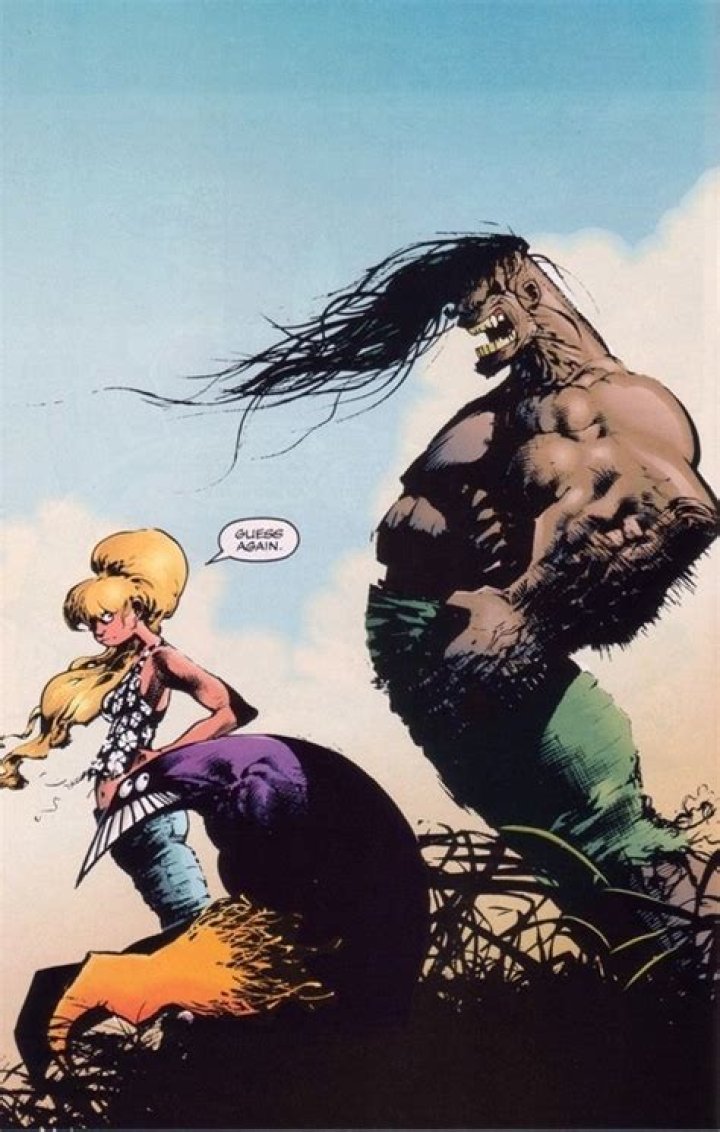
When animation director Gregg Vanzo and cartoonist Sam Kieth adapted The Maxx for television in March 1995, cable broadcasting collided with an uncompromising portrait of unprocessed human agony. Nestled inside late-night cable programming, the series stood as the crowning achievement of the network's experimental block, MTV Oddities. Viewers tuning in during the height of alternative rock expected a gritty superhero slugfest from an Image Comics property. What they witnessed instead was Julie Winters, an independent freelance social worker living in a decaying Manhattan apartment, silently drowning under the weight of sexual assault and psychological displacement.
The narrative engine of the story never belonged to its titular masked bruiser. The story centered on Julie. Her fractured interior life manifested as "The Outback," a primordial, watercolor-streaked Pangea mindscape populated by giant clay effigies, endless savanna grass, and predatory terrors. While mainstream comic adaptations relied on formulaic rescue arcs, Kieth used surrealist sequential art to dissect how human beings compartmentalize real-world violence. Decades after its broadcast debut, the visual mechanics of Julie’s survival mechanisms remain unmatched in American television animation.
📌 Key Takeaways:
- Narrative Realignment: The series inverted superhero tropes by revealing that The Maxx is not an alien savior, but a wandering unhoused man psychically anchored to Julie's subconscious defense mechanisms.
- Visual Architecture: Kieth combined jagged crosshatching, photorealistic paper collage, and dripping watercolor washes to distinguish waking urban desolation from psychic dissociation.
- Thematics of Recovery: Julie's internal realm served as an evolving clinical metaphor for trauma, moving from violent psychic isolation toward hard-won integration.
The Visual Dichotomy of Modern Realism and Primordial Escape
Television animation in the mid-1990s adhered strictly to standardized line weights, flat cel coloring, and predictable storyboards. Kieth obliterated those industry guardrails. Working alongside comic book co-writer William Messner-Loebs, Kieth brought his distinct illustrative idiosyncrasies directly into the animation pipeline. The animated frames mirrored the original Image Comics panels, frequently cutting between static, hand-drawn comic illustrations, fluid dynamic sequences, rotoscoping, and textured mixed-media backgrounds.
This hybrid production method created an unmistakable stylistic rift between Julie’s two worlds:
- Urban Manhattan: Depicted with suffocating, muddy palettes, heavy industrial blacks, harsh angular perspective lines, and claustrophobic street garbage. Life here felt gritty, mundane, and emotionally draining.
- The Outback: Characterized by luminous golden light, endless lavender horizons, deep azure skies, and vast primordial expanses untouched by modern civilization.
The contrast captured a specific psychological truth. Julie's apartment, cluttered with unpaid bills and discarded coffee cups, felt far more hostile than the wild, untamed wilderness of her subconscious mindscape. When Julie locked her deadbolt at night, she did not just go to sleep. She fled. The screen dissolved into warm amber brushstrokes, transforming her from an exhausted Manhattan social worker into the Jungle Queen, an athletic, self-possessed matriarch ruling over an untouched continent.
The Jungle Queen and the Subconscious Architecture of Dissociation
Julie Winters did not create The Outback out of creative whimsy. She erected it as a psychological fortress. Years before the events of the series, an act of violent sexual assault shattered her waking reality when a stranger attacked her after her car broke down on an isolated highway. Unable to process the catastrophic event, Julie covered the assault with denial, mentally burying her injured body under desert rocks within her own mind.
Her psychic retreat materialized as a sovereign prehistoric ecosystem. In this domain, she reigned supreme as the Jungle Queen. The persona represented an idealized compensation fantasy. Where Julie was vulnerable, isolated, and fearful on the city pavement, the Jungle Queen was physically imposing, confident, and completely in command of her surroundings. Her companion, The Maxx, manifested as her dedicated protector. In the waking world, he wandered the streets as a disoriented unhoused man clad in torn purple spandex. In the Outback, his raw physical strength served a singular biological directive: guarding the Jungle Queen from psychic intrusion.
The Outback was never a magical paradise. Kieth made certain that Julie's buried agony polluted her sanctuary. The volcano dominating her horizon smoldered with unresolved rage. The vast savanna grass hid predatory threats. By externalizing dissociation as a physical continent, the series visually articulated how survival mechanisms protect the self in the immediate aftermath of violence, even as they risk trapping the survivor inside an emotional fortress.
Psychic Predators: Decoding Mr. Gone and the Isz Creatures
Every element within Julie’s subconscious landscape served a specific diagnostic purpose. Her internal paradise was not sealed off from external predation; it was systematically stalked by Mr. Gone, a telepathic serial predator whose real-world counterpart directly preyed upon vulnerable women throughout the city. Gone possessed the rare, parasitic ability to breach the personal Outbacks of traumatized individuals, mapping out their private vulnerabilities and turning their psychological defenses against them.
Gone weaponized the Isz, small, oblong creatures native to Julie's subconscious ecology. These organisms operated as living barometers of Julie's mental state, shifting physical forms depending on their dimensional location and moral alignment:
| Manifestation | Physical Form & Color | Psychological Function |
|---|---|---|
| Native Outback Isz | White, smooth, gentle, largely harmless | Passive components of Julie's natural subconscious fauna; benign background thoughts. |
| Corrupted Real-World Isz | Black, predatory, sharp fangs, aggressive | Externalized trauma and invasive memories weaponized by Mr. Gone to assault Julie in reality. |
| Disguised Urban Isz | Dressed in trench coats, fedoras, and wigs | The mundane terror of everyday street harassment; hidden danger lurking in public spaces. |
When native white Isz crossed the boundary into urban Manhattan, their corruption turned absolute. They blackened, grew razor-sharp teeth, and hunted down human flesh. By showing innocent internal thoughts twisted into vicious real-world predators, the production visualized how repressed pain eventually turns toxic, corroding everyday life until the survivor confronts the underlying source of the infection.
Subverting the Superhero Paradigm in 1990s Sequential Art
The early 1990s comic book boom was defined by excess. Image Comics built its commercial empire on exaggerated anatomy, impossible firearms, multi-page battle spreads, and relentless anti-hero machismo. Against that commercial backdrop, Sam Kieth pulled off an extraordinary subversion from inside the system. The Maxx wore the visual skin of a hyper-violent comic, complete with exaggerated traps, massive shoulder plates, and lethal foot claws, yet its internal concerns were radically introspective.
Kieth steadily stripped away the comforting illusions of the genre:
The Maxx himself was not an invincible vigilante clean of human baggage. He was an unhoused man suffering from severe delusions, sustained entirely by the psychic projections of a woman who felt too guilty to abandon him. He possessed no rogue's gallery of world-conquering supervillains. His primary adversary was the psychic aftermath of sexual violence, a challenge that could not be punched into submission. By denying audiences the catharsis of physical victory, the series established that emotional healing requires vulnerability, not destructive force.
The Legacy of MTV Oddities and Julie Winters' Path Forward
The 13-episode animated adaptation wrapped on MTV in June 1995, leaving behind an astonishing visual legacy. Because it preserved the pacing, introspective voice-over monologues, and visual style of Kieth’s comic run, the project avoided the dilution common to corporate adaptations. Over the subsequent decades, the series quietly developed an enduring cult status among graphic novelists, visual storytellers, and psychoanalytic critics.
The true climax of Julie’s arc was not the physical destruction of Mr. Gone, but the dismantling of her personal Outback. Healing demanded that Julie lay down the mantle of the Jungle Queen. In the concluding chapters of the comic run, Julie confronted the memory of her assault, acknowledging that while her prehistoric paradise had kept her alive during her darkest hours, prolonged isolation threatened her long-term survival. As she integrated her pain into conscious awareness, the wild grasses and towering rock spires of Pangea began to fade, clearing the way for real human connection in the everyday world.
Frequently Asked Questions (FAQ)
Q1: What exactly is The Outback in The Maxx?
A1: The Outback is an externalized psychic realm, or personal Pangea mindscape, created by Julie Winters' subconscious mind. It functions as a dissociative psychological sanctuary designed to shield her from the unbearable trauma of a violent past sexual assault.
Q2: How does Julie Winters differ from typical comic book heroines of the 1990s?
A2: Unlike the hyper-sexualized, two-dimensional female characters common in early 1990s comics, Julie was written as an authentic, deeply flawed adult handling depression, professional burnout, and complex trauma. Her heroism stems from her emotional endurance and eventual willingness to face psychological recovery.
Q3: Why did MTV air The Maxx instead of a conventional cartoon network?
A3: In the mid-1990s, MTV carved out an avant-garde late-night animation identity through programs like Liquid Television and MTV Oddities. The network actively courted subversive, adult, and visually experimental projects that traditional commercial broadcast networks flatly rejected.
The Permanent Cultural Mark of Julie's Inner World
Three decades after Julie Winters first stepped across the painted sands of her interior continent, The Maxx remains a rare artistic achievement. In a medium often dominated by power fantasies and simplistic morality plays, Sam Kieth crafted an uncompromising monument to psychic survival. The surreal savannas, roaming Isz, and watercolor skies of Julie’s Outback stand as an enduring visual thesis: the mind will build entire continents to protect itself from ruin, but true recovery only begins when we gather the courage to return home.
