Moon Kanji Breakdown: How to Write and Read 月 in Native Japanese Contexts
Few symbols hold as much linguistic and cultural weight in East Asia as the moon. In Japan, celestial fascination bridges ancient folklore with modern engineering, resurfacing across global pop culture from space exploration headlines to themed attractions. As reported in a Nerdist Report detailing the Sailor Moon theatrical presentation at Universal Studios' Fan Fest Nights, Japan's iconic lunar iconography continues to command international attention. At the center of this enduring imagery sits a single four-stroke character: 月.
Understanding this character requires untangling dual Chinese-derived sounds, a native Japanese root, and astronomical metaphors embedded in daily life. Whether marking the passage of calendar months, calculating lunar phases, or expressing unspoken affection, the character shapes how speakers structure time and sentiment.
📌 Quick Summary:
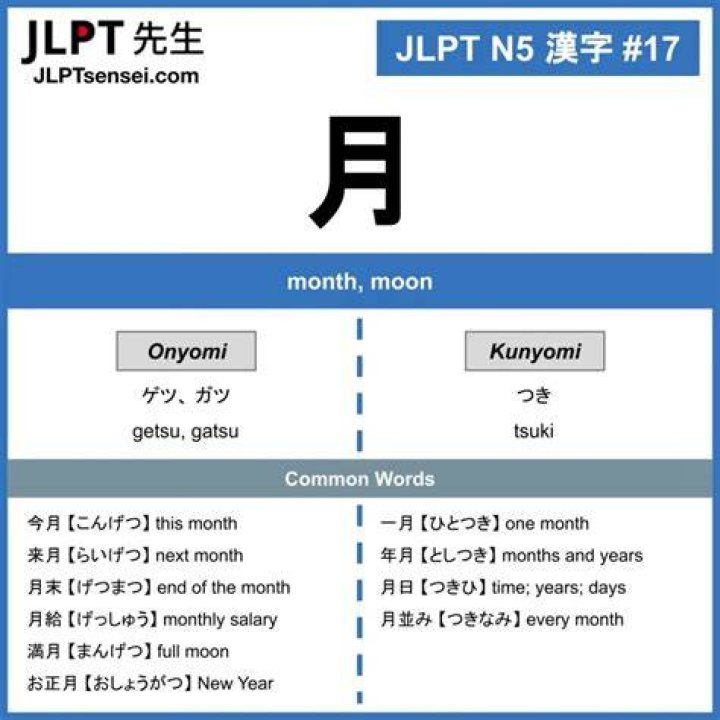
- Core Mechanics: The kanji 月 carries two distinct on'yomi readings (getsu and gatsu) alongside the native kun'yomi reading (tsuki), each governed by strict grammatical rules.
- Temporal Function: Calendar counting requires switching between naming specific calendar months (-gatsu) and counting durations or intervals of time (-kagetsu).
- Cultural Significance: From classical court poetry and Heian-era folklore to modern literary confession, lunar terms serve as an emotional shorthand in Japanese communication.
Stroke Order and Visual Evolution of the Tsuki Kanji
The character 月 began as an oracle bone pictograph depicting a slender crescent moon, complete with internal lines suggesting craters or the earthshine of the lunar night side. Over two millennia, scribal regularizations flattened the curved horns into rigid vertical lines, producing the modern four-stroke radical classified under index number 74.
Executing the kanji stroke order 月 demands precision to avoid confusing it with the radical for meat (⺼, nikuzuki), which shares identical strokes in standard print. The sequence follows classical brush mechanics:
1. First Stroke (Harai): A vertical stroke on the left that descends straight before sweeping gently outward to the lower left.
- Second Stroke (Yokootore-kagi): A horizontal line across the top, pivoting into a sharp downward vertical stroke that concludes with a dynamic hook (hane) upward to the left.
- Third Stroke (Yoko): The upper interior horizontal line, drawn from left to right, meeting the right boundary without piercing it.
- Fourth Stroke (Yoko): The lower interior horizontal line, sealing the inner balance of the frame.
Maintaining consistent negative space between the two inner horizontal lines prevents the character from appearing cramped. In printed typography and calligraphic scripts alike, an upright posture preserves the distinction between a true celestial moon and auxiliary body-part radicals found in kanji like arm (腕) or stomach (胃).
Untangling Onyomi and Kunyomi: The Rules of Getsu, Gatsu, and Tsuki
Navigating the character's phonetic shifts presents an early hurdle for Japanese language learners. The character operates across two primary categorization streams: native Japanese roots (kun'yomi) and Sino-Japanese readings (on'yomi).
The native reading is tsuki (つき). It functions as an independent noun. When a speaker points to the night sky, they say "Tsuki ga dete iru" (The moon is out). Compounds that treat the moon as an evocative physical entity, or poetic descriptor, frequently use tsuki, occasionally softening into zuki through sequential voicing (rendaku), as observed in tsukimi (moon viewing).
By contrast, Sino-Japanese loan readings split into two pronunciations: getsu (げつ) and gatsu (がつ). Selecting between them is not arbitrary; rigid linguistic categories determine the pronunciation:
Gatsu applies exclusively to named months of the Gregorian or traditional calendar. January is Ichigatsu (1月), July is Shichigatsu (7月), and December is Jūnigatsu (12月). Using getsu in these situations is a grammatical error.
Getsu governs time spans, days of the week, and abstract planetary concepts. Monday is getsuyoubi (月曜日), literally "moon-luminary day," echoing the Roman system that tied the second day of the week to the moon. When measuring length of time rather than a named month, speakers rely on getsu paired with a counting counter: one month of duration is ikkagetsu (1か月), and six months is rokkagetsu (6か月).
| Reading Type | Pronunciation | Primary Semantic Function | Contextual Examples |
|---|---|---|---|
| Kunyomi (Native) | tsuki (つき) | The physical orb, natural landscape, descriptive states | Tsukimi (月見), Tsukikage (月影), Tsuki (月) |
| On'yomi (Sino 1) | gatsu (がつ) | Calendar month names (1 through 12) | Shigatsu (4月), Hachigatsu (8月), Nengetsu (年月) |
| On'yomi (Sino 2) | getsu (げつ) | Days of the week, lunar duration, celestial science | Getsuyoubi (月曜日), Getsumatsu (月末), Ikkagetsu (1ヶ月) |
From Mikazuki to Mangetsu: Japanese Lunar Phases and Celestial Terminology
Before adopting the solar Gregorian calendar in 1873, Japan structured civil and agrarian existence around the lunisolar calendar (tenpōreki). This legacy left behind precise lunar calendar vocabulary describing minute shifts in illumination.
The cycle begins with shingetsu (新月), the new moon, marking the invisible start of the astronomical month. As the moon waxes, it forms the famous mikazuki (三日月), literally the "third-day moon." Rather than a loose description of any sickle-shaped lunar arc, mikazuki historically denoted the delicate, visible sliver appearing on the third evening of the lunar cycle. The motif became an emblem of warrior heraldry, famously decorating the ornate kabuto helmet of northern daimyo Date Masamune.
The midpoint of the cycle culminates in mangetsu (満月), the full moon. The 15th night of the lunar month earned the designation jūgya (十五夜). Medieval poets celebrated the nights directly following the full moon with observational names: izayoi (十六夜), the hesitant sixteenth-night moon that rises slightly later; tachimachizuki (立待月), the seventeenth-night moon awaited while standing; and imachizuki (居待月), the eighteenth-night moon for which one sits and waits. Each name records the physical posture of human observers watching the horizon.
Tsukimi and Kaguya Hime: The Cultural Architecture of Moon Watching
Japan's autumn calendar centers on tsukimi, the seasonal moon-viewing custom. Rooted in Heian-era aristocratic banquets where courtiers drank sake while admiring the moon's reflection on palace ponds, the event transformed over centuries into a harvest-thanksgiving rite. Rural communities offered seasonal produce alongside tsukimi dango (rice dumplings) and silver pampas grass (susuki) to invite agricultural protection.
This seasonal tradition remains intertwined with kaguya hime folklore from Taketori Monogatari (The Tale of the Bamboo Cutter), considered Japan's oldest narrative prose work. The story traces a celestial princess sent from Tsuki no Miyako (the Capital of the Moon) to live briefly on Earth, only to be reclaimed by a lunar retinue despite her earthly foster parents' pleas. The enduring tale anchors the cultural impression that the moon is not an uninhabited rock, but a distant, pristine ancestral home.
Folklore also departs from Western traditions regarding the shadows cast upon the lunar surface. Where Western observers see a "man in the moon," Japanese visual tradition identifies tsuki no usagi, a rabbit pounding sweet rice into mochi. This interpretation traces back to Buddhist parables of selfless sacrifice, reinforcing the moon's position in folk art, confection designs, and children's literature.
The Soseki Legend: Decoding "Tsuki ga Kirei Desu Ne"
Perhaps no phrase illustrates Japanese linguistic nuance better than tsuki ga kirei desu ne (月が綺麗ですね). Translated literally, the phrase means "The moon is beautiful tonight, isn't it?" Within Japanese literary lore, however, it serves as a subtle confession of love.
The attribution traces back to novelist and scholar Natsume Sōseki during his tenure teaching English in the Meiji era. According to the widely circulated account, an aspiring student translated the straightforward English declaration "I love you" directly into Japanese as Ware kimi o aisu (我君を愛す). Sōseki corrected the young scholar, remarking that Japanese people do not express love so overtly; instead, walking together under the night sky and noting the beauty of the moon conveys mutual devotion without disrupting emotional decorum.
While modern academic historians debate whether Sōseki ever issued this exact classroom instruction, the phrase remains a cultural touchstone. A companion response developed alongside it: to accept the confession, one might murmur "Shindemo ii wa" (I could die happy), borrowing a dramatic line translated by author Futabatei Shimei. Both expressions reflect the high value classical Japanese literature places on indirection, ambiguity, and shared appreciation of the natural world.
Celestial Names in Modern Japan: Naming Trends and Scientific Ventures
Lunar and stellar themes continue to shape contemporary Japanese naming practices (nanori). While the character 月 can be read directly as Tsuki or combined into compound names like Mizuki (美月 - beautiful moon) or Satsuki (皐月 - fifth month), it frequently assumes specialized readings such as Runa (ルナ) or Yue in modern birth registrations.
A recent cultural register from Milwaukee With Kids cataloging Japanese celestial names underscores how astronomical terminology fuels name choices for children, pairing lunar and stellar elements (like Hoshi or Kosei) to symbolize guidance and steady light. The character conveys themes of quiet resilience, clarity, and grace.
Beyond personal names, Japan's space program directly mirrors this linguistic heritage. When the Japan Aerospace Exploration Agency (JAXA) launched its Smart Lander for Investigating Moon (SLIM) mission, public commentators referenced historical idioms describing lunar terrain. As documented by Universe Today, the lander operated across punishing temperature swings, alternating between scientific transmissions and operational dormancy. Japan's space engineers continue to name planetary exploration probes after cultural roots, bridging archaic terms like Kaguya (the SELENE lunar orbiter) with aerospace projects that explore the Moon and nearby asteroids.
Frequently Asked Questions (FAQ)
Q1: Why does 月 mean both "moon" and "month"?
A1: Traditional Japanese society operated on a lunisolar calendar where each new month began precisely with the new moon. Because the lunar cycle of roughly 29.5 days defined the month, the celestial body and the unit of time shared the identical linguistic signifier, preserved today across Chinese, Japanese, and Korean kanji systems.
Q2: How can I remember whether to say "gatsu" or "getsu"?
A2: Reserve gatsu strictly for proper nouns naming specific calendar months: Nigatsu is February, Kugatsu is September. Use getsu for counting units of time (ikkagetsu - one month), reference markers like kongetsu (this month) and raigetsu (next month), and the weekday Monday (getsuyoubi).
Q3: Is saying "Tsuki ga kirei desu ne" understood as a romantic confession by all native speakers?
A3: Most literate native speakers and younger generations recognize the literary allusion to Natsume Sōseki. Context dictates the interpretation: pointing casually at an unusually bright full moon among friends is generally taken at face value, but whispering the phrase during an intimate walk often carries romantic intent.
The Enduring Pull of Japan's Lunar Lexicon
From the brushwork of its four foundational strokes to high-tech lunar exploration probes, the character 月 ties together everyday schedules and historic traditions. It provides an efficient framework for civil timekeeping while preserving emotional nuance through phases like mikazuki and autumn gatherings like tsukimi. By mastering the shifts between getsu, gatsu, and tsuki, learners gain not just grammatical accuracy, but a direct lens into how Japanese culture tracks the passage of time across the sky.
