Receipt Check: McDonald's Meal Deals Put to the Test Against Top Fast-Food Competitors
Fast-food drive-thrus used to be the default refuge for cheap, frictionless calories. Over the past three years, aggressive price increases altered that equation, sparking widespread customer rebellion across counter lines and social feeds. In response to dropping foot traffic and scathing online receipts, major chains rushed back to promotional discounting. A detailed comparative analysis by the inkl Report examined which corporate heavyweight actually delivers the most sustenance per dollar as the battle for budget-conscious diners escalates.
Behind the corporate marketing campaigns sit hard register tapes. To understand what diners actually get, we analyzed side-by-side orders across McDonald's, Wendy's, and Burger King. The figures reveal a stark split between advertised savings and real value on your tray.
📌 Key Takeaways:
- The Value Winner: Wendy's Biggie Bag edges out competitors in total protein and overall volume, though McDonald's McDouble bundle remains the narrow winner on sheer calorie density per penny.
- The Inflation Reality: Fast food inflation rates outpaced grocery store pricing by over 14% between 2021 and 2024, forcing chains into defensive discounting to retain sub-$75,000 household income diners.
- The Digital Penalty: In-store drive-thru combo meal pricing routinely costs 25% to 40% more than identical orders placed through mobile reward apps running targeted promos.
The Inflation Reckoning Behind the $5 Resurgence
For decades, the dollar menu served as quick-service dining's bedrock customer acquisition engine. Operators tolerated near-zero margins on basic cheeseburgers because diners added high-margin fountain sodas and fries to their trays. That balance broke when cumulative food-away-from-home inflation surged between 2022 and 2024. Frustrated consumers turned to Reddit and TikTok to post $18 Big Mac receipts in high-cost metro stations. Traffic plummeted among lower-income brackets.
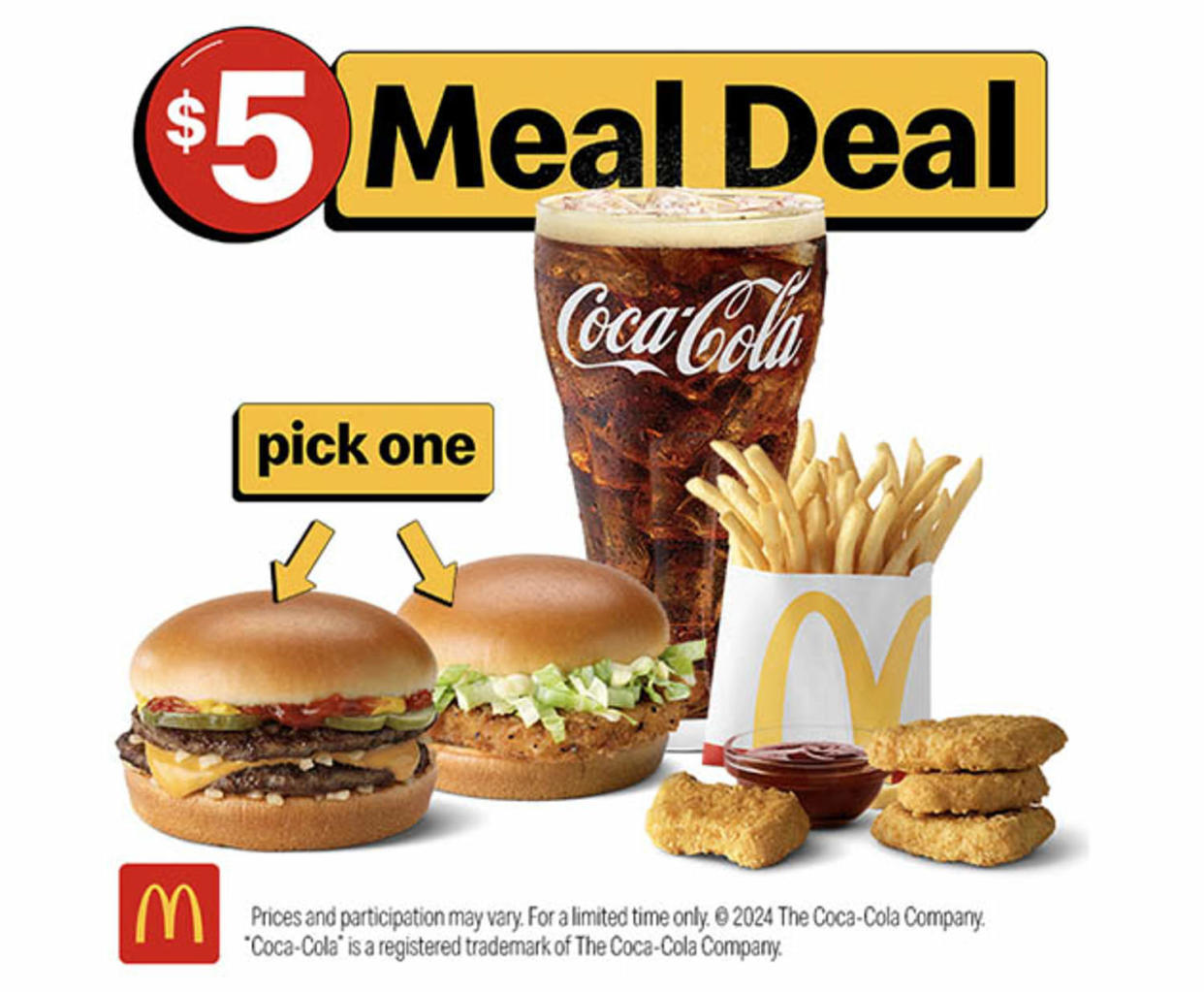
McDonald's executives responded by introducing their limited-time $5 Meal Deal, initially structured as a temporary summer promotion before local franchisee cooperatives voted to extend it. The corporate goal was transparent: halt customer churn. Fast-food value menu wars erupted instantly. Rivals who had pioneered the four-item combo format were forced to defend their territory with matching promotions.
Line-by-Line Receipt Check: McDonald's vs Wendy's vs Burger King
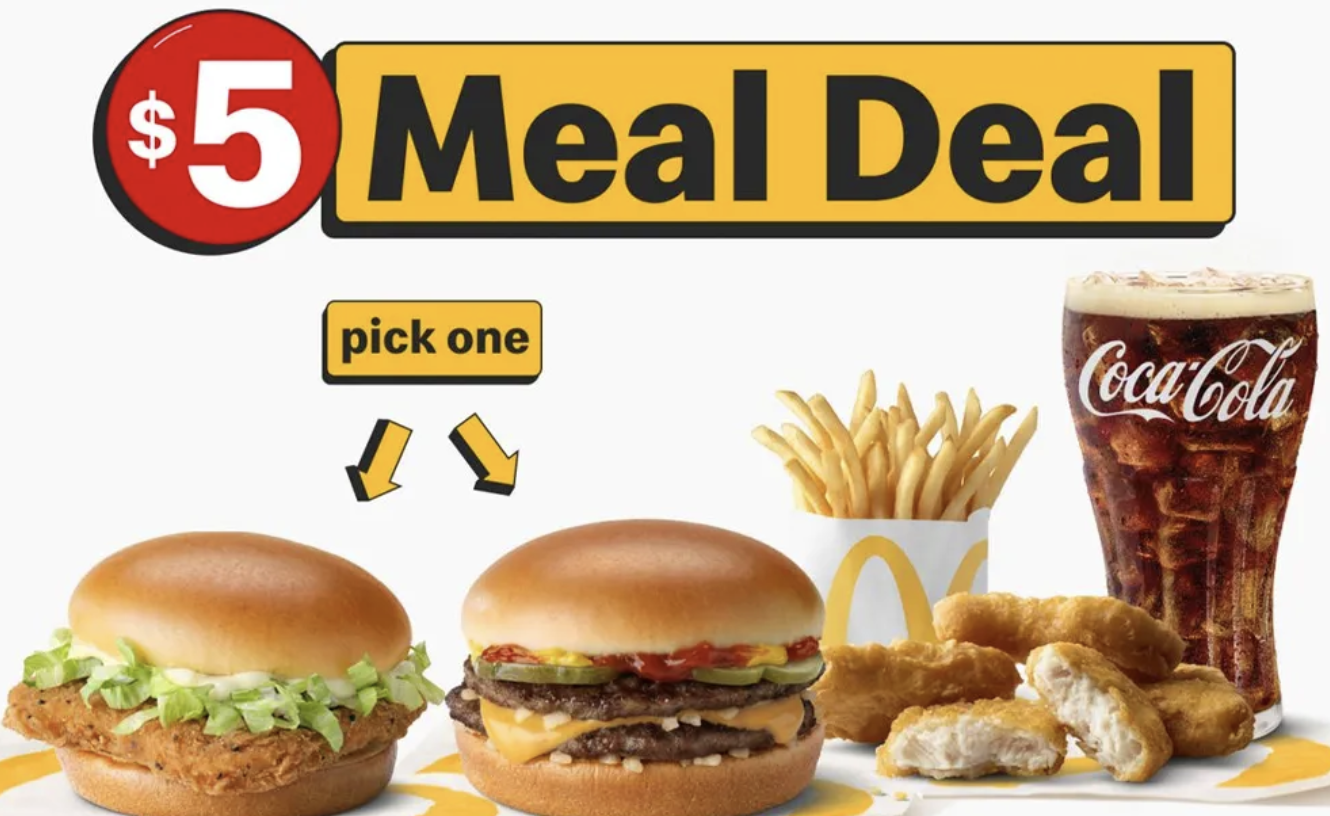
Comparing these bundles requires stripping away promotional graphics and auditing exact food specifications. A standard McDonald's $5 Meal Deal includes a choice between a McDouble or a 4-piece McChicken, accompanied by a 4-piece Chicken McNuggets, small fries, and a small fountain drink.
Wendy's relies on its seasoned Biggie Bag lineup, priced between $5.00 and $7.00 depending on regional market adjustments. The classic $5 variation features a Jr. Bacon Cheeseburger (or Double Stack), a 4-piece nugget order, Jr. hot and crispy fries, and a small soft drink. Wendy's differentiates itself by offering spicy nuggets and a wider array of dipping sauces without surcharges.
Burger King counters directly with its $5 Your Way Meal. That package bundles a choice of a Bacon Double Cheeseburger, Rodeo Burger, or Whopper Jr., along with a 4-piece chicken nugget order, small French fries, and a 16-ounce beverage. On paper, all three formulas look identical. The physical weights and nutritional distributions, however, tell a different story.
Portion Size Analysis and the Price-per-Calorie Ratio
A rigorous fast food receipt check requires matching cost against energy yield and gross food weight. The price-per-calorie ratio demonstrates whether a promotion provides genuine nourishment or merely illusionary savings built on miniature portions.
| Chain & Bundle | Base Price | Total Calories | Cost per 100 Calories | Core Sandwich Size |
|---|---|---|---|---|
| McDonald's ($5 McDouble Meal) | $5.00 | 1,040, 1,180 | $0.45 | 2 beef patties (approx. 3.2 oz precooked) |
| Wendy's ($5 Jr. Bacon Cheeseburger Biggie Bag) | $5.00 | 920, 1,060 | $0.51 | 1 square patty + applewood bacon (approx. 2.0 oz precooked) |
| Burger King ($5 Your Way Bacon Double Cheeseburger) | $5.00 | 980, 1,120 | $0.47 | 2 flame-grilled patties (approx. 3.0 oz precooked) |
McDonald's claims the statistical advantage on pure caloric output. The McDouble contains two beef patties totaling 400 calories on its own, whereas Wendy's Jr. Bacon Cheeseburger relies on bacon strips over a single small patty to deliver flavor rather than raw mass. Burger King balances between the two, offering twin patties with smoky grill notes, though its fry portion registers slightly lighter by net weight than McDonald's small fry sleeve.
The App Advantage Versus the Drive-Thru Markup
The baseline menu price posted on drive-thru boards no longer reflects the cheapest available price. Across 2025 and 2026, quick-service brands engineered a two-tier pricing system. Walk-up or drive-thru orders shoulder the highest cost, while first-party applications feature aggressive discounts designed to collect proprietary consumer habits.
Ordering a standard Quarter Pounder with Cheese combo at a suburban McDonald's drive-thru speaker costs between $9.89 and $12.49 depending on the state. Loading the McDonald's app frequently triggers automated daily deals: 20% to 30% off orders above $10, free medium fries on Fridays, or discounted combo upgrade vouchers. Diners bypassing app digital ecosystems effectively pay an offline convenience tax.
Wendy's and Burger King operate identical retention loops. Wendy's frequently pairs its Biggie Bag with mobile app loyalty rewards yielding free additional sandwiches. Burger King's Royal Perks program cycles regular digital coupons that drop the real cost of a medium combo down to bundle parity. If you order from the physical board without digital coupons, the traditional value proposition evaporates.
Franchisee Resistance and Regional Price Surcharges
National advertising creates expectations that individual store operators cannot always honor. McDonald's corporate leadership does not set the final register price across its roughly 95% franchisee-operated domestic fleet. Store owners must balance local minimum wage regulations, commercial utility rates, and elevated commercial packaging costs.
In high-cost metropolitan markets like New York City, San Francisco, and Seattle, the widely marketed $5 meal frequently costs $6.00 to $6.50 on the register tape. Franchisee organizations have openly voiced concerns regarding product erosion. When margins thin on value meals, operators trim complimentary sauces, charge for water cups, and restrict the hours promotions remain active. In dozens of franchise territories, the $5 bundle is gated to strictly lunch and dinner hours, shutting out late-night drive-thru traffic entirely.
Frequently Asked Questions (FAQ)
Q1: Is the McDonald's $5 Meal Deal a permanent menu item?
A1: No. McDonald's structures these bundles as promotional offerings. While corporate management and regional franchisee cooperatives repeatedly extended the program to defend customer traffic, individual franchise owners retain authority to sunset the bundle or raise prices according to local store economics.
Q2: Which chain offers the healthiest value bundle?
A2: None of these $5 bundles qualify as low-sodium or nutrient-dense meals. Every option exceeds 900 calories and delivers between 1,400 mg and 1,900 mg of sodium, approaching the entire recommended daily limit for an adult. Wendy's allows minor customizations, such as substituting apple slices for fries, which slightly cuts the overall sodium load.
Q3: How do standard combo meal prices compare to these bundles?
A3: Standard numbered combo meals (such as a Big Mac Combo or Dave's Single Combo) feature medium fries and drinks alongside a larger primary sandwich, typically priced between $9.00 and $13.50. The $5 bundles provide smaller fry portions and four-piece nugget sides, delivering comparable total calories at nearly half the retail checkout price.
Navigating the Drive-Thru Value Equation in 2026
Fast-food pricing dynamics have broken the traditional assumption that ordering a standard numbered combo guarantees the best price-to-food ratio. The line-by-line figures prove that $5 value bundles deliver far higher utility per dollar than full-sized specialty combos, provided diners accept downsized fries and drinks.
Maximizing value at the drive-thru now requires deliberate ordering. Sticking to the McDouble bundle or Wendy's Biggie Bag yields solid savings over standalone sandwiches. Relying on paper menus without checking mobile apps ensures you pay peak margin on every bite.
