Rocky Franchise Expands: How Mickey Goldmill’s Legacy Shapes the New Film

Fifty years after a low-budget boxing drama swept the box office and took home the Academy Award for Best Picture, the gritty dynamic between Mickey Goldmill and Rocky Balboa remains the beating heart of cinema’s most durable sports franchise. As industry analyses, including a comprehensive Stacker Report tracing the entire filmography, consistently demonstrate, every emotional peak of the multi-decade saga traces back to the sweat-soaked floorboards of Mighty Mick's Gym. With another theatrical chapter expanding the timeline, Hollywood is once again looking backward to understand how an elderly, gravel-voiced cornerman established the ethical DNA for three generations of fighters.
The bond between Sylvester Stallone's Southpaw underdog and Burgess Meredith's cynical trainer was never a straightforward sports cliché. It was an unsparing study of pride, missed chances, and desperate redemption forged in cold-water Philadelphia walk-ups. Today, as contemporary films interrogate the Creed legacy and test new protégés, Goldmill's brutal training philosophy and working-class stoicism still provide the dramatic blueprint.
📌 Key Takeaways:
- The Core Foundation: Burgess Meredith's portrayal of Mickey Goldmill transformed the standard trainer archetype into a complex portrait of urban regret and paternal hunger.
- The Shifting Power Balance: The original 1976 narrative hinges on vulnerability rather than victory, marked by Goldmill begging a discarded street-fighter for one final shot at relevance.
- Generational Continuity: The training ethos established at Mighty Mick's Gym directly governs how Rocky mentors Adonis Creed, proving the franchise's staying power relies on emotional lineage rather than fight choreography.
The Kensington Alleyways and the Gritty Spark of Mighty Mick’s Gym
Before Rocky Balboa ever heard Apollo Creed offer him an exhibition shot at the heavyweight title, he was a neighborhood bum collecting debts for Tony Gazzo. Mickey Goldmill had already written him off. Meredith played Goldmill not as an inspiring mentor, but as a bitter ex-bantamweight whose prime had slipped away inside smoke-filled rings between 1922 and 1947. Their interaction in the dingy locker room of Mighty Mick's Gym reeked of authentic Philadelphia boxing history: stale spit, damp leather, cheap cigars, and broken promises.
Stallone wrote the dynamic from deep personal desperation, mirroring his own Hollywood obscurity in Rocky’s dead-end existence. When Mickey threw Rocky out of his locker to give it to an up-and-coming contender named Spider Rico, the slight carried visceral weight. It established a realistic baseline rarely seen in 1970s sports cinema. Mickey was not running a charity; he was running an aging gym in a decaying industrial corridor where sentiment got fighters hurt. That hard-edged authenticity gave the pairing its bite.
The Apartment Confrontation That Changed Sports Cinema Forever
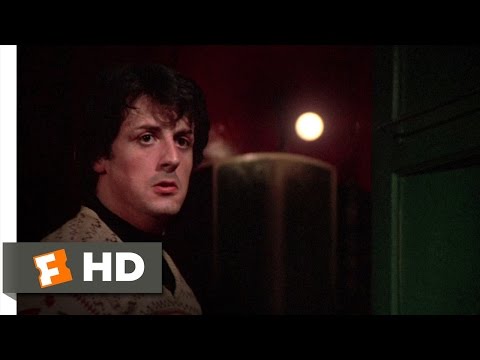
The turning point of the original film contains no gloves, no speed bags, and no crowd noise. It takes place entirely within Rocky’s cramped, dimly lit apartment after Creed’s camp selects Balboa for the Bicentennial title bout. Mickey climbs the stairs uninvited, swallowing fifty years of professional pride to ask for the managerial contract. Meredith delivered a masterclass in physical acting, his trembling hands and wheezing voice revealing a desperate old man terrified of dying forgotten.
Rocky’s immediate reaction was rage, not gratitude. He shouted at the walls about his wasted youth, letting Mickey walk back out into the bitter winter night before chasing him down the street to make amends. Film scholars frequently note that this scene won Stallone and Meredith their Oscar nominations. By grounding their partnership in profound guilt and shared failure, the narrative ensured that their ring walk in the Spectrum was an existential validation for both men, long before the opening bell rang against Apollo.
A Historical Look Across the Balboa-Goldmill Timeline
The evolution of their partnership redefined how sports sequels handled character mortality and narrative stakes across three decades of filmmaking.
| Film & Year | Narrative Milestone | Strategic Core Function |
|---|---|---|
| Rocky (1976) | Mickey takes on Rocky for Apollo Creed title fight | Establishes surrogate father-son bond through raw mutual desperation |
| Rocky II (1979) | Rematch training; switching Rocky from southpaw to right | Introduces specialized ring tactics and tests domestic loyalty |
| Rocky III (1982) | Mickey admits handpicking opponents; fatal heart attack | Exposes protective betrayal; forces Rocky into alliance with Apollo |
| Rocky V (1990) | Posthumous flashback inside empty gym; cufflink gift | Re-anchors broken protagonist to working-class philosophical roots |
| Creed Trilogy (2015, 2023) | Rocky adopts Mickey's corner duties for Adonis Creed | Transfers 1970s mentorship philosophy to modern boxing landscape |
The Brutality of Rocky III and the Burden of Paternal Protection
The tragedy of Mickey Goldmill reached its peak not during his death scene in Rocky III, but in the backstage revelation minutes before Clubber Lang dismantled Balboa. For ten title defenses, Mickey had shielded his fighter from killers, handpicking challengers to protect Rocky's battered body and preserve his celebrity wealth. When Lang cornered them, Mickey confessed the truth: "He'll knock your block off."
That admission dismantled Rocky's entire perception of his championship run. Mickey loved him enough to manage him dishonestly. The fatal heart attack in the dressing room stripped Balboa of his paternal safety net, leaving him emotionally naked against an unforgiving heavyweight division. When Apollo Creed stepped into the vacuum to teach Rocky footwork and rhythm on the sands of California, the narrative shifted into a new gear. Yet Apollo was building on Mickey's structural foundation: raw durability coupled with sheer will.
Passing the Towel: How Rocky Inherited Mickey’s Corner Stool
When Ryan Coogler revitalized the franchise with Creed in 2015, Stallone did not play Balboa as a retired celebrity. He played him as Mickey. Rocky had retreated inside his South Philadelphia restaurant, Adrian’s, reading newspapers by his wife's gravestone and avoiding the modern fight game. Adonis Johnson had to drag Rocky back into the gym the exact same way Rocky had dragged Mickey out of retirement forty years earlier.
Watch Stallone in the corner during the grueling split decision against Ricky Conlan. He wears Mickey’s battered fedora, relies on short, cutman aphorisms, and insists on basic, punishing roadwork. In Creed II, when Balboa takes Adonis to the desert to prepare for Viktor Drago, the training sequence abandons high-tech diagnostics in favor of tractor tires, heavy sledgehammers, and sand pits. It is pure Mickey Goldmill doctrine: machines do not make fighters, suffering does.
The Cultural Endurance of the Philadelphia Gym Archetype
Modern boxing is dominated by private facilities, corporate sponsorships, and digital streaming platforms, yet audiences still romanticize the peeling paint and grease-stained speed bag swivels of Mighty Mick's. That enduring fascination speaks to a broader cinematic appetite. Audiences reject immaculate heroes; they embrace characters shaped by grit, rust, and physical toll. Mickey’s training methods, chasing chickens to improve foot speed, slapping fighters to demand defensive concentration, were cinematic shorthand for unpolished authenticity.
The real-world gym building at 2147 North Front Street in Philadelphia remains an international tourist destination, despite the exterior housing different commercial tenants over the decades. Fans do not travel there for architectural spectacle. They go to stand on the sidewalk where Burgess Meredith screamed through freezing morning air, demanding that an awkward club fighter dig deeper into his own ribs for five more seconds of effort.
Frequently Asked Questions (FAQ)
Q1: Was Mickey Goldmill based on a real boxing trainer?
A1: Mickey was an amalgamation of several iconic mid-century trainers, most notably Charley Goldman, the legendary strategist who conditioned Rocky Marciano. Goldman was famous for compensating for Marciano's short reach and awkward balance with unorthodox, brutal training regimens, much like Mickey did with Balboa.
Q2: Why did Burgess Meredith receive so much acclaim for the role?
A2: Prior to 1976, Meredith was widely recognized for his versatile theater work and playing the eccentric Penguin in television's Batman. His transformation into Goldmill, complete with an altered, raspy voice, distinct limp, and unvarnished emotional ferocity, earned him an Oscar nomination for Best Supporting Actor and redefined the mentor figure in modern cinema.
Q3: How does the new era of the franchise address Mickey's memory?
A3: The contemporary films treat Mickey as an foundational ancestor. Rocky references his lessons constantly, keeping his vintage memorabilia and relying on Goldmill's original training tenets to keep young fighters grounded against the commercial distractions of modern celebrity boxing.
The Unbroken Line from Front Street to the Global Ring
Sports cinema consistently attempts to engineer high-tech rivalries and hyper-stylized action sequences, but the lasting power of this franchise remains rooted in two damaged men talking across a wooden table in an unheated apartment. Mickey Goldmill gave Rocky Balboa self-respect; Rocky gave Mickey an ending worthy of his sacrifices. That reciprocity transformed what could have been a forgotten mid-seventies B-movie into an enduring modern myth.
As the boxing saga continues to roll into production facilities, streaming ecosystems, and multiplexes worldwide, its moral compass stays firmly anchored in North Philadelphia. New champions will emerge, foreign rings will host record gates, and titles will change hands under digital spotlights. Yet whenever a cinematic fighter looks down at their trainer through swollen eyelids between rounds, they are listening for the rough, unvarnished cadence of Mickey Goldmill telling them to get back up.
