Spirit Airlines Baggage Policy Updates: What Flyers Must Know Before Boarding
The yellow boarding gate at Spirit Airlines remains one of the most scrutinized checkpoints in commercial aviation. While budget travelers routinely hunt for $29 base fares, the final cost of that seat often hinges entirely on whether a travel bag clears the metal sizing box before stepping onto the jet bridge. Aviation news cycles highlight passenger loyalty movements and airline brand resurgences, including reporting documented in a Reader's Digest Report, yet the pragmatic everyday reality for ticket holders comes down to exact centimeters and under-seat clearance.
A single miscalculation turns a bargain flight into an expensive lesson. Spirit built its business model on unbundled pricing, and personal items represent the final frontier of free luggage on ultra-low-cost carriers. Navigating gate staff, physical measurement boxes, and overhead bin rules requires understanding the precise parameters enforced on Spirit's Airbus fleet.
📌 Key Takeaways:
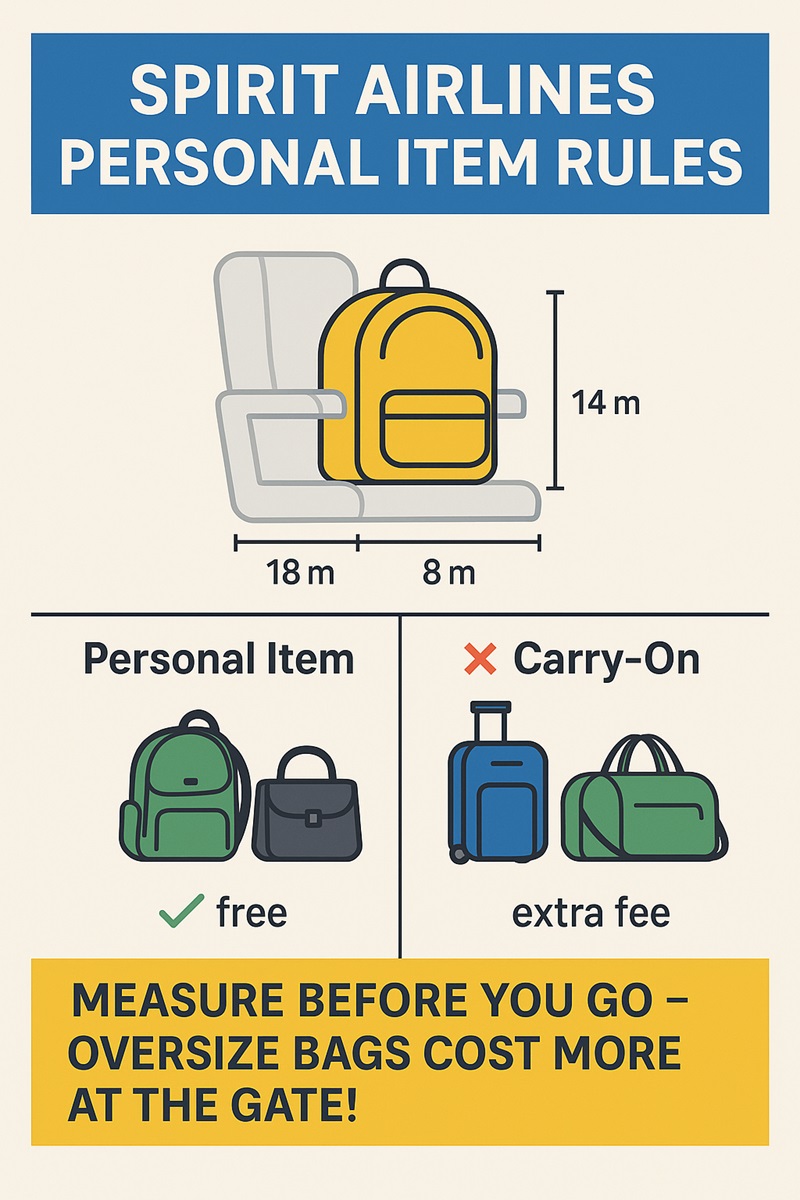
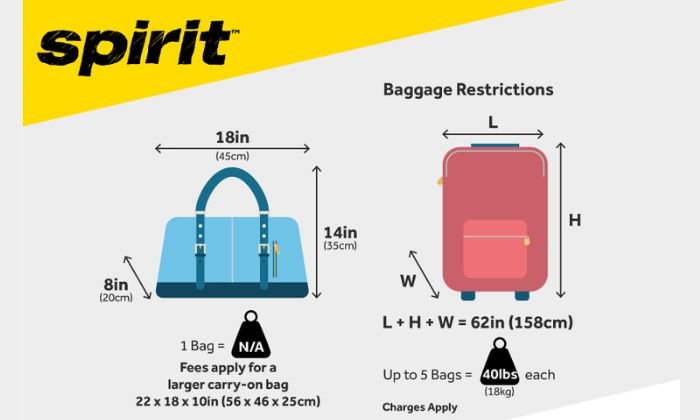
- The Dimension Cap: Spirit strictly defines a personal item as 18 x 14 x 8 inches (45 x 35 x 20 cm), handles and wheels included.
- The Enforcement Mechanism: Gate agents actively spot-check bags in metal sizers during boarding; non-compliant items face on-the-spot carry-on gate fees up to $99.
- Packing Geometry: Soft-sided backpacks and unstructured duffels squeeze through the sizer far more reliably than rigid rolling mini-suitcases.
The Geometry of the 18 x 14 x 8 Under-Seat Rule
Spirit provides each passenger with exactly one free personal item allowance. That piece of luggage must fit completely underneath the seat directly in front of you. The airline sets the maximum under-seat dimensions at 18 x 14 x 8 inches (45 x 35 x 20 cm). Unlike standard legacy carriers that permit a standard carry-on rolling suitcase alongside a backpack, Spirit charges for anything designated as an overhead carry-on.
The restriction includes external components. Wheels, rigid top handles, and stuffed exterior utility pockets count toward the total footprint. A backpack measuring 18 inches long on paper can expand past 10 inches deep once loaded with a laptop charger, water bottle, and spare shoes. When gate agents monitor boarding groups, protruding water bottle pockets or extended zippers are the primary triggers for secondary checks.
Cabin floor architecture also dictates these dimensions. Spirit operates an all-Airbus fleet, primarily A320 and A321 configurations. Window seats and aisle seats often feature slightly narrower floor compartments due to structural framing and onboard electronics boxes. A bag packed to the maximum 8-inch depth limit slides smoothly under a middle seat, while an aisle seat might require compressing the fabric to achieve full under-seat fit.
Surviving the Spirit Airport Bag Sizer
Every Spirit boarding gate features a bright yellow metal bin known as the Spirit airport bag sizer. It serves as the definitive legal metric between a zero-dollar personal item and a punitive gate fee. If an agent questions the bulk of your luggage, you will be instructed to step aside and insert the piece into the metal framework.
The rule of the sizer is straightforward: the bag must slide in without brute force. Gate staff will not permit passengers to jump on bags, kick them into the metal slot, or leave four inches of canvas protruding from the open top. If the bag binds on the metal edges due to an inflexible frame or stiff wheels, it fails.
Unstructured gear holds a major advantage here. A duffel bag measurement check typically favors soft nylon or canvas, which bends around rigid metal borders. Conversely, hard-sided under-seat rolling bags lack flexibility. If a rigid mini-roller measures 18.5 inches including its stationary caster wheels, no amount of pushing will get it into the bin.
Carry-On vs Personal Item: Financial Realities at the Gate
The financial divide between advance baggage booking and gate-level reclassification is steep. Spirit adjusts baggage rates dynamically based on the route, travel season, and when the bag is purchased during the customer journey. Booking a carry-on during initial ticket reservation remains dramatically cheaper than getting stopped in line during boarding.
| Baggage Category & Booking Point | Typical Price Range (2024, 2026) | Operational Constraint |
|---|---|---|
| Personal Item (Under-seat) | $0 (Included) | Strict maximum: 18 x 14 x 8 inches; must clear sizer freely |
| Carry-On (Reserved at Booking) | $39, $65 | Max 22 x 18 x 10 inches; fits in overhead compartment |
| Carry-On (Added Post-Booking / Check-In) | $55, $79 | Added via app or website prior to airport arrival |
| Oversized Personal Item Penalty (At Gate) | $99, $109 | Assessed immediately by gate agent; requires credit card payment |
When an item exceeds the personal item allowance and gets flagged by an agent, it does not simply incur a minor surcharge. It converts instantly to a gate baggage fee. At that juncture, the flyer pays the full gate-check premium, erasing whatever savings prompted the budget ticket booking in the first place.
Backpack Dimension Limits and Gear Selection
Travelers looking to bypass extra charges routinely turn to 20- to 30-liter travel backpacks. However, standard school backpacks and technical outdoor trekking packs carry wildly different shapes. Outdoor packs are built tall and narrow with internal aluminum stays, often stretching to 22 or 24 inches in height. Even when half-empty, the internal spine prevents them from sinking into an 18-inch sizer.
Ideal under-seat luggage relies on rectangular geometry. Bags designed specifically for low-cost carrier luggage rules maximize the corner volume while maintaining a depth of 7 to 8 inches. Several travel gear manufacturers now produce dedicated bags matching the exact 18 x 14 x 8 footprint.
When packing, keep internal organization disciplined:
- Place heavier, flat items like laptops and documents against the back panel to prevent bulging.
- Avoid packing bulky coats or oversized shoes inside the main compartment; wear those items through the boarding gate instead.
- Utilize compression straps to cinch the bag's depth down to 7 inches before entering the boarding line.
- Keep outer zip compartments empty until after you board. Bulging front organizer pockets frequently catch on the sizer's steel frame.
A dedicated laptop bag fits under the seat with ease, but combining a laptop sleeve, work files, and three days of clothing into a single pack tests the threshold. If your bag looks stressed at the seams, an agent is far more likely to request a physical test.
Enforcement Changes Across Gate Terminals
Boarding gate procedures have evolved across low-cost domestic carriers. Airline operational staff focus heavily on turnaround times, ensuring aircraft push back on schedule to maintain daily fleet utilization. At the same time, ancillary revenue remains critical to low-cost balance sheets.
Recent Spirit baggage policy updates continue to place visual screening responsibilities directly on frontline agents during Group 3 and Group 4 boarding calls. Agents monitor passenger lines, singling out travelers carrying multiple items or visibly swollen bags. Spirit allows one personal item total. That means a separate purse, camera bag, or retail shopping bag counts as a second item unless tucked entirely inside the primary backpack.
Boarding queues frequently move fast until an agent spots a rollaboard without a paid bag indicator on the boarding pass. Boarding passes clearly display whether a customer purchased a carry-on allotment. If the pass indicates no paid luggage, any bag larger than an average school satchel draws immediate scrutiny.
Frequently Asked Questions (FAQ)
Q1: Does a small purse or crossbody bag count as an extra item on Spirit?
A1: Yes. Spirit strictly limits unpaid travelers to one personal item total. A small purse, fanny pack, or camera bag must fit completely inside your primary backpack or personal bag before you scan your boarding pass. Wearing a crossbody bag alongside a backpack will cause an agent to stop you at the gate.
Q2: What happens if my backpack fits under the seat but does not fit the gate sizer?
A2: The gate sizer is the legal baseline. Even if your bag could theoretically squeeze under certain cabin seats, gate agents rely entirely on the airport sizer box. If the bag cannot fit inside the sizer during boarding, it is classified as oversized, and you will be required to pay the gate carry-on fee.
Q3: Are medical devices and infant diaper bags exempt from Spirit's personal item limit?
A3: Yes. In compliance with FAA regulations, approved medical devices (such as CPAP machines) and diaper bags for traveling infants do not count toward your personal item allowance. These items may be brought aboard in addition to your single free personal item without extra fees.
Q4: Can I sit in an exit row with a personal item under the seat?
A4: No. Federal safety regulations mandate that all luggage must be stowed in the overhead bins for passengers seated in emergency exit rows during taxi, takeoff, and landing. If you sit in an exit row, flight attendants will require you to place your personal item in an overhead bin, though you will not be charged extra if it meets the 18 x 14 x 8 standard.
Boarding Prepared for the Flight
Flying on ultra-low-cost carriers requires precision over assumptions. The entire fare calculation falls apart the moment an unmeasured bag meets an alert gate agent holding a card reader.
Treat the 18 x 14 x 8 inch boundary as a fixed wall rather than a guideline. Measure your packed gear at home with a physical tape measure, pack soft fabrics that yield to pressure, and ensure every accessory fits within a single zippered shell. Taking ten minutes to confirm your bag's dimensions before heading to the airport guarantees that your low-cost ticket stays truly low-cost.
