Stick and Poke vs. Rotary Machine: Visual Breakdown for Absolute Beginners
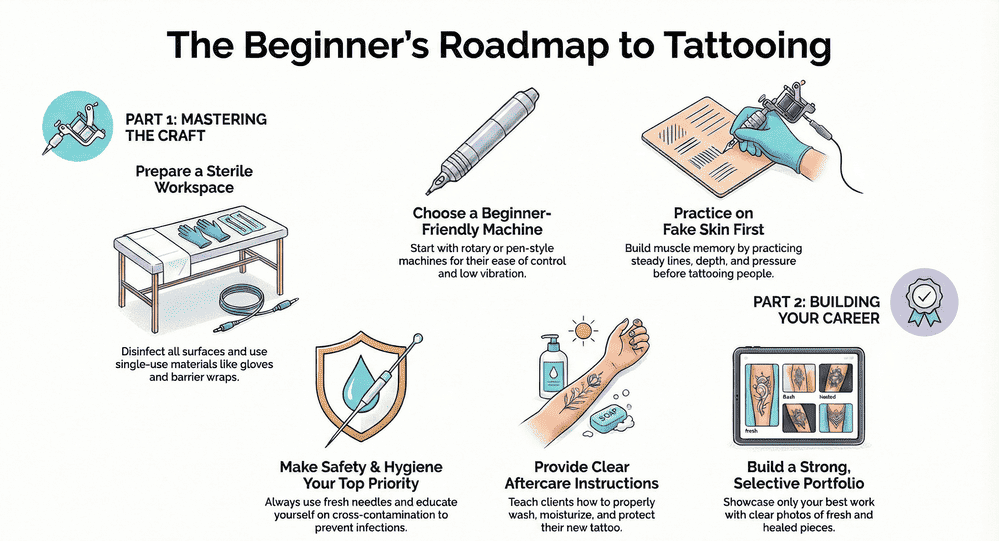
A sudden surge in DIY body art has transformed bedrooms and garage workshops into impromptu creative spaces. Where apprentices once spent years scrubbing shop grip tubes before ever touching human skin, novice artists now unbox mail-order hardware within hours of watching online tutorials. The debate over whether novices should start with manual hand poking or modern motor-driven equipment remains contentious among working tattooers. As outlined in a detailed Byrdie Report on non-electric methods, the manual craft demands deliberate rhythm and strict clinical sanitation rather than casual, kitchen-table experimentation.
Entering body modification without structured studio training carries immense biological and aesthetic responsibility. The margin between an indelible piece of folk art and permanent soft-tissue trauma measures less than a single millimeter. Deciding between a manual needle bundle and a motorized rotary device involves trade-offs in line saturation, mechanical speed, and physical control that directly dictate early artistic results.
📌 Key Takeaways:
- The Core Trade-Off: Hand poking provides tactile feedback and slower needle control, whereas a rotary tattoo machine offers rapid ink saturation at the cost of higher skin blowout risks.
- Critical Depth Control: The human dermis sits merely 1.0 mm to 2.0 mm beneath the surface, requiring rigorous practice on silicone pads before touching living tissue.
- Biological Safety: Cleanliness is absolute; both methods demand medical-grade barrier wraps, single-use cartridges, and strict compliance with bloodborne pathogen prevention standards.
The Kitchen-Table Renaissance and the Shift to Sterile Craft
Amateur tattooing has moved past sewing needles bound with thread and india ink taken from desk drawers. Archival reporting from The University Daily Kansan captured the classic impulse of college students accepting dorm-room ink jobs on a dare, exposing the chronic risks of cross-contamination and irregular scarring. Simultaneously, cultural lifestyle outlets like Brit + Co highlighted how minimalist micro-tattoos propelled hand poke aesthetics into mainstream pop culture.
This visibility fueled a thriving commercial market for entry-level gear. Novices can purchase an all-in-one beginner tattoo starter kit online with a credit card, but commercial availability does not impart medical discipline. Hand poke methods have evolved away from reckless counterculture markers into methodical crafts governed by sterile procedures. Modern practitioners use factory-sealed medical needles, autoclaved grip attachments, and regulated pigments designed for dermal stability. Treating manual tattooing as an informal hobby ignores the basic reality of dermal inoculation: the second skin is punctured, systemic contamination risks emerge immediately, and permanent scar tissue forms without proper mechanical control.
Mechanics of Application: Hand Poke Technique vs. Motorized Rotary Power
The fundamental mechanical divide comes down to energy delivery. The traditional hand poke technique relies entirely on kinetic muscle memory. The operator drives a pre-sterilized needle bar directly into the skin at a 45-degree angle, creating an individual dot with each puncture. Solid lines emerge through dense, overlapping dot patterns placed in methodical rows. Because the speed stays locked to hand movement, beginner artists have time to evaluate every entry point. The absence of mechanical vibration reduces immediate anxiety, helping novices evaluate skin tension and needle bounce directly through their fingertips.
HAND POKE:
[Manual Force] ---> [Individual Dot Inoculation] ---> [Direct Tactile Resistance]
ROTARY MACHINE:
[Direct-Drive Motor] ---> [8,000, 10,000 RPM Cam] ---> [High-Frequency Mechanical Saturation]
A rotary tattoo machine operates on an entirely different scale of efficiency. Driven by a compact electric motor, the machine turns an eccentric cam that converts rotational torque into linear needle strokes cycling between 8,000 and 10,000 RPM. When dialed in at 6 to 9 volts, the machine drives needles into tissue anywhere from 60 to 130 times per second. A rotary device lays consistent, saturated lines in single forward passes. However, this same mechanical speed can quickly chew through soft tissue if hands drag or hesitate. A microsecond stutter with a running rotary pen cuts the epidermis like an oscillating blade, causing irreversible scarring and ink blowouts that manual hand poking rarely produces under equal concentration.
Technical Specifications, Setup Differences, and Healing Timelines
The gear requirements for each method dictate preparation complexity, financial investment, and biological healing responses.
| Core Specification | Stick-and-Poke Setup | Rotary Machine Setup |
|---|---|---|
| Initial Equipment Cost | $25, $65 for verified sterile components | $150, $450 for quality pen, battery, and cartridges |
| Needle Penetration Rate | 1, 3 manual punctures per second | 60, 130 motorized strokes per second |
| Tissue Trauma Profile | Localized pinpricks; minimal epidermal peeling | Broad epidermal abrasion; heightened swelling risk |
| Average Healing Window | 7, 14 days for surface recovery | 14, 28 days for full dermal settling |
| Primary Point of Failure | Ink fallout and uneven dot spacing | Subcutaneous blowouts and skin overworking |
Initial setup ergonomics differ fundamentally. A stick and poke kit operates without electrical wiring or foot switches. It relies on a balanced medical-grade grip, single-use needles, sterile ink caps, and medical tape. In contrast, operating an electric machine introduces cross-contamination risks through motor chassis, battery packs, and power cables. Every component must be sheathed in disposable barrier sleeves before opening single-use cartridge blisters.

Calibrating Needle Depth and Mastering Synthetic Practice Skin
Precision needle control separates clean ink saturation from scarred tissue. Human skin comprises three operational layers: the non-vascular epidermis outside, the receptive dermis below, and the subcutaneous adipose tissue beneath. Permanent ink must rest safely in the papillary and upper reticular layers of the dermis, requiring an exact tattoo needle depth between 1.0 mm and 2.0 mm.
Deposit pigment too shallowly into the shedding epidermis, and the work sloughs off entirely within three weeks. Drive the needle too deep into subcutaneous fat, and the pigment expands uncontrolled across lipid membranes. This creates an irreversible blue-gray halo known as a blowout.
Novices should never practice basic mechanical control on live subjects. High-density synthetic practice skin provides a realistic, flat training surface. Modern 3-millimeter silicone practice sheets mimic human tissue density without exposing anyone to cross-contamination or permanent scarring.
[ Epidermis: 0.1 mm ] -> Too Shallow: Ink sheds within 21 days
----------------------------------------------------------------- [Target Dermal Zone]
[ Dermis: 1.0, 2.0 mm ] -> Optimum Depth: Permanent pigment retention
----------------------------------------------------------------- [Adipose Subcutaneous]
[ Subcutaneous Fat ] -> Too Deep: Ink migrates into blowout halo
Working on silicone sheets trains novices to identify correct needle groupings and liners. A 3RL (Round Liner) uses three micro-needles soldered into a tight circular point for hairline precision, while a 9RL groups nine needles to produce heavier traditional outlines. Hand poking with a 3RL requires exceptional dot density to achieve clean lines. On a rotary machine, a 3RL cuts fast and deep, demanding smooth, confident hand movement. Learning how varying needle configurations displace ink on silicone practice sheets builds the muscle memory needed before ever touching living tissue.
Hygiene Protocols, Bloodborne Pathogens, and Cross-Contamination Realities
The moment a needle breaks skin, the workstation becomes a clinical biohazard environment. Blood and interstitial fluids carry infectious risks, including Hepatitis B, Hepatitis C, and HIV. Maintaining strict sterilization and hygiene protocols is an ethical baseline, not an optional preference. Complete safety requires understanding OSHA standards for managing bloodborne pathogens and preventing cross-contamination across the workspace.
Amateur artists often cross-contaminate their stations through simple handling errors:
- Touching squeeze bottles, lamps, or mobile devices with contaminated nitrile gloves.
- Re-dipping needle configurations into raw pigment stock rather than portioned, disposable ink caps.
- Skipping medical barrier plastic across work surfaces, power units, clip cords, and machine grips.
- Reusing needle bars or cartridge configurations between design variations.
Every drop of pigment introduced to human tissue must be certified sterile tattoo ink, free from industrial heavy metals and bacteriological contamination. Standard retail craft supplies, calligraphy inks, and open pigment bottles harbor ambient fungi and spore-forming bacteria that trigger systemic infections. Professional workstations demand broad-spectrum surface disinfectants, hospital-grade skin prep solutions, single-use wrapped consumables, and direct biohazard disposal for every needle assembly.
Stencil Application, Healing Outcomes, and Aftercare Realities
A lasting tattoo requires a clean transfer before any needle touches the skin. Professional tattoo stencil application begins by prepping the target skin site with an alcohol-based sanitizer, closely shaving fine hair, and applying an antibacterial transfer solution. Placing stencils on complex anatomical curves requires cutting relief splits in the transfer paper to prevent warping. Novices must wait a full 15 to 20 minutes for stencil emulsions to dry completely; working into a wet stencil smears guidelines and leaves artists guessing at paths on skin clouded by excess ink.
Once ink application wraps, healing dictates long-term artistic retention. The body responds to tattoo trauma with an immediate inflammatory repair cascade. Modern tattoo aftercare protocols rely on gas-permeable polyurethane adhesives, often called "second skin" barriers. These medical films seal the area against opportunistic pathogens while trapping cellular exudate, accelerating epidermal recovery over the first 72 to 96 hours.
When transparent film dressings are impractical, artists default to classic wash protocols. This involves cleaning the area two to three times daily with fragrance-free antibacterial soap, patting dry with clean paper towels, and applying minimal coats of petroleum-free moisturizing ointments. Hand-poked work heals with light flaking and minimal swelling because the needle creates small, isolated puncture wounds. In contrast, heavy rotary work creates broad dermal abrasions that weep lymph fluid and form protective scabs. Picking or scratching these scabs pulls uncured pigment straight out of the dermis, leaving blank patches across the healed tattoo.
Frequently Asked Questions (FAQ)
Q1: Is stick-and-poke tattooing safer for an absolute novice than a rotary machine?
A1: Mechanically, yes. Hand poking runs at human speeds, giving novices time to manage needle depth and avoid tearing skin. However, biological risks remain identical. Both approaches expose clients to bloodborne pathogens and run equal risks of infection without medical barrier films, single-use disposables, and sterile inks.
Q2: Can I use calligraphy ink, sewing needles, or pen ink for stick-and-poke?
A2: Absolutely not. Sewing needles lack the microscopic barbs, solder stability, and medical sterilization needed to deposit pigment cleanly, tearing dermal tissue instead. Non-tattoo inks contain toxic chemical solvents, acrylic polymers, and industrial heavy metals that can trigger intense immune rejections, soft-tissue necrosis, and systemic poisoning.
Q3: How do I know if I have punctured the skin to the correct depth?
A3: Correct dermal placement at 1.0 mm to 2.0 mm produces a subtle, light tactile pop as the needle passes through the basement membrane into the dermis. There should be little to no bleeding beyond pinpoint spotting. Excessive bleeding and instant, clouded pigment halos signal subcutaneous blowout, meaning the needle penetrated far too deep.
Establishing Practical Standards for First-Time Artists
Tattooing is a permanent medical and artistic craft that leaves no margin for careless execution. Aspiring artists should treat equipment choice as a question of mechanical control rather than creative style. The slower pace of hand poking helps novices master depth calibration, spot spacing, and sterile field maintenance without having to manage the high speeds and deep cutting risks of motorized equipment.
A rotary tattoo machine delivers rich, solid color and rapid, steady lining, but its motorized action cuts deep into skin the instant a beginner's hand hesitates or shakes. Whichever path you choose, hone your skills on synthetic practice skin, master clinical disinfection protocols, and use verified, sterile single-use supplies. Respecting biological safety and learning proper mechanical technique ensures your first designs turn into clean, permanent body art rather than lifelong physical scars.
