Street-Legal F1 Cars: The Closest Road-Ready Hypercars Money Can Buy

Every motorsport fanatic shares the same intrusive fantasy: pulling out of a petrol station, dropping the hammer on a green light, and hearing a Grand Prix engine scream toward an 11,000 RPM redline on a public road. For decades, automotive purists dismissed that dream as mechanical suicide. Formula 1 cars require pre-warmed fluids, external starter motors, and an army of trackside computer technicians simply to crank over. Yet a tiny cadre of engineering lunatics refused to take no for an answer, birthing a radical class of road-legal hypercars engineered directly around Formula 1 DNA. Even as automotive design shifts toward electrification, collectors and track enthusiasts remain obsessed with analog downforce and raw motorsport mechanics, a sentiment echoed by a recent Highsnobiety report highlighting how modern collectors gravitate toward classic motorsport styling and visceral mechanical drama.
Translating an open-wheel racer into a machine that legally wears a license plate is an engineering nightmare. Civil authorities demand crumple zones, catalytic converters, pedestrian impact bumpers, and windshield wipers. Grand Prix machines strip away every gram that does not contribute to cornering speed or straight-line velocity. Between those competing philosophies sits a small fleet of extraordinary, street-registered machines that come shockingly close to putting an F1 grid on public pavement.
📌 Key Takeaways:
- The Direct F1 Engine: The Mercedes-AMG ONE remains the only production street car powered by a literal Formula 1 hybrid powertrain lifted directly from a championship-winning Grand Prix chassis.
- Aero Dominance: Adrian Newey designed the Aston Martin Valkyrie to generate over 2,400 pounds of downforce without a massive top wing, exploiting underbody ground effects.
- The Regulatory Wall: Strict DOT safety regulations and emission standards make genuine single-seater track-to-road homologation virtually impossible in the United States without "Show or Display" exemptions.
The Mercedes-AMG ONE and the Taming of the 1.6-Liter Turbocharged V6
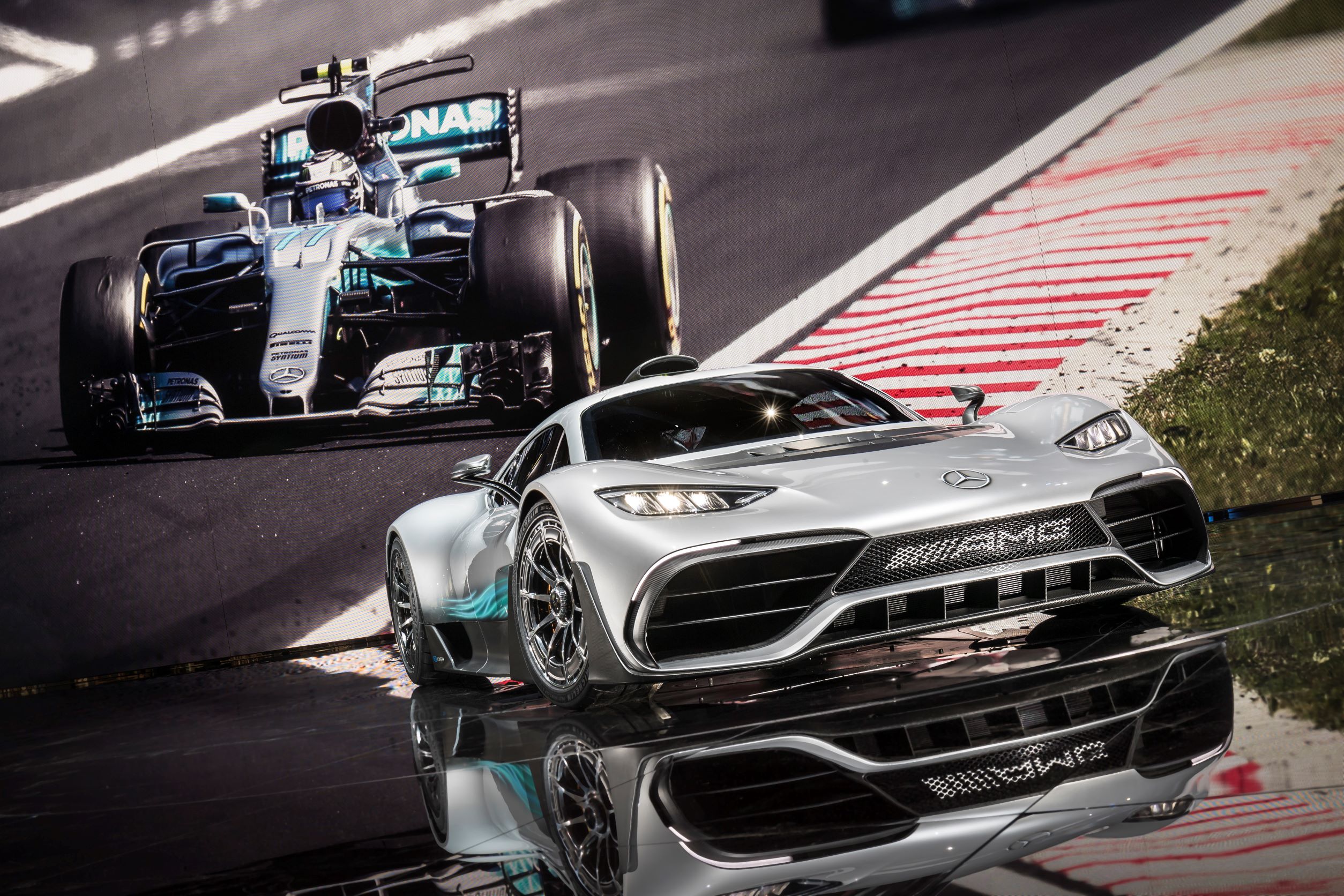
The Mercedes-AMG ONE stands alone in automotive history. Other hypercars borrow styling cues or marketing jargon from Formula 1, but Affalterbach went a step further: they shoehorned the actual 1.6-liter turbocharged V6 internal combustion engine and quad-motor hybrid setup from the championship-winning W07 F1 racer into a production chassis. Developing the car was an agonizing process that delayed customer deliveries by nearly five years.
A standard Grand Prix engine idles at roughly 5,000 RPM. Sitting at a traffic light at that speed would vaporize fuel and blow past every municipal noise and emissions limit on Earth. Mercedes-AMG engineers spent hundreds of thousands of hours rewriting software maps to force the thermal efficiency monster to idle steadily at 1,200 RPM. They also had to integrate an electrically heated catalytic converter system to clean up exhaust gases before the engine reaches full operating temperature.
The result is a combined 1,049 horsepower delivered through an all-wheel-drive system with torque vectoring. The engine spins to an astonishing 11,000 RPM, featuring pneumatic valve springs instead of mechanical steel coils. The ownership compromise is steep: the bespoke powertrain requires a complete factory rebuild every 50,000 kilometers (31,000 miles), an operational reality that underscores just how thinly veiled this racing engine really is.
Ground Effects and Adrian Newey's Aston Martin Valkyrie
While Mercedes chased powertrain authenticity, Red Bull Racing's aerodynamic genius Adrian Newey pursued pure ground effects. The Aston Martin Valkyrie does not use an F1 engine; it houses a naturally aspirated 6.5-liter V12 developed by Cosworth that screams to 11,100 RPM. In terms of chassis architecture, cockpit layout, and airflow management, the Valkyrie is an open-cockpit racer disguised in minimal bodywork.
The car is built around a razor-thin carbon fiber monocoque that forces the driver and passenger into an authentic Formula 1 seating position. Your heels sit elevated above your hips, canting your torso backward to clear room for massive underfloor Venturi tunnels. Newey prioritized downforce and aerodynamics to an extreme degree. Rather than relying on gigantic dive planes and towering rear spoilers that create high drag, the Valkyrie channels immense volumes of air beneath the floorboards, generating up to 2,425 pounds (1,100 kg) of downforce at track speeds.
Its suspension mirrors current single-seater geometry. An active pushrod suspension system mounts the spring and damper assemblies horizontally inboard, keeping them out of the clean airflow moving across the front wheels. When switched to Track mode, hydraulic actuators pull the chassis down toward the tarmac, stiffening the ride to handle massive aerodynamic loads without bottoming out.
The Radical Predecessors: Caparo T1 and the Lightweight Purists
Before multibillion-dollar manufacturers committed to building multi-million-dollar hypercars, a pair of ex-McLaren engineers tried to solve the equation directly. In 2006, Ben Scott-Geddes and Graham Halstead built the Caparo T1. It looked precisely like a closed-cockpit Le Mans prototype mated with a Formula 1 car, featuring exposed front wishbones, a center seating position, and a distinct high-nose front wing.
Weighing an unbelievable 1,036 pounds (470 kg) dry, the Caparo T1 relied on a high-revving 3.5-liter Menard V8 delivering 575 horsepower. Its power-to-weight ratio embarrassed every contemporary production car on the planet. The Caparo suffered from developmental instability, catching fire during multiple media demonstrations and demanding professional-grade driving talent to keep pointed straight. It served as a stark lesson: bringing open-wheel racing dynamics to ordinary asphalt is fraught with hazard.
Modern boutique outfits took those lessons to heart. Companies like Briggs Automotive Company (BAC) built the Mono, a single-seater, street-legal chassis that captures the visual silhouette and balance of an F1 racer while using bulletproof, naturally aspirated four-cylinder and turbocharged powerplants. The Mono delivers the sensory thrill of an open-wheel cockpit without requiring a pit crew of ten engineers just to check the oil.
Technical Comparison: Track Titans on the Pavement
Examining these machines side-by-side reveals how dramatically engineering priorities diverge when balancing track performance against street compliance.
| Model | Powertrain Architecture | Downforce & Weight | Base Price (USD) |
|---|---|---|---|
| Mercedes-AMG ONE | 1.6L Turbo V6 + 4 Electric Motors (1,049 hp) | 1,543 lbs @ 155 mph | 3,737 lbs curb | $2,750,000 |
| Aston Martin Valkyrie | 6.5L Cosworth V12 + KERS (1,140 hp) | 2,425 lbs peak | 2,800 lbs dry | $3,500,000 |
| Caparo T1 | 3.5L Menard V8 (575 hp) | 1,600 lbs @ 150 mph | 1,036 lbs dry | $480,000 (at launch) |
| BAC Mono R | 2.5L Mountune Inline-4 (343 hp) | 270 lbs @ 100 mph | 1,223 lbs dry | $280,000+ |
The Homologation Trap: Why Real F1 Chassis Cannot Be Road Registered
Every few years, an eccentric collector claims they plan to install headlights and turn signals on a retired Ferrari or Williams chassis to drive it on highway asphalt. It never works. The hurdle is not mechanical ingenuity; it is the rigid wall of government bureaucracy.
Meeting DOT safety regulations in the United States and global type-approval frameworks requires crash testing multiple vehicles into concrete barriers. Crushing three or four hand-laid composite chassis worth tens of millions of dollars destroys the economic feasibility of any low-volume conversion. Furthermore, modern safety statutes require dual-stage frontal airbags, side-curtain airbags, high-mounted third brake lights, backup cameras, and specific bumper impact absorption heights that open-wheel racing noses completely violate.
Then comes the matter of street registration requirements. The EPA and European regulators inspect evaporative emissions, cold-start tailpipe toxins, and decibel levels. Real Formula 1 engines run loose clearances when cold, spewing unburned hydrocarbons until the metals expand under intense heat. Even the Mercedes-AMG ONE skipped American federalization entirely. US buyers who imported the vehicle must rely on the NHTSA "Show or Display" exemption, which caps road usage at a strict 2,500 miles per year and prohibits daily transportation utility.
Living With Race Hardware: The Nightmare of Practical Use
Driving one of these machines through a city street is not an exercise in glamor; it is an assault on the senses. The Aston Martin Valkyrie does not feature sound insulation. The direct-gear drive system between the V12 Cosworth engine and the carbon monocoque turns the entire cabin into a sounding board. Drivers and passengers must wear aviation-grade noise-canceling headsets with integrated microphones simply to speak to one another over the mechanical whine.
Visibility is practically nonexistent. Sitting inches off the ground inside a sculpted aero capsule means blind spots swallow entire semi-trucks. The steering rack features an impossibly aggressive ratio with zero wheel-turn slack, meaning every pothole, expansion joint, and road crown wrenches the wheel in your palms. A single highway expansion joint hit at 45 MPH feels like a kick to the base of the spine.
Thermal management is equally punishing. Race cars rely on high forward velocity to force hundreds of cubic feet of air per second through radiators and brake ducts. Sitting in downtown traffic causes cabin temperatures to soar as the exhaust system and battery packs radiate heat through the carbon bulkheads. These are precision instruments engineered to operate on billiard-smooth FIA Grade 1 circuits. On public roads, every driveway curb becomes an insurmountable mountain, even with hydraulic nose-lift systems engaged.
Frequently Asked Questions (FAQ)
Q1: Can you legally convert a retired Formula 1 race car for street use?
A1: Practically speaking, no. While a handful of individual collectors in jurisdictions with loose kit-car registration rules (such as certain UK Single Vehicle Approval pathways) have registered historic, vintage racers from the 1960s or 70s, modern F1 cars cannot meet crash-structure, emissions, headlight-height, or pedestrian-impact standards. Modern single-seaters also lack reverse gears, cooling fans, and onboard starting mechanisms.
Q2: Why did Mercedes limit the engine life of the AMG ONE to 50,000 kilometers?
A2: The Mercedes-AMG ONE uses an actual Formula 1 1.6-liter turbocharged V6 with pneumatic valve springs running an 11,000 RPM redline. Because race engines are engineered with razor-thin tolerances and subjected to intense internal pressures, the piston rings, valvetrain components, and crank bearings experience mechanical wear rates exponentially higher than conventional sports car engines.
Q3: How do buyers drive the Mercedes-AMG ONE or Aston Martin Valkyrie in the US?
A3: Mercedes did not federalize the AMG ONE for general highway use in the United States due to emissions and crash-testing requirements. American owners must import the car under the federal "Show or Display" exemption law, which limits driving to 2,500 miles per year and requires special NHTSA approval based on the vehicle's historical or technical significance.
The Vanishing Era of Formula-Engineered Street Cars
We are watching the curtain fall on direct motorsport translation. As global vehicle regulations tighten emissions limits toward zero-tailpipe thresholds and mandate autonomous safety suites, the technical path required to shoehorn a screaming Grand Prix engine into a road car is rapidly closing. The Mercedes-AMG ONE and Aston Martin Valkyrie are not precursors to a broader wave of production open-wheel racers; they are the final, outrageous high-water mark of a mechanical obsession that will never be repeated.
Owning or driving a vehicle with genuine Formula 1 pedigree is deeply uncomfortable, absurdly expensive, and completely impractical for daily travel. That is precisely why these cars command such reverence. They represent a brief, defiant moment when master engineers ignored common sense, fought regulatory agencies to a standstill, and successfully proved that an F1 machine could survive on the street.
