The Cruise Control Fuel Myth: When Turning It On Actually Drains Your Gas Tank Faster
Every highway driver knows the temptation to flick on cruise control, lean back, and let the vehicle manage the drive. For decades, drivers treated the steering wheel button as an automatic fuel saver, assuming that a steady speedometer reading guarantees maximum miles per gallon (MPG). That calculation breaks down the moment the road begins to climb. As drivers track personal operating costs more closely, interest in hypermiling techniques has expanded well beyond niche forums. An analysis from a recent Daily Kos Report highlights how commuter strategies for stretch-saving fuel are shifting, showing that leaving automation engaged across undulating roads silently burns fuel rather than saving it.
The core problem lies in the machine's programming. Standard cruise control knows only how to match a target number, lacking eyes for the road ahead and an understanding of physical momentum. On level pavement, constant speed maintenance provides verified flat terrain fuel savings. Yet on rolling grades, that mechanical determination forces abrupt downshifting on inclines and wide-open throttle inputs. Understanding how and when to disable cruise control transforms routine highway driving gas consumption, keeping money in your wallet rather than pouring it through the exhaust pipe.
📌 Key Takeaways:
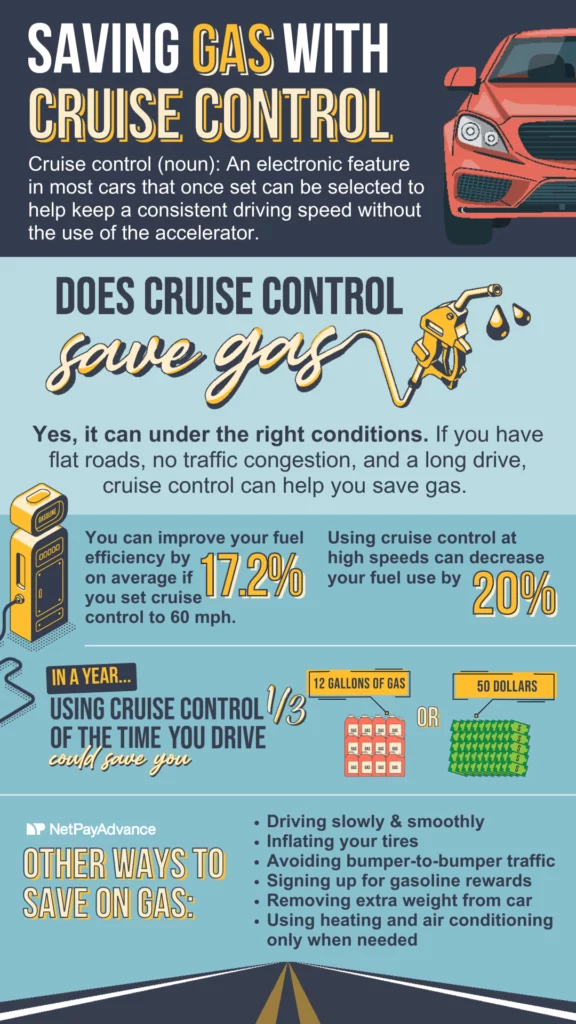
- The Topographical Divide: Automated throttle delivers 7% to 14% fuel economy gains on flat highways, but can slash efficiency by 5% to 10% across rolling hills.
- Mechanical Rigidity: Standard systems trigger dramatic engine RPM fluctuations by downshifting two to three gears on climbs, burning excess fuel to defend an arbitrary speed.
- The Radar Tax: Adaptive cruise control efficiency plummets in dense highway traffic due to repeated friction braking followed by aggressive recovery acceleration.
The Physics of Speed Maintenance on Level Highway Tarmac
On a flat stretch of interstate, human feet make poor speed regulators. Drivers unconsciously adjust pedal pressure based on music, wandering focus, or minor cabin distractions. A driver attempting to hold 65 mph manually often drifts between 62 and 71 mph. Every unintended micro-acceleration demands a burst of fuel; every subsequent lift of the foot throws that kinetic energy away to aerodynamic drag. Steady throttle management remains the single most effective way to optimize fuel economy over extended distances.
Cruise control shines in this specific operational window. By monitoring wheel speed sensors dozens of times per second, the vehicle computer makes minute adjustments to the electronic throttle body, holding manifold pressure exceptionally steady. Eliminating the human "accordion foot" cuts wasteful fuel pulses. Real-world testing consistently shows that using cruise control on flat stretches nets a 7% to 14% improvement in overall highway mileage. The engine sits comfortably in its highest gear, turning at low, steady RPMs where thermal efficiency peaks.
The Hilly Terrain Trap: Why Computers Waste Fuel on Grades
The efficiency curve crashes when the highway enters rolling hills. To a driver scanning the horizon, an approaching hill signals an intuitive adjustment: allow momentum to carry the car upward, let speed bleed off by 3 or 4 mph near the crest, and recover that speed freely on the descent. Cruise control computers cannot see the crest. Programmed with rigid tolerances, the system panics the millisecond gravitational load slows the vehicle below the designated setpoint.
To compensate, the transmission controller commands aggressive downshifting on inclines. A modern eight-speed automatic might drop instantly to fifth or fourth gear. Engine RPM fluctuations surge from a calm 1,800 RPM to over 4,200 RPM, forcing the engine into open-loop fueling where the fuel-air mixture enriches heavily to prevent pre-ignition and deliver peak torque. This hilly terrain fuel burn wipes out any savings accumulated across previous flat miles. By the time the vehicle crests the summit, it has burned through an enormous amount of fuel simply to defend an arbitrary set point that a human driver would have naturally compromised.
Data Benchmarks: Cruise Control Efficiency Across Driving Profiles
Operating conditions dictate whether automated throttle management saves money or drives up operating costs. The table below illustrates how different highway environments alter fuel consumption between automated and manual driving modes.
| Highway Environment | Cruise Control Behavior | MPG Impact vs. Conscious Manual | Recommended Driving Action |
|---|---|---|---|
| Flat Interstate | Minimal throttle changes; stays in top overdrive gear. | +7% to +14% MPG | Engage cruise control; maintain constant buffer. |
| Rolling Foothills (3, 6% grade) | Frequent multi-gear downshifts; rapid throttle opening. | -5% to -10% MPG | Disengage cruise; apply steady throttle uphill. |
| Moderate Traffic (Adaptive) | Repetitive radar braking followed by brisk acceleration. | -4% to -8% MPG | Drive manually; coast to absorb traffic gaps. |
| Mountain Passes (>7% grade) | Sustained high-RPM revving; excessive brake usage downhill. | -12% to -18% MPG | Manual control; select lower gear for descent. |
The Hypermiling Counter-Strategy: Driving with Load
Long-distance efficiency experts rely on a technique known as "driving with load." Instead of holding speed constant, the driver keeps the engine's mechanical load steady. As your car encounters an incline, you maintain a fixed throttle position rather than depressing the accelerator pedal further. The vehicle naturally sheds speed, dropping from 70 mph down to 64 mph as the grade steepens, while the transmission remains locked in its highest, most fuel-efficient gear.
Commercial transit operations understand this exact vulnerability. When regional fleets update their vehicles, such as Baxters Haulage adding dedicated gas-powered Volvo FM trucks equipped with predictive powertrains, the underlying software uses satellite terrain maps to cut fuel delivery before an incline and free-wheel across crests. Without high-end predictive GPS cruise control in your personal car, mimicking this hypermiling habit manually remains the only way to avoid the incline fuel penalty. Letting your car settle slightly on climbs and recovering speed on downhills preserves momentum without dumping raw gasoline into the cylinders.
Adaptive Cruise Control in Congestion: The Hidden Brake-and-Surge Cycle
Modern vehicles frequently pair speed control with forward-facing radar and cameras, introducing adaptive cruise control (ACC). While ACC reduces driver fatigue in busy highway corridors, its impact on fuel economy is often negative. Human drivers spot brake lights four or five cars ahead, easing off the accelerator early to coast through slowing traffic. Radar sensors, by contrast, react exclusively to the direct vehicle ahead.
When the lead car taps its brakes, the ACC system often reacts late, clamping down on friction brakes to preserve the set following gap. Brake pads convert kinetic energy into wasted ambient heat. Once the gap opens, the system applies heavy throttle to regain the programmed speed quickly. This continuous cycle of hard braking and aggressive throttle recovery turns smooth highway driving into a stop-and-start pattern that sharply increases fuel consumption. Unless traffic flows freely with wide car spacings, ACC acts as an efficiency penalty.
Developing Fuel-Saving Driving Habits for Mixed Routes
Maximizing range does not require abandoning automated systems entirely. It demands treating cruise control as a selective tool rather than a default driving mode. Smart fuel management involves engaging the system only when conditions match its design strengths: open sightlines, gentle topography, and sparse traffic patterns.
When approaching highway hill country, tap the cancel button early. Use your right foot to establish a steady pedal angle, allowing the vehicle to surrender a small amount of speed as it ascends. Never accelerate violently to regain speed immediately after cresting; let gravity assist the vehicle down the descent. Combining selective cruise control on flat terrain with intuitive manual throttle management over rolling topography bridges the gap between driver convenience and peak efficiency.
Frequently Asked Questions (FAQ)
Q1: Does cruise control always save gas on road trips?
A1: No. Cruise control saves measurable fuel on flat, open highways by keeping throttle inputs steady. On rolling or mountainous terrain, it forces frequent downshifts and wide throttle openings, consuming noticeably more fuel than a driver managing speed manually.
Q2: Why does adaptive cruise control consume more gas than traditional systems in traffic?
A2: Adaptive cruise control responds reactively to the car directly ahead rather than anticipating overall traffic flow. It frequently applies mechanical brakes to preserve spacing and then uses aggressive throttle inputs to regain speed, burning excess fuel compared to smooth, manual coasting.
Q3: At what speed does aerodynamic drag wipe out cruise control savings?
A3: Wind resistance increases exponentially relative to speed. Regardless of cruise control engagement, vehicle efficiency drops sharply above 65 mph. Driving at 75 to 80 mph on cruise control can burn up to 15% to 20% more fuel than traveling at 65 mph under the same conditions.
Mastering Throttle Control on the 2026 Highway
Vehicle automation continues to grow more advanced, but standard speed control remains bound by simple geometry and mechanical limits. A vehicle computer cannot weigh the fiscal trade-off of dropping a few miles per hour on an uphill grade; it will always burn whatever fuel is required to satisfy its code. Drivers who recognize this limitation retain an immediate edge at the pump. By taking manual control on grades and reserving automation for flat, open tarmac, you maintain mechanical sympathy for your engine while extracting the highest possible mileage from every gallon.
