The Evolution of the Mirror Fun House: From 19th-Century Sideshows to Modern Stage Plays

Step inside a traditional mirror fun house, and your immediate reality buckles within three paces. Your torso stretches into a comic spindle, your companions multiply into infinite corridors, and a single miscalculated step sends your nose straight into polished plate glass. For over a century, these optical labyrinths have anchored amusement park boardwalks across the globe, translating the basic physics of reflection into raw sensory disorientation. Yet, as cultural critics at The Times of Israel Report observed when analyzing contemporary public discourse through the metaphor of funhouse mirrors, the attraction has evolved into something far more expansive than a boardwalk novelty: it has become an indispensable framework for understanding psychological perception, modern stagecraft, and the fractured narratives of the media age.
Far from fading into dusty carnival history, the format is undergoing an ambitious commercial and artistic revival. Industry coverage from Blooloop tracking modern amusement revamps, including major midway refurbishments like the reimagined walkthrough funhouse experiences at Pacific Park on the Santa Monica Pier, proves that audiences still crave physical, tactile spatial disorientation. Even as virtual reality headsets promise total immersion, thousands of visitors still queue each weekend to bump their shins against plate glass, seeking the unpretentious joy of a distorted reflection.
📌 Key Takeaways:
- The Mechanical Origins: Patented in Europe during the late 19th century, mirror maze design rapidly transitioned from Parisian scientific spectacles into quintessential American carnival side shows on Coney Island's early 20th-century boardwalks.
- The Deceptive Optics: Funhouse mirrors rely entirely on alternating combinations of cylindrical convex and concave glass, bending light along perpendicular planes to produce drastic vertical elongation and lateral squashing.
- Modern Artistic Integration: Contemporary stage plays and digital media installations now adapt mirror maze geometry to physically externalize cognitive dissonance, memory distortion, and societal identity crises.
Coney Island Boardwalks and the Genesis of the Distorted Maze
The mirror fun house did not originate as children's entertainment. It emerged from European optical research and Victorian visual exhibitions. In 1888, Parisian inventor Gustav Castan secured early patents for labyrinthine mirror systems, marketing them as high-society diversions that demonstrated the bizarre properties of light propagation. These early installations, modeled loosely after Versailles' historic Hall of Mirrors, prioritized elegant architectural symmetry over shock value.
The concept turned rowdy when it crossed the Atlantic. American midway pioneers stripped away the gilded European salon aesthetics, realizing that unmoored visual perception could drive massive gate receipts. By the time Steeplechase Park and Luna Park opened at Coney Island in the early 1900s, walkthrough funhouse attractions had become staples of seaside entertainment. Operators discovered that patrons were eager to pay a nickel or dime to watch their neighbors stumble through dark corridors, scream at dead ends, and laugh at grotesque parodies of their own bodies.
These vintage midway attractions merged the hall of mirrors with moving floors, sudden blasts of compressed air, and spinning barrels. The mirrors formed the centerpiece. They gave visitors license to laugh at bodily shapes that defied strict Edwardian social propriety, laying the groundwork for a multi-million-dollar entertainment genre.
The Physics of Curvature: How Convex and Concave Glass Trick the Eye
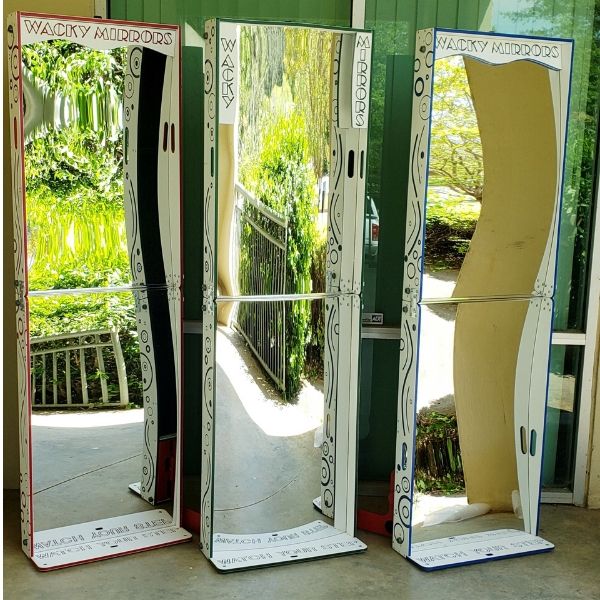
The mechanics behind funhouse mirrors are surprisingly straightforward, depending entirely on cylindrical curves rather than spherical ones. Standard household flat mirrors present a specular reflection where the angle of incidence equals the angle of reflection across every square millimeter, yielding an accurate 1:1 image. Funhouse mirrors shatter that uniformity.
By shaping glass or polished acrylic into convex and concave forms, designers manipulate the focal point of the reflected rays:
- Concave Curves (Inward Bending): Light rays converge toward a central focal point. When a viewer stands outside that focal length, the image flips upside down. When standing inside the focal point, the image expands outward, stretching the viewer's proportions into wide, squat dimensions.
- Convex Curves (Outward Bending): Light rays diverge, spreading out as they bounce off the reflective surface. This compresses the reflected image, making the viewer appear unnaturally elongated and slender.
- Compound Undulations: Most commercial funhouse mirrors fuse both geometries onto a single vertical pane. A mirror curved outward at the top, inward in the middle, and outward at the base creates an accordion effect: an elongated forehead, a compressed waistline, and oversized feet.
Because the curvature runs primarily along one axis, typically vertical or horizontal, the mirror warps one dimension while leaving the other untouched. That stark asymmetry short-circuits the brain's baseline visual processing, creating immediate comic relief.
Two Centuries of Distorted Reflection: From Midways to Mixed Reality
The structural layout of reflective attractions has shifted dramatically over the past 130 years, transitioning from fragile silvered glass mazes to computerized multisensory environments.
| Era | Structural Mechanics | Sensory Experience | Primary Materials |
|---|---|---|---|
| 1890s, 1930sMidway Golden Age | Equilateral triangular floorplans, manual hand rails, gas and early incandescent lighting. | Pure physical disorientation, slapstick comedy, bodily surprises via compressed air. | Plate glass mirrors, silver nitrate, timber frames, tin accents. |
| 1940s, 1980sTraveling Carnivals | Modular folding trailers, simplified dead-end hallways, high-throughput pathing. | Rapid navigation, carnival barker showmanship, pop-art visual gags. | Tempered safety glass, lightweight steel chassis, neon and blacklight paint. |
| 1990s, 2010sThemed Destination Hubs | Computer-assisted 60-degree triangular grids, integrated escape-room puzzles. | Atmospheric sound design, ambient infinity effects, directional LED lighting. | Optical-grade acrylic, one-way mirrors, digital sensor arrays. |
| 2020s, 2026Hybrid Digital Installations | Dynamic kinetic mirrors, responsive projection mapping, generative AI cameras. | Personalized narrative shifts, theatrical metaphors, real-time avatar morphing. | Smart glass with variable opacity, flexible OLED panels, LiDAR tracking. |
Spatial Disorientation and the Secrets of Mirror Maze Design
Designing a compelling mirror maze requires a balance between architectural discipline and psychological warfare. A poorly designed maze is either transparently easy or dangerously frustrating. The gold standard of mirror maze architecture relies on an equilateral triangle geometry. By setting mirror panels at exact 60-degree angles, designers eliminate the visual clues that normally reveal spatial depth.
In a standard square hallway, a viewer's eyes easily track corners and shadows. At 60 degrees, reflections repeat outward across triangular nodes, creating an illusion of infinite repeating corridors. The ceiling and floor become critical vulnerabilities for the illusionist. If the carpet has a directional grain or the ceiling features visible light fixtures, visitors can simply stare down at the floorboards to navigate their way out.
Master maze builders counter this by installing uniform black floors, indirect baseboard lighting, and false overhead arches that reflect endlessly alongside the walls. Modern park operators also provide plastic gloves at the ticket counter. Fingerprints on glass instantly shatter the illusion, transforming a confounding optical trap into a series of dirty windows.
From Boardwalk Oddities to Theatrical Stages and Digital Installations
Over the past decade, the mirror fun house has migrated from seaside boardwalks into fine art galleries and regional theaters. Stage directors increasingly use reflective mazes to externalize psychological fragmentation. When regional theater productions examine hidden social histories, such as historical plays uncovering forgotten institutions reported by community arts outlets like Mirror Indy, scenic designers frequently lean on distorted glass and fractured reflection panels to dramatize memory lapses and institutional deceit.
Contemporary stage productions deploy motorized two-way mirrors that shift from reflective surfaces into transparent windows as backstage lighting shifts. Characters literally confront distorted caricatures of their past actions before the glass dissolves to reveal historical truths waiting behind the wall. The midway attraction has transformed into a sophisticated theatrical instrument.
Parallel shifts have transformed experiential retail and modern art. High-profile exhibits like Yayoi Kusama's Infinity Mirror Rooms and teamLab's interactive environments take the basic premise of the 1920s fun house and inject endless, algorithmically generated patterns. In these contemporary spaces, the distortion is no longer just about bending an arm or inflating an abdomen; it questions the physical boundaries of the individual self in an interconnected world.
Perceptual Psychology: Why We Pay to See Ourselves Warped
Why does watching our bodies twist into carnival proportions trigger delight instead of horror? Cognitive scientists point to a concept known as "controlled discrepancy." Humans maintain a rigid internal schema of their own body proportions, known as the somatosensory homunculus. The brain spends significant energy tracking where our physical limbs begin and end.
When you stand before a concave carnival mirror, your visual cortex delivers sensory data that flatly contradicts your internal kinesthetic map. You know your legs are normal length, yet your eyes report they have shriveled to six inches. In a threatening context, this perceptual disconnect triggers panic or depersonalization. In a brightly lit funhouse filled with ambient carnival music and laughing companions, the brain categorizes the mismatch as entirely benign.
The resulting laughter serves as a neurological reset button. It is the brain's release valve after rapidly resolving a sensory conflict. Far from an idle triviality, the mirror fun house offers a safe, controlled environment where we temporarily surrender bodily control, laugh at our physical limitations, and re-emerge onto the boardwalk with our senses refreshed.
Frequently Asked Questions (FAQ)
Q1: Why do classic mirror fun houses require visitors to wear plastic gloves?
A1: Natural skin oils leave smudges and fingerprints on the glass panes. In a mirror maze, visible smudges reveal which surfaces are solid glass and which are open archways, ruining the optical illusion for subsequent visitors and increasing the risk of people walking into the glass.
Q2: How do commercial theme parks prevent injuries inside mirror mazes?
A2: Modern operators use high-impact architectural safety glass or scratch-resistant polycarbonate acrylic mounted on heavy shock-absorbing gaskets. Facilities also limit corridor lengths to prevent guests from building up walking speed, while strategically placed soft LED floor lighting indicates boundary lines without breaking the reflective illusion.
Q3: What is the main structural difference between a hall of mirrors and a mirror maze?
A3: A hall of mirrors is typically a linear corridor flanked by distorted convex and concave glass designed purely for passive observation and comedic viewing. A mirror maze is a non-linear labyrinth built on strict triangular or hexagonal angles with multiple dead ends, designed to produce active navigational disorientation.
The Enduring Pull of the Distorted Self
More than a century after its midway debut, the mirror fun house retains an uncommon hold over public amusement. Its survival defies our era of hyper-rendered digital entertainment. Screen-based virtual environments can engineer impossibly rich fantasy worlds, yet they cannot reproduce the tactile sensation of reaching into empty space only to discover cold plate glass against your palms.
The enduring power of the funhouse mirror lies in its analog honesty. It does not replace the viewer's reality with computer graphics; it takes the viewer's actual physical form and twists it using nothing more complex than bent glass and ambient light. In an era obsessed with curated digital profiles and filtered perfection, the mirror fun house remains a welcome sanctuary where we can step out of the everyday grind, watch our faces bend out of proportion, and laugh without hesitation at our own distorted reflections.
