What Is Uranium? Debunking the Myths Behind Radiation, Chemistry, and Indigenous Resistance
Uranium sits at the center of the modern energy transition, yet public understanding of the dense, silvery metal remains clouded by Cold War folklore and science-fiction tropes. As nations deploy next-generation small modular reactors to hit decarbonization targets, geopolitical friction over breakout times and fuel supplies has spiked. Clarifying how this metal functions in the real world has become urgent; as detailed in a recent Foundation for Defense of Democracies Report examining widespread fallacies surrounding national fuel programs, widespread confusion often conflates civilian power generation with immediate weapons capability.
Strip away the political posturing and pop-culture glow, and you find a naturally occurring heavy metal governed by exacting physical principles. Uranium is neither an unstable green sludge nor an inherently explosive powder. It is a geological fixture that shaped Earth's interior heat, built the architecture of twentieth-century warfare, and now underpins roughly 10% of global electricity generation. Examining the realities of the element requires separating atomic physics from persistent cultural myths, assessing the legacy of extraction on native lands, and understanding where fuel chemistry is heading next.
📌 Key Takeaways:
- The Baseline Chemistry: Uranium is a naturally occurring heavy metal with atomic number 92; its primordial instability generates low-level alpha radiation and slow radioactive decay.
- The Isotope Bottleneck: Natural ore contains over 99.2% uranium-238 and only 0.7% fissile uranium-235 isotope, requiring industrial-scale gas centrifuges to concentrate the fuel.
- The Human Footprint: Unremediated mill tailings in communities like the Navajo Nation present chronic heavy metal toxicity and lung risks via radon, distinct from nuclear fallout.
The Primordial Heavy Metal: Atomic Number 92
Uranium holds the highest atomic mass among all naturally occurring elements. With atomic number 92, its nucleus contains 92 protons bound to a shifting number of neutrons. Discovered in 1789 by German chemist Martin Heinrich Klaproth inside pitchblende samples from modern-day Czechia, the element was named after the newly spotted planet Uranus. Klaproth believed he had found a pure metal, but French chemist Eugène-Melchior Péligot isolated the true metallic element in 1841.
In its pure form, uranium is a dense, malleable metal with a density of 19.1 grams per cubic centimeter, nearly 70% denser than lead. You could hold a polished block of natural uranium in your hand with minimal acute danger. The element undergoes very slow radioactive decay, primarily emitting alpha particles. Because alpha particles cannot penetrate human skin or a standard sheet of paper, the exterior radiation exposure risks of holding the raw metal are remarkably low.
The core physics changes entirely when uranium is inhaled, ingested, or forced into fission. Geological formations across Australia, Kazakhstan, and Canada harbor uranium alongside decay daughters like radium, thorium, and radon gas. Inside the Earth, this sluggish decay supplies an estimated half of the planet’s internal geothermal heat, keeping our mantle churned and magnetic field intact.
The Nuclear Fuel Cycle: From Yellowcake to Gas Centrifuges
Nuclear fuel production relies on an intricate, capital-intensive manufacturing sequence known as the nuclear fuel cycle. The journey begins underground, where companies mine uraninite deposits either through conventional hard-rock extraction or in-situ recovery (ISR), which pumps oxygenated groundwater into permeable sandstone to dissolve the mineral in place.
Once extracted, the liquid ore passes through processing facilities that crush, leach, and concentrate the mineral into a dry, coarse powder called yellowcake uranium (predominantly $U3O8$). Despite its historical name, modern yellowcake typically looks dark brown or black. It is chemically toxic, similar to lead or mercury, but exhibits negligible radioactivity.
[Uranium Ore] ➔ [Milling & Leaching] ➔ [Yellowcake (U3O8)] ➔ [Fluorination (UF6 Gas)] ➔ [Gas Centrifuges] ➔ [Enriched UO2 Fuel Pellets]
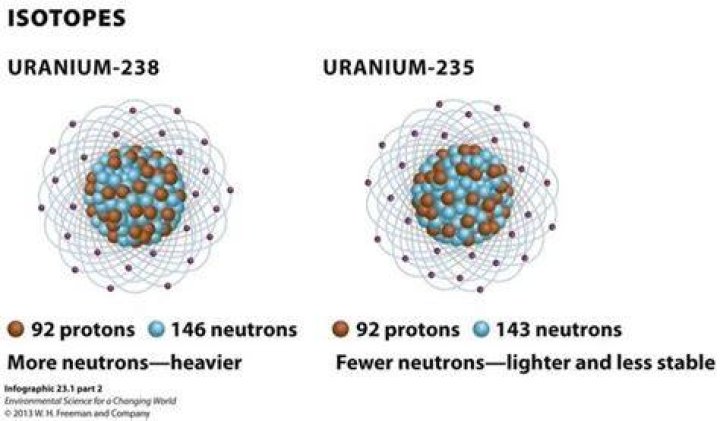
To harness the metal for energy, civil engineers require nuclear fission, the splitting of an atomic nucleus that releases extraordinary amounts of thermal energy. Only one natural uranium isotope easily undergoes fission when struck by a slow neutron: the uranium-235 isotope.
The natural distribution of isotopes creates a fundamental engineering bottleneck:
- Uranium-238: Accounts for roughly 99.27% of mined ore; it is fertile rather than fissile.
- Uranium-235: Accounts for just 0.72% of natural deposits.
- Uranium-234: A trace decay product present at roughly 0.0055%.
Because U-235 and U-238 possess identical chemical properties, chemical reactions cannot separate them. Engineers must exploit the minuscule 1.26% difference in their physical mass. Refiners transform yellowcake into uranium hexafluoride ($UF_6$), a compound that sublimates into gas at 56.5°C (133.7°F).
Operators feed this gas into cascades of rapidly spinning gas centrifuges. Spinning at rotor wall speeds exceeding 1,000 meters per second, the centrifuges cast the slightly heavier U-238 toward the outer cylinder walls, drawing the slightly lighter U-235 from the center. Repeating this cycle hundreds of times produces low-enriched fuel for civilian reactors, leaving behind vast stockpiles of depleted uranium stripped of its fissile material.
Evaluating Uranium Grades Across Civilian and Military Uses
The degree of enrichment dictates what the material can physically achieve. Civilian power stations do not use weapons-grade material, and low-enriched power station fuel cannot detonate like a bomb, regardless of operating conditions.
| Uranium Grade | U-235 Concentration | Primary Application | Non-Proliferation Risk Tier |
|---|---|---|---|
| Depleted Uranium (DU) | Tank armor, counterweights, armor-piercing munitions | Negligible (Zero explosive utility) | |
| Natural Uranium | 0.72% | CANDU heavy-water reactors, enrichment feedstock | Baseline monitoring (IAEA safeguards) |
| Low-Enriched (LEU) | 3.0, 5.0% | Standard commercial light-water reactors (PWR/BWR) | Strictly tracked; unviable for weapons |
| High-Assay LEU (HALEU) | 5.0, 19.75% | Advanced small modular reactors, research facilities | Heightened surveillance; sub-weapons threshold |
| Highly Enriched (HEU) | 20.0, 90.0%+ | Naval propulsion reactors (submarines), nuclear weapons | Critical proliferation hazard; immediate security response |
Reaching weaponization requires climbing a steep enrichment hill. The physical work needed to enrich raw material from 0.7% to 4% represents roughly three-quarters of the total separative work units (SWU) required to reach weapons-grade 90% HEU. Because the volume of material shrinks drastically as concentrations rise, an enrichment cascade processing 4% or 20% material can sprint toward weapons levels far faster than it can process natural feedstock. This technical dynamic makes enriched fuel monitoring the central pillar of international safeguards.
The Human Toll: Mill Tailings and Environmental Injustice
While reactor cores draw the focus of engineering summits, uranium extraction left deep scars on marginalized communities. The early nuclear age extracted raw materials without informing local populations of the radiological consequences.
Between 1944 and 1986, commercial extraction operations pulled roughly 30 million tons of uranium ore out of lands belonging to the Navajo Nation in the American Southwest. Cold War defense procurement paid little heed to dust containment or groundwater protection. When extraction companies abandoned these sites, they left behind more than 520 unsealed open-pit mines, exposed shafts, and mountainous piles of waste known as mill tailings.
Uranium Ore Processing Waste:
85% of Original Ore Radioactivity Remains in Mill Tailings
├── Radium-226 (Half-life: 1,600 Years)
│ └── Decays into Radon-222 Gas (Inhalation Hazard)
└── Heavy Metal Leaching (Arsenic, Cadmium, Uranium Salts)
└── Contaminates Aquifers & Shallow Wells
Mill tailings contain roughly 85% of the original radioactivity found in raw ore. Radium-226 continually decays into radon-222, an odorless, invisible gas that settles in depressions, arroyos, and unventilated homes.
On July 16, 1979, the United Church Rock tailing dam in New Mexico failed, releasing more than 1,100 tons of solid radioactive mill waste and 94 million gallons of acidic effluent into the Puerco River. It stands as the largest liquid radioactive release in United States history, surpassing Three Mile Island in volume, yet it drew only a fraction of the contemporary media coverage.
Generations of Diné miners and families faced elevated rates of lung cancer, kidney damage, and unique autoimmune disorders linked to heavy-metal toxicity. Medical research from the ongoing Navajo Birth Cohort Study confirms that uranium functions primarily as a potent nephrotoxin: its chemical behavior damages renal tubules far more rapidly than its alpha radiation can induce tissue ionization. Remediating these areas remains slow, caught in litigation and funding shortages.
Chemical Frontiers: Seawater Mining and Non-Proliferation Safeguards
Current mining methods cannot expand indefinitely without driving up energy inputs and land disruption. Uranium occurs in the world's oceans at an average concentration of just 3.3 parts per billion, yet because of oceanic scale, that tiny ratio amounts to roughly 4.5 billion metric tons of dissolved uranium, almost 1,000 times the known reserves buried on dry land.
Recent advances in coordination chemistry have made harvesting this dispersed reservoir technically feasible:
- Polymeric Amidoxime Adsorbents: Marine engineers anchor woven polyethylene braids treated with amidoxime functional groups to ocean shelves. The chemical arms selectively bind uranyl ions ($UO_2^{2+}$) amid competing ions like vanadium, iron, and magnesium.
- Electrochemical Desorption: Instead of using harsh acids to strip adsorbed minerals, researchers now use low-voltage electric pulses, cutting chemical waste by 60% while extending the working life of the absorbent braids.
- Metal-Organic Frameworks (MOFs): Synthetic porous crystals achieve extraction selectivity up to five times higher than baseline polymers, functioning effectively in brackish conditions and industrial wastewater outfalls.
As extraction methods evolve, tracking enriched material grows more difficult. International organizations enforce strict guidelines under nuclear non-proliferation treaties to deter secret weapons programs. Advanced environmental sampling methods detect trace concentrations of $UF_6$ gas and distinct isotopic shifts around centrifuge halls from kilometers away. These forensic tools allow investigators to spot unauthorized enrichment work long before a country can assemble a functional device.
Frequently Asked Questions (FAQ)
Q1: Can raw uranium ore explode on its own?
A1: No. Natural uranium ore cannot detonate or trigger a chain reaction under ambient conditions. A self-sustaining fission reaction requires a high concentration of the rare uranium-235 isotope, an external neutron source, and a geometry that prevents excess neutrons from escaping.
Q2: Why is uranium dangerous if its radiation cannot penetrate skin?
A2: The primary danger of natural uranium is chemical toxicity rather than radiation. Ingested or inhaled dust damages the kidneys much like lead or mercury poisoning. Over long periods, trapped particles also release alpha radiation directly into sensitive lung tissue, raising lifetime cancer risks.
Q3: What makes HALEU fuel central to new reactor designs?
A3: High-Assay Low-Enriched Uranium (enriched between 5% and 19.75% U-235) allows advanced small modular reactors to run on smaller, more efficient cores with longer intervals between refueling. It boosts power output without crossing the 20% enrichment line that triggers strict military safeguards.
Navigating the Nuclear Calculus Beyond 2026
Uranium presents modern society with a stark set of engineering and ethical realities. The physical characteristics of element 92 make it uniquely valuable: a single uranium fuel pellet measuring less than half an inch tall delivers the same usable energy as one ton of coal, all without emitting carbon dioxide during fission.
Realizing that potential requires reckoning with the metal's entire lifespan. The nuclear industry faces pressing challenges, including managing historical mine waste, remediating tailings on sovereign native lands, and securing enrichment facilities under international oversight. Responsible use demands treating uranium not as a quick technological fix or a cartoonish menace, but as a complex material whose long-term risks require constant, transparent vigilance.
