Why King of Prussia's IMAX 70mm Print of 'The Odyssey' Is Such an Elusive Visual Feat
Moviegoers across the Mid-Atlantic are packing their cars and crossing state lines this summer for a film experience that digital multiplexes cannot replicate. When showtimes opened for the epic production, enthusiasts realized just how few venues could project the director's true vision. Regal UA King of Prussia emerged as a central pilgrimage site for audiences spanning Pennsylvania, New Jersey, Delaware, and beyond. As detailed in an engadget.com Report on the release, the machinery required to run a physical celluloid copy demands hardware and specialized labor that modern theaters dismantled years ago.
The cinematic landscape of 2026 runs almost entirely on hard drives, encrypted DCP satellite streams, and automated solid-state laser bulbs. Yet King of Prussia is bucking the industry standard by running a physical print on an enormous scale. The presentation offers an uncommon glimpse into heavy-duty analog engineering that turns a standard movie screening into an industrial tightrope walk.
📌 Key Takeaways:
- Extreme Scarcity: Regal UA King of Prussia is one of only 25 theaters worldwide capable of projecting 'The Odyssey' on 15-perf 70mm celluloid.
- Towering Geometry: The physical print fills a complete 1.43:1 aspect ratio, unlocking 40 percent more visual information than standard digital auditoriums.
- Mechanical Scale: Operating the 600-pound print requires a continuous horizontal platter system and seasoned projectionists working around the clock.
The Rarity Factor Behind the 25-Theater Worldwide Footprint
Seeing a modern release on large-format film is no longer a standard consumer option. It is an anomaly. Out of thousands of commercial screens across North America, only a handful preserved their legacy 15/70 projection rigs after the industry completed its digital conversion in the early 2010s. For 'The Odyssey', distribution logistics restricted physical prints to roughly 25 locations globally, turning regional theaters into major cultural destinations.
This geographic concentration creates substantial travel demands for dedicated cinephiles. Reporting from the Cincinnati Enquirer highlighted that residents across entire states like Ohio must drive hundreds of miles east to King of Prussia or north to Michigan to catch an authentic analog screening. Regional film communities organize carpools and weekend road trips specifically to secure seats in the suburban Philadelphia auditorium.
The shortage is not just about screen hardware. Striking a 15-perforation 70mm film print is an astonishingly expensive, labor-intensive process. Specialized laboratories run chemical development baths and optical quality checks on miles of delicate stock. Multiplex operators must also invest tens of thousands of dollars to service aging mechanical gear that sits dormant between major auteur releases.
The Visual Scale of the 1.43:1 Aspect Ratio
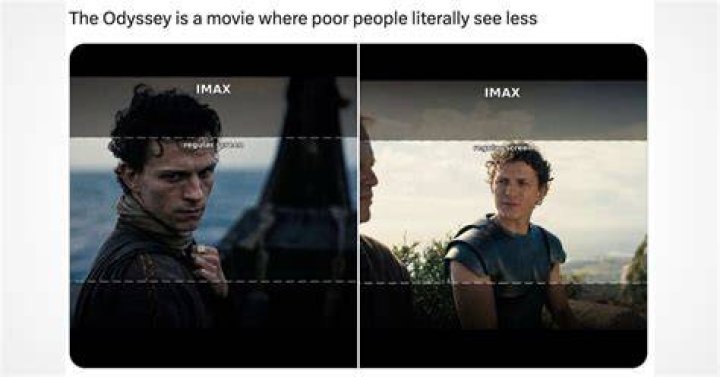
Most commercial cinema screens operate at a wide, rectangular ratio of 2.39:1 or 1.85:1. An IMAX 70mm film print, however, feeds horizontally through the projector gate to produce an expansive 1.43:1 picture. The top and bottom of the frame open up completely. The image looms over peripheral vision, transforming maritime sequences and sweeping vistas into vertical panoramas that swallow the viewer's field of view.
The screen dimensions at Regal UA King of Prussia measure approximately 71 feet tall by 90 feet wide. When scenes shot with 65mm cameras expand into this full frame, the sheer square footage of illuminated celluloid dwarfs standard theatrical setups. The optical resolution of the stock has no digital pixel grid; film scientists estimate its native detail resolves to the equivalent of 16K to 18K digital clarity.
Audiences sitting in the center rows experience zero visible grain clumping or compression artifacts. Water spray, textile textures, and deep-focus horizons retain razor-sharp definition even across thousands of square feet of canvas. That scale cannot be duplicated by simply sitting closer to a smaller, letterboxed screen.
Format Differences: 70mm Film Against Modern Digital Options
Navigating the premium cinema market in 2026 requires understanding distinct technical tiers. Standard digital auditoriums often brand themselves with premium badges, but the underlying projection hardware differs drastically in brightness, resolution, and native geometry.
| Exhibition Format | Aspect Ratio | Estimated Clarity | Projection Method |
|---|---|---|---|
| IMAX 15/70mm Film | 1.43:1 (Full Height) | 16K, 18K Equivalent | Horizontal 15-perf analog film with rolling loop |
| Dual Laser (GT) | 1.43:1 (Full Height) | 4K Native (Dual Engine) | Dual 4K RGB laser projection units |
| Single Commercial Laser | 1.90:1 (Cropped) | 4K Native | Single laser engine with optical prism |
| Standard Multiplex DCP | 2.39:1 / 1.85:1 | 2K to 4K Digital | Xenon lamp digital projector |
While the debate surrounding dual laser vs 70mm highlights laser's superior contrast and lack of dust, celluloid delivers an organic, high-luminance depth that digital sensors still struggle to match. The mechanical shutter creates an organic pulse. The human eye detects subtle tonal gradations in daylight and sea foam that look clinical on consumer digital chips.
Inside the Projection Booth: Platters, Splices, and Mechanical Strain
Projecting an analog print this large is an unforgiving industrial process. Because 'The Odyssey' features an expansive cinematic runtime passing the three-hour mark, the physical footprint of the print is staggering. It spans roughly eleven miles of acetate and weighs north of 600 pounds.
A standard vertical reel cannot hold this mass without tearing the film under its own weight. The booth at King of Prussia relies on a massive horizontal platter system. The film rests flat on wide steel discs, spooling outward from the center, feeding through a series of rollers into the projector head, and rewinding onto a companion platter in real time.
This operational hurdle requires an expert film projectionist. The technician must manually thread the print through the vacuum-assisted rolling loop mechanism, monitor tension arms, and keep the glass gate clean of microscopic debris. A single friction snag can heat the stock, melt frames, or shut down a screening instantly. Modern cinema projection has become a push-button affair; King of Prussia's booth operates like a mid-century locomotive engine room.
Ticket Demand and the Practical Realities of Film Tourism
When The Odyssey 70mm tickets went on sale, the ticketing infrastructure experienced immediate strain. Film buffs tracked showtimes through specialized forum trackers and social platforms, snapping up center-auditorium reservations weeks in advance. The geography of King of Prussia, positioned right off the Pennsylvania Turnpike and I-76, makes it the prime target for millions of residents along the Interstate 95 corridor.
Seat position matters substantially inside an auditorium this steep. The optimal viewing zone sits in rows F through J, centered directly with the projector lens. Sitting too close forces viewers into neck strain as their eyes dart across the towering 1.43:1 frame. Sitting in the extreme back corners can cause keystoning distortion along the edges of the curved screen.
Prospective viewers should plan around early showtimes or weekday matinees to secure premium sightlines. With physical reels subject to mechanical wear over weeks of continuous screenings, catching a print early in its theatrical run ensures the cleanest possible image before natural friction leaves minor surface marks on the film base.
Frequently Asked Questions (FAQ)
Q1: Why are there only 25 theaters showing this format worldwide?
A1: Maintaining 15/70mm projection rigs requires rare machinery, specialized mechanical parts, and trained analog projectionists. Most cinema chains converted entirely to digital projection over a decade ago, leaving only two dozen venues worldwide capable of running these heavy physical prints.
Q2: How does the King of Prussia screen compare to a standard multiplex auditorium?
A2: The King of Prussia IMAX screen measures roughly 71 by 90 feet, filling the full 1.43:1 aspect ratio when playing 70mm film. Standard multiplex screens use wider, shorter ratios (such as 1.85:1 or 2.39:1) that crop out up to 40 percent of the vertical image captured by native 65mm cameras.
Q3: Is the visual difference noticeable to someone who isn't a film technician?
A3: Yes. The sheer physical size of the frame, paired with the organic color depth and ultra-high resolution of 70mm celluloid, creates a distinct sense of three-dimensional depth and immense scale that is immediately visible compared to compressed digital projection.
The Enduring Power of Physical Film in 2026
The overwhelming demand at King of Prussia proves that high-end physical presentation retains a magnetic hold over modern audiences. In a media landscape dominated by algorithmic streaming and compressed living-room screens, moviegoers actively seek out experiences that cannot be beamed to a smartphone or replicated on a home display.
Running an analog print of this magnitude represents a costly defiance of modern multiplex economics. It requires physical logistics, chemical processing, freight transportation, and hands-on mechanical oversight. Yet as crowds file into the King of Prussia auditorium to watch miles of celluloid pass over high-intensity lamps, the result speaks for itself: an uncompromising visual spectacle that keeps the grand tradition of cinema alive.
