Why NFL Partners Hate the Word WAG: What the Acronym Really Means and How It Turned Toxic
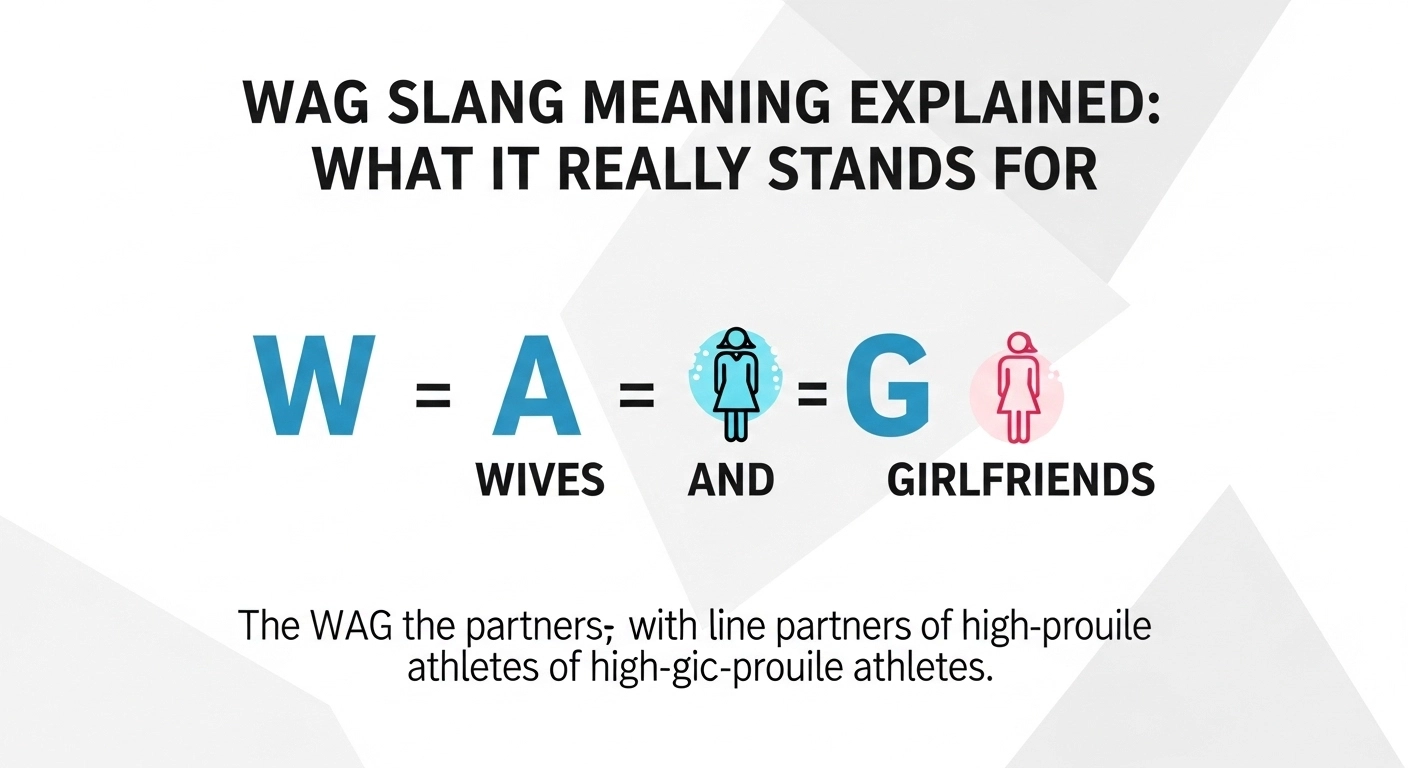
The three-letter acronym WAG stands for "wives and girlfriends." Originally coined by the British press to categorize the romantic partners of elite athletes, the term spent two decades functioning as a tabloid shortcut for high-spending, glamorous women perched in stadium luxury suites. Yet as sports media culture expanded across the Atlantic into American football locker rooms and national broadcasts, the label collided with a fierce pushback from accomplished female entrepreneurs, Olympic legends, and recording artists who flatly refuse to have their identities swallowed whole by someone else's athletic career.
The English language frequently recycles this syllable across wildly different cultural corners, causing occasional confusion for casual observers. In political journalism, "wag the dog" describes a deliberate foreign crisis staged to divert attention from domestic political scandals, a phrase that saw renewed viral traction when public discourse surged around cinematic parallels to military posturing in the Middle East. On the basketball hardwood and baseball diamonds, athletes deploy a defensive "finger-wag" taunt to break an opponent's rhythm, a gesture examined in a recent Fox News Report detailing on-court tensions. In the realm of elite athletic relationships, however, the acronym carries a pointed social charge that many women now actively dismantle.
📌 Key Takeaways:
- Core Definition: WAG stands for "wives and girlfriends," an acronym popularized in 2002 to group together the romantic partners of professional association football players.
- The Inflection Point: The label reached global notoriety during the 2006 FIFA World Cup in Baden-Baden, Germany, when British tabloids prioritized hotel shopping sprees over match analysis.
- Modern Resistance: High-profile partners in American sports, from Simone Biles to Taylor Swift, reject the classification because it flattens accomplished careers into passive accessories.
The Tabloid Origins of Baden-Baden and British Football
The term surfaced in 2002 within the pages of the British press ahead of the Japan, South Korea FIFA World Cup, initially attributed to staff at Dubai's Jumeirah Beach Club during an England team warm-up getaway. Fleet Street reporters seized on the abbreviation as efficient headline shorthand. It replaced wordy phrases like "the romantic companions of the squad" and neatly squeezed into narrow tabloid columns. What started as print logistics rapidly mutated into an aggressive journalistic genre.
Everything crystallized during the 2006 FIFA World Cup in the German spa town of Baden-Baden. Dozens of photographers camped outside the Brenners Park-Hotel & Spa, tracking every move of Victoria Beckham, Cheryl Cole, and Coleen Rooney. British newspapers published daily tallies detailing champagne tabs, designer boutiques raided, and oversized sunglasses worn in VIP boxes. Sports journalists openly blamed the women for England's eventual quarter-final exit against Portugal, claiming late-night partying created an intolerable circus that distracted manager Sven-Göran Eriksson's squad.
The framing was mercilessly reductive. Tabloid editors constructed an archetype: women who produced no visible labor, possessed no distinct intellectual interests, and existed entirely on an athletic paycheck. Even successful pop stars with multi-platinum albums were subsumed into this collective noun. By grouping women with disparate lives into an undifferentiated swarm, British media laid the groundwork for an enduring cultural caricature.
Why Modern NFL Partners Reject the Stereotype
When the term crossed the Atlantic into American sports coverage, it hit an immediate cultural barrier. Major League Baseball and the National Football League long referred to families simply as "spouses" or "partners." As digital media attempted to import the British shorthand into American locker rooms, the partners themselves pushed back with visible irritation.
The modern sports celebrity ecosystem looks nothing like 2006 Germany. Consider Simone Biles, married to Chicago Bears safety Jonathan Owens. Biles is the most decorated gymnast in history, possessing 11 Olympic medals and 30 World Championship medals. Reducing her presence in an NFL stadium suite to a "WAG" strikes sports fans as absurd. Biles brings historic athletic prestige, major equity stakes, and a global following that vastly eclipses typical stadium coverage.
The resistance extends through every stratum of American sports. When Taylor Swift began attending Kansas City Chiefs games to support Travis Kelce, international entertainment headlines occasionally tested the British acronym. The label collapsed under its own weight. Swift's $1.5 billion net worth, self-owned publishing catalog, and historic stadium tour made it mathematically and culturally impossible to describe her as an adjunct to a tight end's career. Even partners who are not global icons, such as Kylie Kelce, routinely emphasize that their collegiate athletic careers, philanthropic foundations, and corporate projects exist outside their husbands' contracts.
Two Decades of Sports Partner Coverage in the Media
The evolution of high-profile relationship labels reflects a wider shift in how society evaluates women standing near the bright lights of professional sports. Tabloid culture once treated these women as silent mannequins. Today, digital platforms allow partners to communicate directly with audiences, effectively bypassing legacy gatekeepers.
| Era & Milestone | Media Framing | Economic & Public Response |
|---|---|---|
| 2002, 2006: World Cup Emergence | Tabloid scrutiny, blame for athletic losses, shopping-spree trackers in Baden-Baden. | Passive coverage; subjects had limited direct channels to rebut newspaper narratives. |
| 2010, 2018: Reality TV Exploitation | Commercialized drama (E!'s WAGS series), leaning into luxury consumerism and interpersonal friction. | Participants earned appearance fees but reinforced narrow social tropes regarding wealth and dependency. |
| 2020, 2026: Direct Digital Independence | Podcasts, venture investing, personal brand sponsorships, and direct rejection of the collective acronym. | Partners maintain separate IP, corporate endorsements, and substantial equity stakes independent of team contracts. |

Linguistic Clashes: From On-Field Taunts to Political Allegory
Understanding the word requires separating the sports acronym from longstanding idioms and gestures that share the exact same spelling. Readers encountering headlines often face three distinct uses of the word:
The oldest linguistic usage is the motion of wagging. In athletic arenas, the defensive finger-wag became iconic through NBA Hall of Famer Dikembe Mutombo, who swung his index finger after blocking opponent shots. The tradition remains alive across professional sports, occasionally triggering bench-clearing debates and technical fouls when players use it to taunt rivals on court. In sports analysis, a player performing a wag has nothing to do with relationship status; it is a declaration of defensive supremacy.
In politics, the expression "the tail wags the dog" dates back to 19th-century humorists, describing situations where a minor component controls a major entity. The 1997 satirical film Wag the Dog cemented the term in popular consciousness, showing a spin doctor concocting an imaginary war in Albania to insulate a sitting president from a domestic sex scandal. Whenever foreign strikes or military deployments coincide with domestic political revelations, political commentators pull the phrase off the shelf to question administrative motives.
Independent Brands Over Red Carpet Accessories
The foundational tension behind the acronym lies in economic autonomy. The 2006 tabloid model assumed female partners derived their financial security entirely from the athlete's contract. In that setup, the woman functioned as a display case for luxury goods bought with soccer wages.
Today's market dynamics flipped that formula on its head. Athlete spouses frequently manage sophisticated media houses, direct charitable foundations, or hold competitive C-suite roles. Brittany Mahomes built an ownership stake in the Kansas City Current of the National Women's Soccer League, helping finance the first stadium built specifically for a women's professional sports franchise. Kristin Juszczyk turned game-day sideline appearances into a licensed apparel deal with the NFL, using custom puffer jackets worn by high-profile friends to secure corporate manufacturing rights.
When commentators reduce these professionals to "WAGs," it erases their commercial labor. It signals that a woman's primary contribution to the public sphere is romantic proximity to an athletic man. By building standalone businesses, personal brand platforms, and distinct public profiles, modern partners make the old tabloid classification look woefully outdated.
Frequently Asked Questions (FAQ)
Q1: What does WAG stand for in sports?
A1: WAG stands for "wives and girlfriends." It originated in the early 2000s in the British tabloid press to collectively describe the romantic partners of professional football (soccer) players, particularly the England national team.
Q2: Why do many athlete partners object to the term?
A2: Many partners dislike the acronym because it devalues their personal identities, professions, and achievements. It treats distinct women as a homogeneous group defined solely by their romantic relationship to an athlete, often carrying connotations of vanity and financial dependency.
Q3: How is the acronym WAG different from the phrase 'wag the dog'?
A3: The sports acronym WAG specifically refers to "wives and girlfriends." In contrast, "wag the dog" is an English political idiom derived from the idea of the tail controlling the dog, used to describe deliberate geopolitical diversions designed to pull media focus away from domestic scandals.
The Shifting Lexicon of High-Profile Partnerships
Language reflects the power structures of the era that produces it. The acronym WAG was designed by an aggressive British tabloid apparatus that prioritized sensational paparazzi photos, luxury spending logs, and easy scapegoats for international tournament exits. It was an editorial tool engineered to diminish women into decorative background noise.
That world has largely dissolved. Today, partners of high-profile athletes possess direct distribution networks, lucrative intellectual property, and standalone careers that command public respect on their own merits. When an accomplished Olympian, corporate executive, or pop culture icon sits in an arena luxury suite, she is not an accessory to the game. She is an equal participant in modern entertainment culture, and the vocabulary used to describe her is finally catching up.
