Why the Family Guy Skin Color Chart Just Re-Entered the National Spotlight
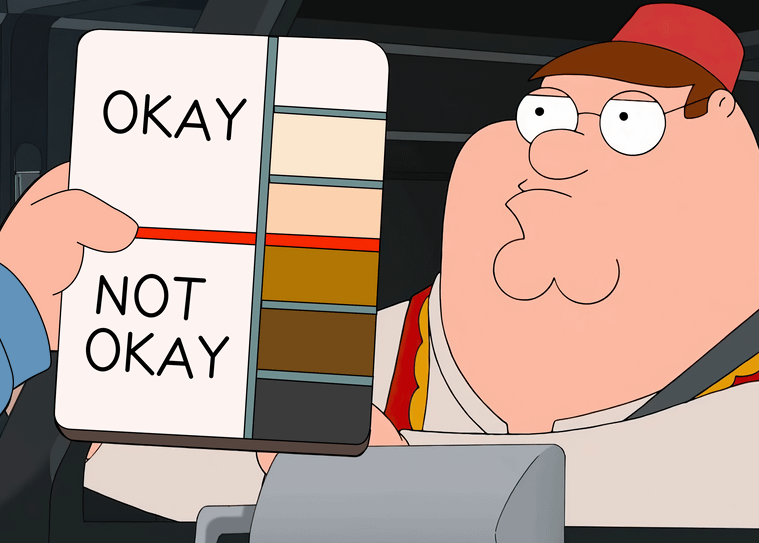
When a seven-second cutaway gag aired on Fox on January 29, 2012, few television animators expected a pocket-sized cardboard swatch to become one of the defining visual metaphors of digital political discourse. Yet more than a decade later, legal observers, civil rights advocates, and commentators routinely resurface the Peter Griffin skin tone chart whenever federal courts tackle the limits of executive discretion, border enforcement, and Fourth Amendment protections.
According to comprehensive archival tracking in the Know Your Meme Report, the image originally debuted as a quick airport security parody before mutating into the ubiquitous "Okay / Not Okay" reaction graphic. The joke is brutally simple: a security guard holds up a laminated strip featuring gradient skin tones, split down the middle between acceptable and suspect. As the Supreme Court continues to navigate legal challenges involving racial profiling and immigration checkpoints within 100 miles of the border, that satirical strip has ceased being mere cartoon trivia. It has turned into a national shorthand for structural bias.
📌 Key Takeaways:
- The Origin: The visual debuted in Family Guy Season 10, Episode 12 ("Livin' on a Prayer"), parodying arbitrary TSA and border security screening.
- The Legal Parallel: Civil liberties analysts invoke the chart to satirize federal doctrines that permit broad, subjective law enforcement stops within interior border zones.
- The Cultural Reach: The template expanded far beyond its original broadcast, spawning major offshoots across international affairs, historical critiques, and algorithmic culture.
The 2012 Cutaway That Redefined Seth MacFarlane's Satire
The sequence lasts less than ten seconds. In "Livin' on a Prayer," Peter Griffin pulls his station wagon up to a checkpoint. An armed guard steps forward, pulls out a pocket-sized color swatch displaying five skin tones ranging from peach to dark brown, and checks Peter's face against the card. Peter's pale complexion matches the top half marked "Okay." The officer waves him through with a smile. The bottom half, labeled "Not Okay," sits reserved for darker complexions.
Seth MacFarlane's writers room had spent years trading in shock value cutaways. This specific gag struck a completely different chord. It stripped away nuance to expose a reality that racial justice advocates had argued for decades: subjective security screenings frequently reduce complex human populations to crude, color-coded filters. Rather than leaning on dialogue or exaggerated slapstick, the scene relied on a quiet, administrative gesture. That chilling bureaucratic calm gave the bit its bite.
How Legal Analysts Turned Peter Griffin Into a Constitutional Critique
The meme re-emerged with fierce velocity in legal commentary following major federal rulings on immigration stops. Federal jurisprudence has long granted authorities wide latitude under the "border search exception." Within the expansive 100-mile border zone, an area that encompasses roughly two-thirds of the United States population, Border Patrol agents can stop vehicles without a traditional warrant if they possess what the law calls "reasonable suspicion."
The central point of friction is how federal agents formulate that suspicion. In landmark cases such as United States v. Brignoni-Ponce, the Supreme Court ruled that Mexican ancestry alone cannot justify a vehicle stop, but agents may consider apparent ethnic appearance alongside other factors like vehicle load or route location. Critics argue this legal balancing act effectively legitimizes stops based on melanin under the thin veil of contextual suspicion.
Whenever high-profile cases involving immigration enforcement or state-level stop-and-frisk laws reach federal appeals courts or the Supreme Court docket, legal scholars on platforms like X, Bluesky, and Substack circulate the Peter Griffin color swatch. It serves as an immediate visual rebuttal to state arguments that law enforcement officers act purely on behavioral cues. For civil liberties groups, the cartoon captures the unwritten standard operating procedure that formal statutes refuse to put in print.
Tracking the Evolution of the "Okay Not Okay" Meme
The image took several years to move from an isolated television broadcast to an omnipresent reaction template. Its longevity rests on its radical adaptability. Anyone can erase the skin tones and replace them with political candidates, historical events, consumer products, or corporate policies.
| Era & Variant | Primary Context | Discursive Impact |
|---|---|---|
| Broadcast Era (2012, 2014) | Fox broadcast of Season 10, Episode 12; initial Reddit and Tumblr screen-caps. | Focused primarily on post-9/11 TSA airport screening absurdity and airline passenger profiling. |
| Ebola & Crisis Phase (2014, 2016) | Public panic over the West African Ebola outbreak and international travel bans. | Used to highlight double standards in how Western nations responded to disease outbreaks among white vs. Black populations. |
| The History Channel Variation (2018, 2021) | Critiques of mainstream documentary networks portraying ancient civilizations through Eurocentric lenses. | Mocked the premise that light-skinned ancient figures were deemed "historically advanced" while darker societies were attributed to "ancient aliens." |
| Constitutional & Judicial Era (2022, 2026) | Analysis of federal border search exceptions, Fourth Amendment erosion, and state immigration statutes. | Employed by legal analysts and digital creators as a shorthand for discretionary police stops and immigration checkpoint policies. |

From TSA Checkpoint Meme to the History Channel Parody
Once internet users detached the chart from its original context, it developed several distinct sub-genres. One prominent branch became known as the History Channel meme variation. Online creators began using the chart to satirize how cable television networks discuss ancient architecture.
In these variations, the top "Okay" section features monuments built by lighter-skinned cultures, such as the Roman Colosseum or the Parthenon, labeled "Built by Human Ingenuity." The bottom "Not Okay" tier features Mesoamerican step pyramids or Great Zimbabwe, labeled "Must Have Been Built by Aliens." The meme cleanly skewered the latent cultural chauvinism hiding inside historical infotainment.
More recently, digital creators have spliced the graphic into surreal, algorithmically boosted formats, such as Minecraft parkour backgrounds paired with audio parodies. Despite these absurd remix layers, the core mechanics of the template remain untouched. It exposes double standards where an institution pretends to apply neutral rules while relying entirely on an unwritten aesthetic prejudice.
Why Minimalist Imagery Outlasts Complex Political Commentary
Academic essays on disparate impact and institutional prejudice fill thousands of pages every year. Most rarely register outside legal seminars. The Peter Griffin skin tone chart cuts through that academic density because it provides an immediate visual summary of systemic hypocrisy.
The image works because it mimics the visual grammar of legitimate corporate design. It looks like a paint swatch you might find at a hardware store or a makeup foundation guide at a beauty counter. By pairing that familiar, sterile consumer design with explicit racial hierarchy, the joke unmasks the banality of discrimination. The checkpoint officer is not shouting slurs. He is not visibly aggressive. He is simply holding up a piece of printed cardboard, running a routine administrative check.
That exact combination, neutral bureaucratic process layered over racial discrimination, mirrors modern civil liberties concerns. The gag avoids heavy-handed sentimentality. Instead, it offers pure, unvarnished cynicism about the state apparatus.
Frequently Asked Questions (FAQ)
Which specific episode of Family Guy contains the skin color chart?
The scene appears in Season 10, Episode 12, titled "Livin' on a Prayer," which premiered on Fox on January 29, 2012. It occurs during a cutaway gag where Peter Griffin is waved through a security checkpoint after an officer compares his face to a laminated reference card.
Why are legal analysts referencing a Family Guy gag in Supreme Court discussions?
Commentators use the meme as visual shorthand to criticize broad law enforcement discretion. In debates over Fourth Amendment rights, interior border checkpoints, and reasonable suspicion standards, the chart cleanly illustrates how subjective criteria can allow officers to profile motorists based on appearance while maintaining that their actions follow procedural rules.
What was the first major variation of the meme outside of border security?
The first widespread viral mutations emerged around 2014 during international health crises, where users adapted the chart to mock disparate global reactions to medical emergencies. Later, the "History Channel be like" variant gained massive traction across Reddit and Twitter, using the chart to mock television documentaries that attributed non-European architectural achievements to extraterrestrial interference.
The Enduring Power of a Cardboard Swatch
Internet culture burns through humor at a relentless pace. Most viral gags fade within weeks, buried by algorithmic churn and shifting platform formats. The Peter Griffin color swatch has avoided that fate because the legal and social conditions that inspired it never disappeared.
As state legislatures and federal courts continue to spar over border enforcement authority, the boundaries of reasonable suspicion, and the scope of interior checkpoints, the cartoon remains eerily relevant. Seth MacFarlane's writing staff designed a disposable seven-second joke to fill airtime on a Sunday night. More than a decade later, that plastic card remains the sharpest mirror the public has to hold up against systemic bureaucracy.
